

| Primary stress hormone | Cortisol |
| Primary sleep-onset hormone | Melatonin |
| Cortisol peaks | Within 30-60 minutes of waking (Established circadian biology research) |
| Melatonin rises | 1-2 hours before habitual sleep time (General physiological consensus) |
| Key disruptor of melatonin | Blue-spectrum light exposure in the evening |
| Hormone released during deep sleep | Growth hormone (GH) |
| Body clock location | Suprachiasmatic nucleus (SCN), hypothalamus |
Your Body Runs on a Hormonal Clock
Long before your alarm sounds, your body has already begun preparing you to wake up. A cascade of chemical signals - hormones - rises and falls across a roughly 24-hour cycle called the circadian rhythm. Two hormones sit at the center of this system: cortisol, often called the stress hormone, and melatonin, the hormone most associated with sleep onset. Understanding what each one does - and how they interact - gives you a clearer picture of why stress disrupts sleep, and why poor sleep can amplify stress.
| Primary stress hormone | Cortisol |
| Primary sleep-onset hormone | Melatonin |
| Cortisol peaks | Within 30-60 minutes of waking (Established circadian biology research) |
| Melatonin rises | 1-2 hours before habitual sleep time (General physiological consensus) |
| Key disruptor of melatonin | Blue-spectrum light exposure in the evening |
| Hormone released during deep sleep | Growth hormone (GH) |
| Body clock location | Suprachiasmatic nucleus (SCN), hypothalamus |
This is general health information intended to build background knowledge, not medical advice. If you have concerns about sleep disorders or stress-related health issues, please speak with a qualified healthcare professional.
Cortisol: More Than Just a Stress Hormone
Cortisol is produced by the adrenal glands, which sit atop each kidney. It plays a central role in regulating blood sugar, immune response, metabolism, and - crucially - the body's response to perceived threats. When your brain detects danger or pressure, the HPA axis (hypothalamic-pituitary-adrenal axis) triggers a cortisol surge to fuel a rapid physical response.
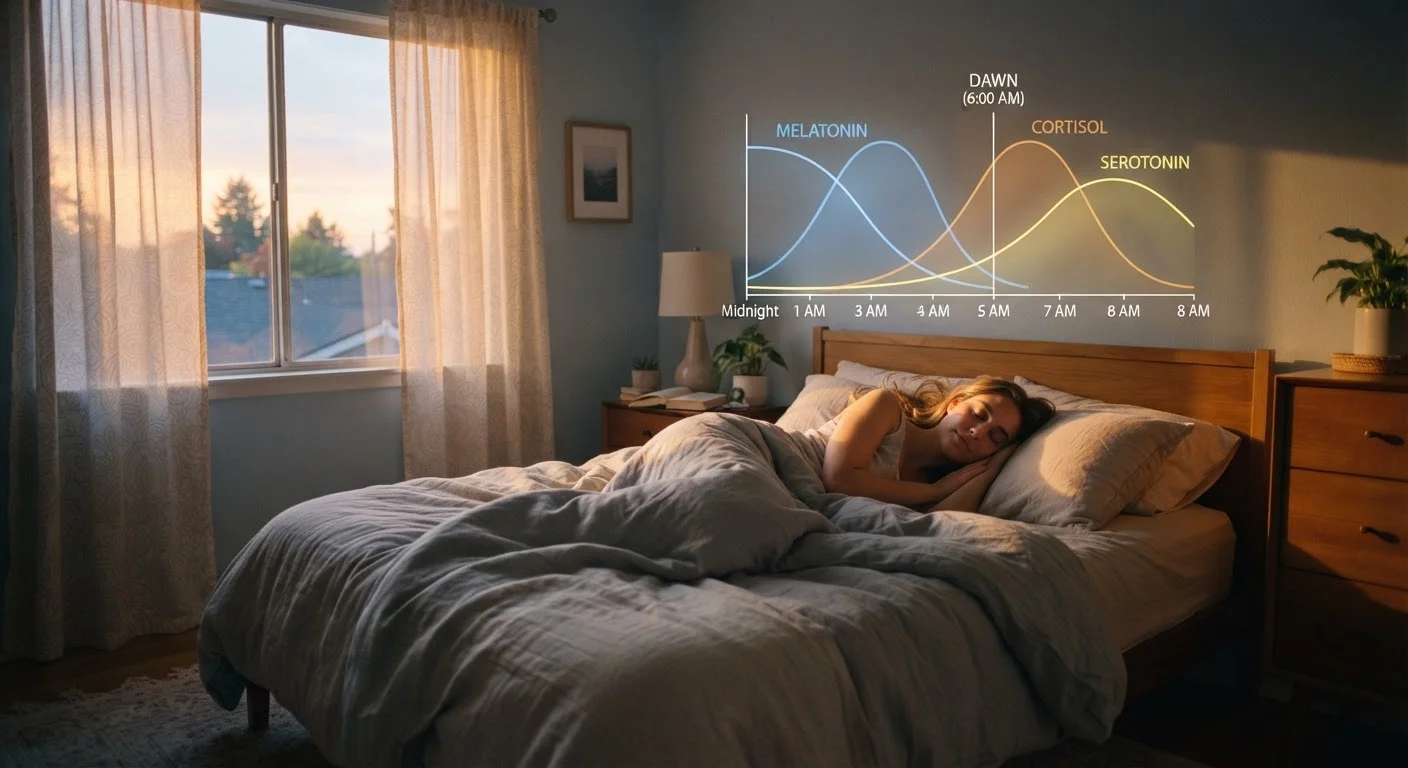
Under healthy conditions, cortisol follows a reliable daily arc: it peaks sharply in the first hour after waking (a pattern researchers call the cortisol awakening response) and gradually declines through the afternoon and evening. This natural peak helps promote alertness, supports blood pressure, and mobilizes energy stores for the day ahead.
The problem arises when cortisol remains elevated well into the evening - whether from chronic work stress, anxiety, or disrupted routines. High evening cortisol actively interferes with the body's ability to initiate sleep. See our detailed look at sleep deprivation's effects for more on how this cycle compounds over time.
Melatonin: The Darkness Signal
Melatonin is produced primarily by the pineal gland, a small structure deep in the brain. Unlike cortisol, melatonin is not a sleep-inducing sedative - it is more accurately described as a biological darkness signal. As light fades in the evening, the brain's suprachiasmatic nucleus (SCN) - its master internal clock - reduces suppression of the pineal gland, allowing melatonin to rise.
This rise in melatonin cues the body that night has arrived and helps lower core body temperature, reduce alertness, and set the stage for sleep. Melatonin levels typically peak in the middle of the night and fall sharply before dawn, coordinating with the cortisol awakening response.
Exposure to bright or blue-spectrum light in the evening - from screens, overhead lighting, or other sources - can delay melatonin release, effectively shifting your body's internal clock later. This is one reason why common pre-bed habits can quietly erode sleep quality without feeling obviously harmful.
Circadian Rhythm
A roughly 24-hour internal biological cycle that regulates sleep, hormone release, body temperature, and other physiological processes. It is synchronized primarily by light and darkness.
HPA Axis
The hypothalamic-pituitary-adrenal axis - a network of glands and feedback signals that governs the body's stress response and cortisol production.
Cortisol Awakening Response
A natural spike in cortisol that occurs within the first 30-60 minutes after waking, believed to help mobilize energy and prime the body for daytime activity.
Suprachiasmatic Nucleus (SCN)
A small region of the hypothalamus in the brain that acts as the body's master circadian clock, coordinating daily rhythms in response to light signals received through the eyes.
Adenosine
A chemical that builds up in the brain during waking hours, creating increasing pressure to sleep. Caffeine works partly by blocking adenosine receptors, temporarily reducing that pressure.
Melatonin
A hormone released by the pineal gland in response to darkness. It signals to the body that nighttime has arrived and helps facilitate the transition into sleep.
How Stress and Sleep Create a Two-Way Loop
Cortisol and melatonin function as near-opposites in the body's daily rhythm: cortisol promotes arousal; melatonin promotes rest. When stress keeps cortisol elevated at night, it suppresses the melatonin rise. When melatonin is suppressed, sleep is fragmented or delayed. And when sleep is insufficient, cortisol regulation the next day becomes less precise - producing higher daytime cortisol, greater emotional reactivity, and lower stress tolerance.
Other hormones contribute to this loop as well. Adenosine, a byproduct of neural activity, accumulates throughout waking hours and creates mounting sleep pressure. Adrenaline (epinephrine), released alongside cortisol during acute stress, heightens physical arousal. Growth hormone is secreted primarily during deep sleep and is essential for tissue repair and metabolic regulation - meaning chronic sleep loss directly limits its availability.
For a broader look at how mental state and sleep quality mutually shape each other, see our full guide on the mind-sleep relationship. And for evidence-based approaches to managing the stress side of the equation, this comparison of stress management methods is a useful companion resource.
This article is for informational purposes only and does not constitute medical advice. Always consult a qualified healthcare professional for guidance specific to your health situation.