

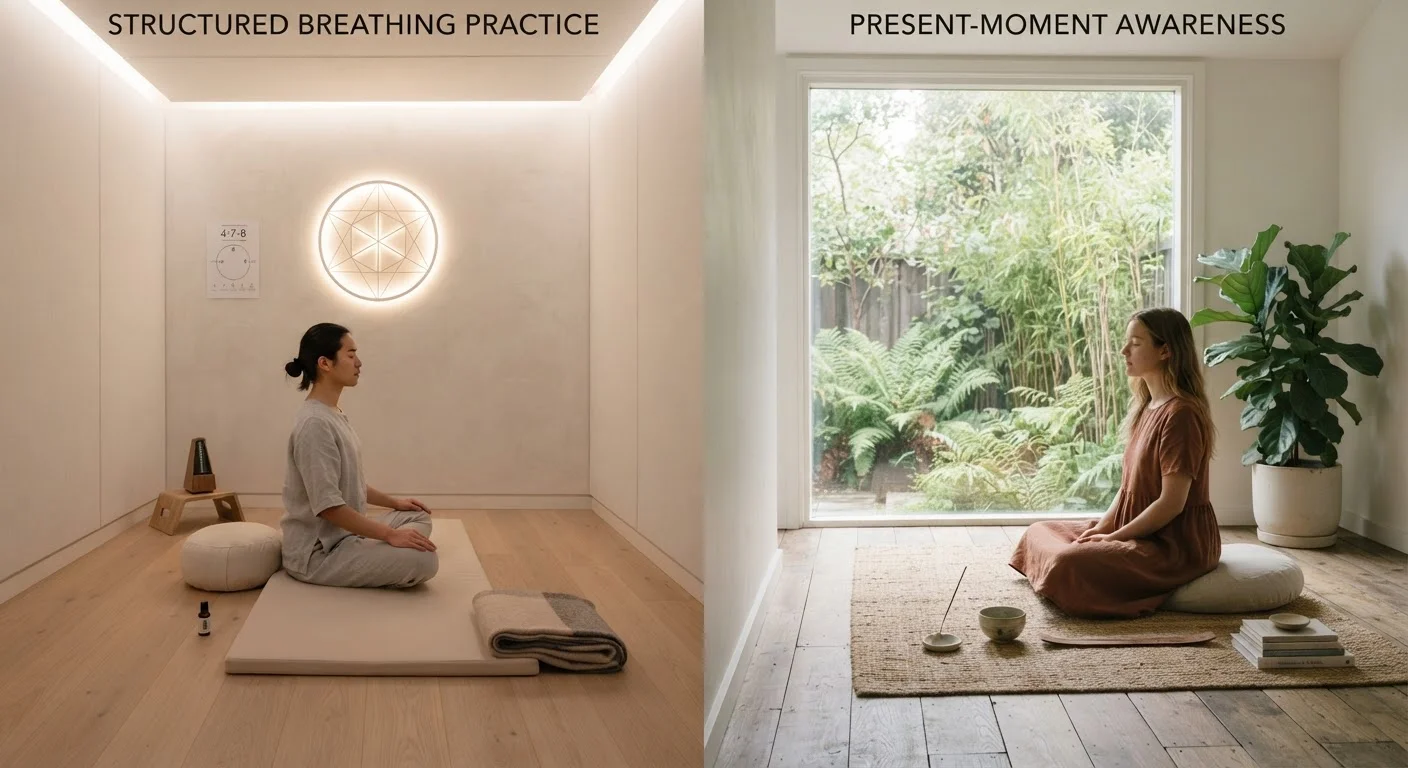
Key Takeaways
Option A
Relaxation Response
The structured, physiologically grounded technique.
Best for: People who prefer a clear, repeatable protocol to counteract the stress response.
Option B
Mindfulness Meditation
The awareness-centered, moment-to-moment practice.
Best for: People seeking to change their relationship with thoughts and emotions over time.
If you want a structured, predictable routine to calm your body quickly
Relaxation Response
Its repeatable format - a focus word, slow breathing, passive attitude - makes it easy to learn and apply consistently, even under pressure.
If you want to build long-term emotional resilience and reduce anxious thinking patterns
Mindfulness Meditation
Mindfulness cultivates the skill of observing thoughts without reacting to them, which research links to improved emotional regulation over time.
If you struggle with racing thoughts at bedtime
Relaxation Response
The physiological shift it induces - slower heart rate, reduced muscle tension - directly supports the body's transition into sleep.
If you want a practice that integrates into everyday activities, not just seated sessions
Mindfulness Meditation
Mindfulness can be applied informally during eating, walking, or conversations, making it highly adaptable to busy lifestyles.
If you are new to any meditation practice and prefer clinical backing
Relaxation Response
Developed through decades of research, its mechanism is well-documented and its technique is straightforward for first-time practitioners.
Where Each Technique Comes From
The relaxation response is a term coined by cardiologist Herbert Benson and his colleagues at Harvard Medical School in the 1970s. Benson identified a measurable physiological state - the opposite of the stress-driven fight-or-flight response - that could be deliberately elicited through a simple mental practice. His work drew on both Western medicine and contemplative traditions, distilling them into a secular, reproducible protocol.
Mindfulness meditation has roots in Buddhist contemplative practice but was adapted for clinical and general use largely through the work of Jon Kabat-Zinn, who developed Mindfulness-Based Stress Reduction (MBSR) at the University of Massachusetts in the late 1970s. Where Benson focused on a specific physiological outcome, Kabat-Zinn emphasized training attention itself - learning to observe experience without judgment rather than escape or suppress it.
Understanding these origins matters because each technique carries a different intention from the outset, which shapes how you practice and what you can expect from it. For a broader look at how mental practices interact with sleep, see how the mind and sleep shape each other.
How Each Technique Actually Works
The relaxation response is elicited through four core elements: a quiet environment, a mental device (such as a repeated word or phrase), a passive attitude toward distracting thoughts, and a comfortable body position. Practitioners focus on their chosen word or phrase with each exhale, gently returning to it whenever the mind wanders - without self-criticism. This process appears to downregulate the sympathetic nervous system, lowering heart rate, blood pressure, and muscle tension.
Mindfulness meditation, by contrast, asks practitioners to observe whatever arises in awareness - breath sensations, sounds, emotions, or thoughts - without labeling them as good or bad. Rather than redirecting attention away from the mind's activity, mindfulness turns attention toward it with curiosity. Over time, this practice is thought to reduce automatic, habitual reactions to stressors by creating a small but meaningful gap between stimulus and response.
| Criterion | Relaxation Response | Mindfulness Meditation |
|---|---|---|
| Primary goal | Elicit a specific calm physiological state | Train non-judgmental present-moment awareness |
| Core technique | Repeated focus word + passive attitude | Open, curious observation of experience |
| Typical session structure | 10-20 minutes, quiet and seated | Formal sessions or informal daily integration |
| Learning curve | Low - clear, defined steps | Moderate - requires familiarity with observation |
| Primary evidence base | Physiological stress markers, blood pressure | Anxiety, mood, emotional regulation |
| Sleep application | Reduces physical tension to ease sleep onset | Addresses bedtime cognitive arousal and worry |
Both practices share an emphasis on returning attention when it wanders - that moment of noticing and redirecting is considered central to both methods' effectiveness.
Evidence and Practical Applications
Research on the relaxation response has shown measurable decreases in physiological stress markers such as cortisol, oxygen consumption, and blood pressure with regular practice. It is used in clinical settings for conditions including hypertension, anxiety, and chronic pain management - always as a complement to, not a replacement for, medical treatment.
Mindfulness meditation has accumulated a substantial research base as well. Systematic reviews suggest that regular practice is associated with reductions in self-reported anxiety and improvements in mood regulation. MBSR programs, which combine mindfulness meditation with gentle movement and group support, have been studied in hospital, workplace, and community settings.
~38%
Reduction in anxiety symptoms with MBSR
A meta-analysis published in JAMA Internal Medicine found mindfulness meditation programs produced meaningful reductions in anxiety, depression, and pain compared to control groups.
10-20 min
Typical daily practice for relaxation response
Benson's original research protocol suggested practicing once or twice daily for 10 to 20 minutes to consistently elicit the physiological response.
8 weeks
Standard MBSR program duration
The Mindfulness-Based Stress Reduction program developed by Kabat-Zinn typically runs over eight weeks with weekly group sessions and daily home practice.
For sleep specifically, both practices can be useful. The relaxation response may help initiate sleep by shifting the body into a physiologically calmer state, while mindfulness addresses the cognitive arousal - the loop of worrying thoughts - that keeps many people awake. You can explore how to incorporate either into a consistent evening routine with our guide on building a wind-down routine that actually sticks.
If you're curious how these techniques compare to other approaches like journaling or breathwork, the article on stress management approaches offers a useful side-by-side overview. And for the broader principles underpinning mental resilience, see evidence-backed principles for a calmer, more resilient mind.
This article is for general informational purposes only and is not a substitute for professional medical or mental health advice. If you are managing a health condition or experiencing significant psychological distress, please consult a qualified healthcare provider.