

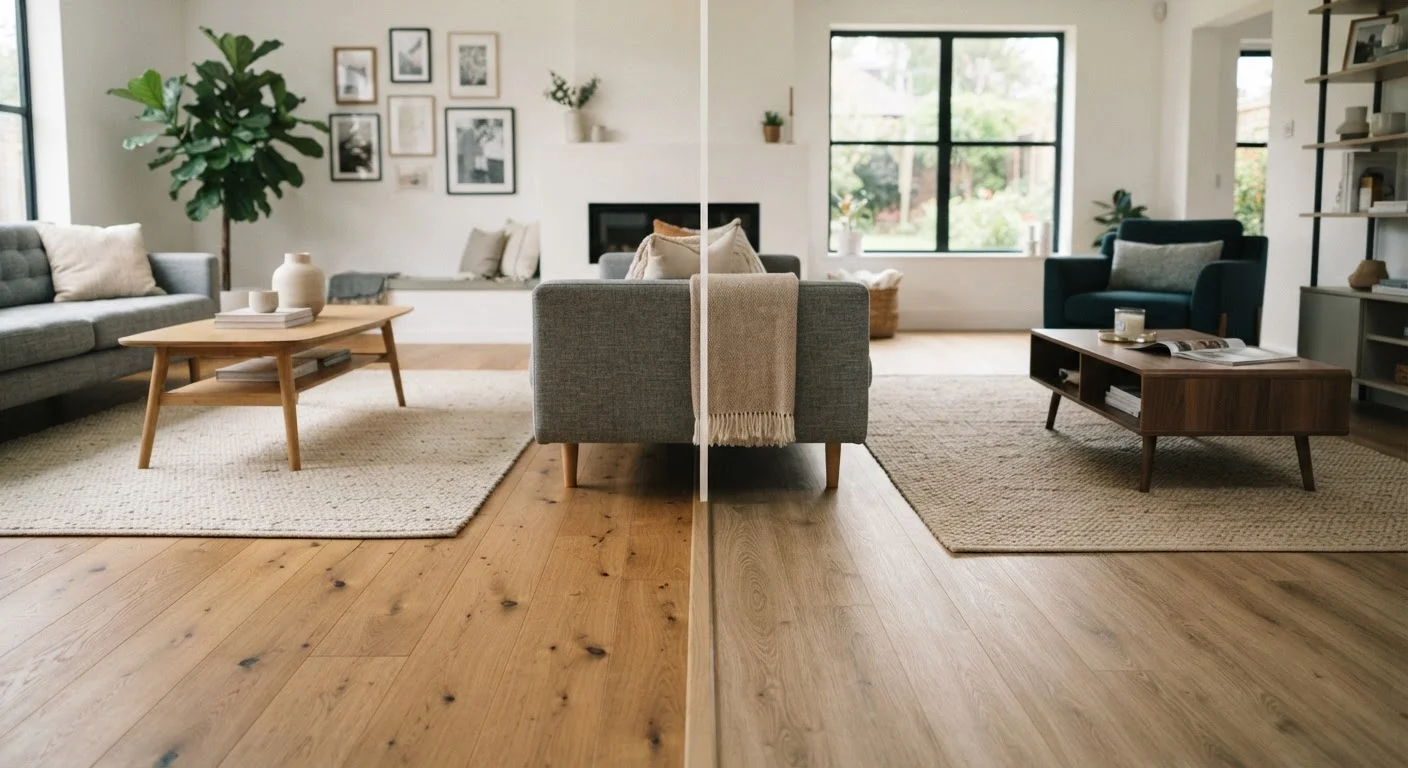
Key Takeaways
Option A
Solid & Engineered Hardwood Flooring
The timeless, refinishable classic.
Best for: Homeowners who want long-term investment value, a natural look and feel, and the ability to sand and refinish floors multiple times over decades.
Option B
Luxury Vinyl Plank (LVP) Flooring
The resilient, moisture-tolerant modern alternative.
Best for: Homeowners tackling high-traffic or moisture-prone rooms who want a budget-friendlier install with straightforward DIY appeal.
If you're renovating a primary living room or bedroom for the long haul
Solid & Engineered Hardwood Flooring
Hardwood's ability to be sanded and refinished means you can refresh worn or dated surfaces without replacing the floor entirely, making it a strong long-term investment.
If you're flooring a basement, bathroom, laundry room, or rental unit
Luxury Vinyl Plank (LVP) Flooring
LVP's waterproof core handles moisture that would warp or buckle solid hardwood, and lower replacement costs suit spaces where wear and tear is higher.
If you're a DIYer who wants to handle installation yourself
Luxury Vinyl Plank (LVP) Flooring
Most LVP products use a floating click-lock installation that doesn't require nailing, gluing, or acclimation periods as lengthy as hardwood, lowering the skill barrier significantly.
If maximizing resale value in a competitive housing market is your primary goal
Solid & Engineered Hardwood Flooring
Real wood flooring is consistently cited by real estate professionals as a sought-after feature that can positively influence buyer perception, particularly in mid-to-upper price brackets.
If you're working with a tight renovation budget across multiple rooms
Luxury Vinyl Plank (LVP) Flooring
LVP typically costs significantly less per square foot for both materials and labor, allowing you to cover more area for the same spend without sacrificing a wood-look aesthetic.
Durability and Lifespan: Which Floor Goes the Distance?
Hardwood flooring - both solid and engineered variants - is renowned for longevity. Solid hardwood, properly maintained, can last the lifetime of a home. Its most significant advantage is refinishability: surface scratches, dents, and worn finishes can be sanded away and recoated, sometimes three to seven times depending on plank thickness. Engineered hardwood has a thinner real-wood veneer over plywood, offering more dimensional stability but fewer refinishing cycles.
LVP, by contrast, has a wear layer - measured in mils - that determines scratch and dent resistance. Commercial-grade LVP with a 20-mil wear layer holds up impressively in busy households, but once the wear layer is gone, the plank cannot be refinished. It must be replaced. Most quality LVP carries warranties ranging from 15 to 25 years, while premium solid hardwood is often described as a generational material.
For pet owners, LVP's harder surface often resists claw scratches better than softer wood species, though both materials will show wear over time in high-traffic corridors.
| Criterion | Hardwood Flooring | Luxury Vinyl Plank (LVP) |
|---|---|---|
| Typical material cost (per sq ft) | $5-$12+ | $2-$7 |
| DIY installation ease | Moderate to difficult | Beginner-friendly click-lock |
| Waterproof | No (engineered: moisture-resistant) | Yes (most rigid-core products) |
| Refinishable | Yes, multiple times | No |
| Typical lifespan | 50+ years with care | 15-25 years (warranty) |
| Resale value perception | High, broadly recognized | Moderate, market-dependent |
| Best room suitability | Living rooms, bedrooms, above-grade | Any room, including basements |
| Underfoot feel | Solid, natural warmth | Slight give (WPC); firm (SPC) |
Moisture Tolerance: The Deciding Factor for Many Rooms
This is arguably where the two options diverge most sharply. Solid hardwood and moisture are a difficult combination. Wood is hygroscopic - it absorbs and releases moisture with changes in humidity, which causes expansion and contraction. In damp basements, bathrooms, or below-grade spaces, solid hardwood risks cupping, warping, and mold growth. Engineered hardwood tolerates moderate humidity variation better, but it still is not considered waterproof.
Most LVP products feature a 100% waterproof rigid core, typically made from stone-plastic composite (SPC) or wood-plastic composite (WPC). Spills, splashes, and even minor flooding won't penetrate the plank. This makes LVP the practical choice for kitchens, laundry rooms, mudrooms, and any below-grade space.
One nuance worth knowing: LVP is waterproof, but subfloor moisture can still cause problems if it migrates through unsealed concrete. A quality vapor barrier under LVP on concrete is standard practice and a step DIYers should not skip.
Cost Considerations: Materials, Installation, and the Long View
Hardwood commands a higher upfront price. Solid hardwood materials commonly range from $5 to $12 or more per square foot, with professional nail-down installation adding $3 to $8 per square foot depending on region and complexity. Engineered hardwood sits slightly lower in material cost but still represents a meaningful investment.
LVP materials typically run $2 to $7 per square foot, and the floating click-lock installation method reduces labor costs. Motivated DIYers can often handle LVP themselves with basic tools and careful subfloor preparation, trimming labor costs significantly.
The long-view calculation shifts this picture somewhat. Hardwood that is refinished every 10 to 15 years avoids full replacement costs for decades. LVP, if it reaches the end of its wear layer, requires full replacement. Over a 40- to 50-year horizon in a living room, hardwood's total cost of ownership may be competitive despite the higher starting price.
54%
Home buyers who prefer hardwood floors
According to the National Association of Realtors, a majority of home buyers surveyed indicated hardwood flooring as a desirable or preferred feature.
$3-$8
Per sq ft professional installation cost (hardwood)
Labor costs for nail-down or staple-down hardwood installation vary by region, subfloor condition, and contractor rates.
20 mil
Wear layer thickness for heavy residential LVP use
Flooring industry guidelines generally recommend a 20-mil wear layer for households with pets, children, or high foot traffic.
Feel, Sound, and Aesthetics: Living With Your Floor Every Day
Hardwood has a warmth and solidity underfoot that is difficult to replicate. It's a natural material with grain variation that ages and develops character over time. It also tends to feel warmer than LVP in cooler months, though area rugs address this in either case.
LVP has improved dramatically in visual realism. Embossed-in-register (EIR) texturing aligns the plank's surface texture with its printed grain, making high-quality LVP convincing to the eye. Underfoot, however, WPC-core LVP has a slight cushioned give that some find comfortable and others find less authentic. SPC-core LVP is denser and feels more rigid.
Sound is a real differentiator. Both materials can transmit footfall noise, but LVP - particularly thinner formats - benefits from an attached underlayment to dampen sound. Hardwood over a wood subfloor tends to produce a more natural resonance. In multi-story homes or apartments, check building requirements, as some settings mandate specific impact sound ratings.
This article is for general informational and educational purposes only. Costs, performance characteristics, and installation requirements vary widely by product, region, and subfloor conditions. Consult a qualified flooring professional before beginning any renovation project.