

Key Takeaways
Our Verdict
Each note-taking method has a distinct cognitive strength. Cornell Notes reward active recall, mind mapping supports holistic understanding, and outlining clarifies hierarchical information. The most effective learners typically select their method based on subject type and then review consistently - not just capture.
| Best for | Recommended |
|---|---|
| Lecture-heavy courses or structured class environments | Cornell Notes |
| Visual learners exploring interconnected or creative topics | Mind Mapping |
| Textbook reading or content with clear sequential hierarchy | Outlining |
| Rapid capture during fast-moving sessions or brainstorming | Sentence or Flow Method |
Why Your Note-Taking Method Matters
Taking notes is not simply transcribing words - it is an act of cognitive processing. Research in learning science consistently shows that how you record information shapes how deeply you encode it. Passive copying yields shallow retention, while structured methods that require you to categorize, question, or connect ideas engage elaborative encoding - the process of linking new knowledge to what you already know.
Despite this, most students default to whichever format feels fastest in the moment, rather than choosing a method suited to the subject or their learning goals. Pairing the right approach to the right context - much like the logic behind building a study schedule that holds up - makes a measurable difference in long-term retention and exam performance.
| Cornell Notes | Mind Mapping | Outlining | Sentence Method | |
|---|---|---|---|---|
| Best subject fit | Lectures, structured courses | Conceptual, relational topics | Textbooks, sequential content | Fast-paced lectures, seminars |
| Setup effort | Moderate (page template needed) | Low to moderate | Low | Very low |
| Supports retrieval practice | Yes - built-in cue column | Indirectly, via redrawing | Requires separate effort | Requires separate effort |
| Handles non-linear content | Moderately | Very well | Poorly | Adequately |
| Review-friendly format | High - self-quiz built in | Moderate | High - easy to scan | Low - requires reorganization |
| Digital tool compatibility | Good (templates available) | Good (dedicated apps exist) | Excellent (native in most apps) | Excellent (plain text) |
Cornell Notes: The Active-Recall Workhorse
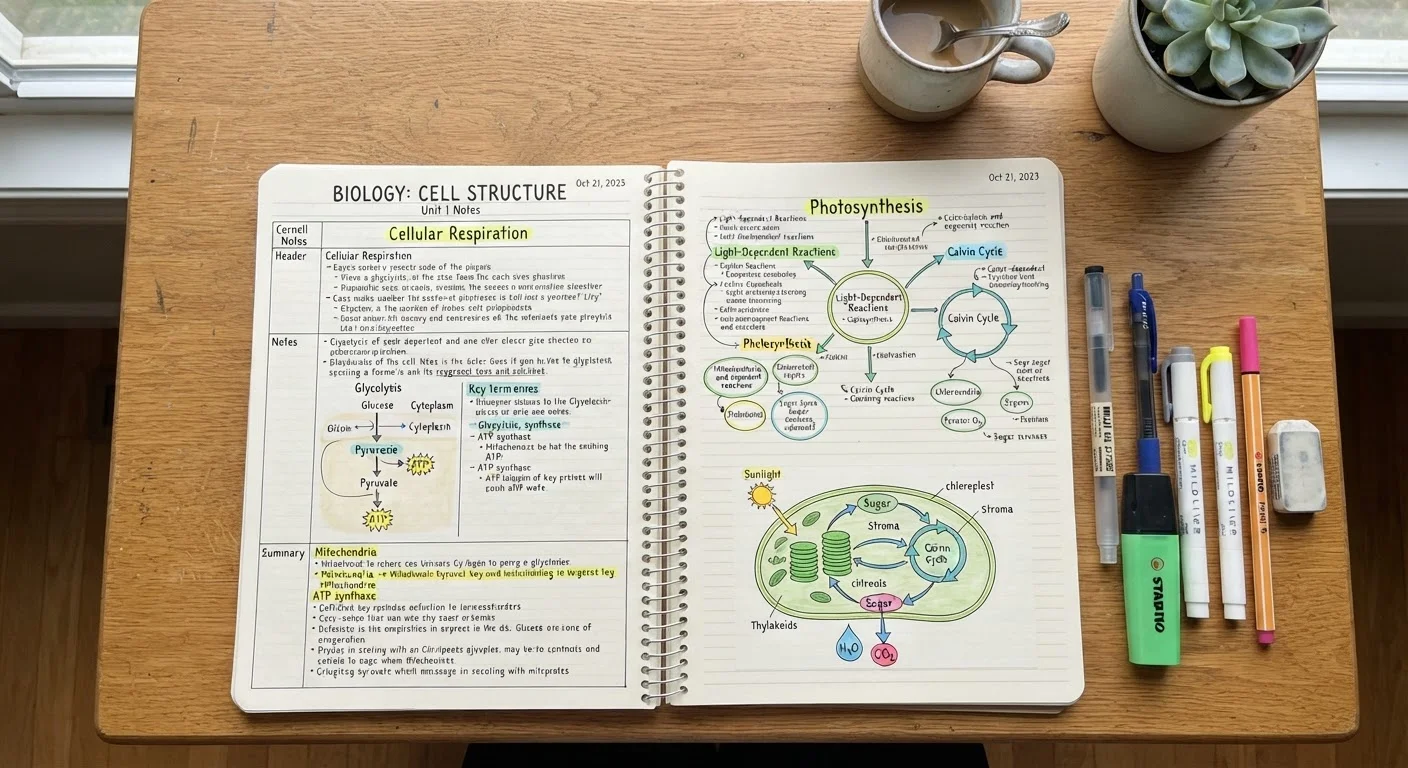
Developed at Cornell University in the 1950s, the Cornell method divides each page into three zones: a narrow cue column on the left, a wider notes column on the right, and a summary box at the bottom. During a lecture or reading, you capture main ideas in the notes column. Afterward, you generate questions or keywords in the cue column that prompt recall - then cover your notes and test yourself.
This built-in retrieval-practice loop is its greatest strength. Cognitive science research consistently identifies retrieval practice as one of the most effective ways to consolidate memory. The summary section reinforces synthesis. The main limitation: Cornell Notes require a bit of setup and deliberate post-session effort, making them less effective when learners skip the review step.
Mind Mapping: Thinking in Networks
A mind map starts with a central concept written in the middle of the page, with branches radiating outward to subtopics, examples, and connections. This non-linear format mirrors how the brain stores associative knowledge, making it particularly well-suited to subjects with overlapping themes - history, biology, literature analysis, or project planning.
Mind mapping encourages you to identify relationships rather than just list facts, which can deepen conceptual understanding. However, it is less efficient for sequential or procedural content (such as mathematical proofs or chemistry reaction steps), where order and hierarchy carry meaning that a web structure can obscure.
Outlining: Hierarchy Made Visible
The classic outline uses Roman numerals, letters, and indentation to organize information into nested levels of importance. It is an ideal companion for structured readings, textbook chapters, or any source that presents clear main points and supporting details. Outlines are fast to scan, easy to expand, and integrate naturally into most word processors.
The limitation is rigidity: if a lecture jumps between topics or a concept is inherently relational, forcing it into a strict hierarchy can distort understanding. Outlining rewards subjects with predictable structure more than exploratory or discussion-based learning environments. Pairing outlines with active review - rather than rereading - closes the gap between capture and retention.
The Sentence and Flow Methods: Speed and Flexibility
Two additional methods suit learners who prioritize speed or adaptability. The sentence method records every idea as a separate numbered sentence, preserving sequence without imposing structure during capture - useful when content arrives faster than you can organize it. The flow method, popularized by learning educator Scott Young, de-emphasizes verbatim capture and instead uses arrows, symbols, and mini-sketches to show how ideas connect in real time.
Both approaches work best for learners who process well during active listening but struggle to restructure notes afterward. If you find yourself short on study time, consulting strategies like those in learning under time pressure can help you decide when lighter-touch methods are worth the tradeoff.
Choosing and Combining Methods Strategically
No method dominates across all subjects or all learners. Effective note-takers often mix formats: Cornell Notes for lecture courses, mind maps for brainstorming or essay planning, outlines for dense readings. The key is intentionality - selecting based on what the content demands, not what requires least effort in the moment.
Whichever method you use, the evidence points to one non-negotiable habit: review your notes within 24 hours of taking them. Forgetting curves documented in memory research show that without review, recall drops sharply within a day. Processing and self-testing - not just re-reading - is where the learning actually happens.