

Key Takeaways
Option A
Spaced Repetition
The research-backed method for durable, long-term memory.
Best for: Learners who want knowledge to stick across weeks, months, or years - from language learners to medical students.
Option B
Massed Practice (Cramming)
The familiar, intense, short-burst approach most students default to.
Best for: Situations requiring rapid, temporary recall - though retention fades quickly after the test or deadline.
If you need to retain information beyond the exam or deadline
Spaced Repetition
Research shows spaced repetition builds durable memory traces that persist over weeks and months, making it the clear choice for lasting learning.
If you have only 24 hours before a low-stakes quiz
Massed Practice (Cramming)
Massed practice can be effective for very short-term recall, though you should expect significant forgetting shortly after.
If you are learning a language, professional certification material, or complex subject matter
Spaced Repetition
Distributed review over time is especially effective for large, interconnected bodies of knowledge that require deep encoding.
If you want to build efficient, semester-long study habits
Spaced Repetition
Shorter, regularly spaced sessions reduce total study time while producing stronger retention than marathon cramming sessions.
The Core Difference: When You Study Matters
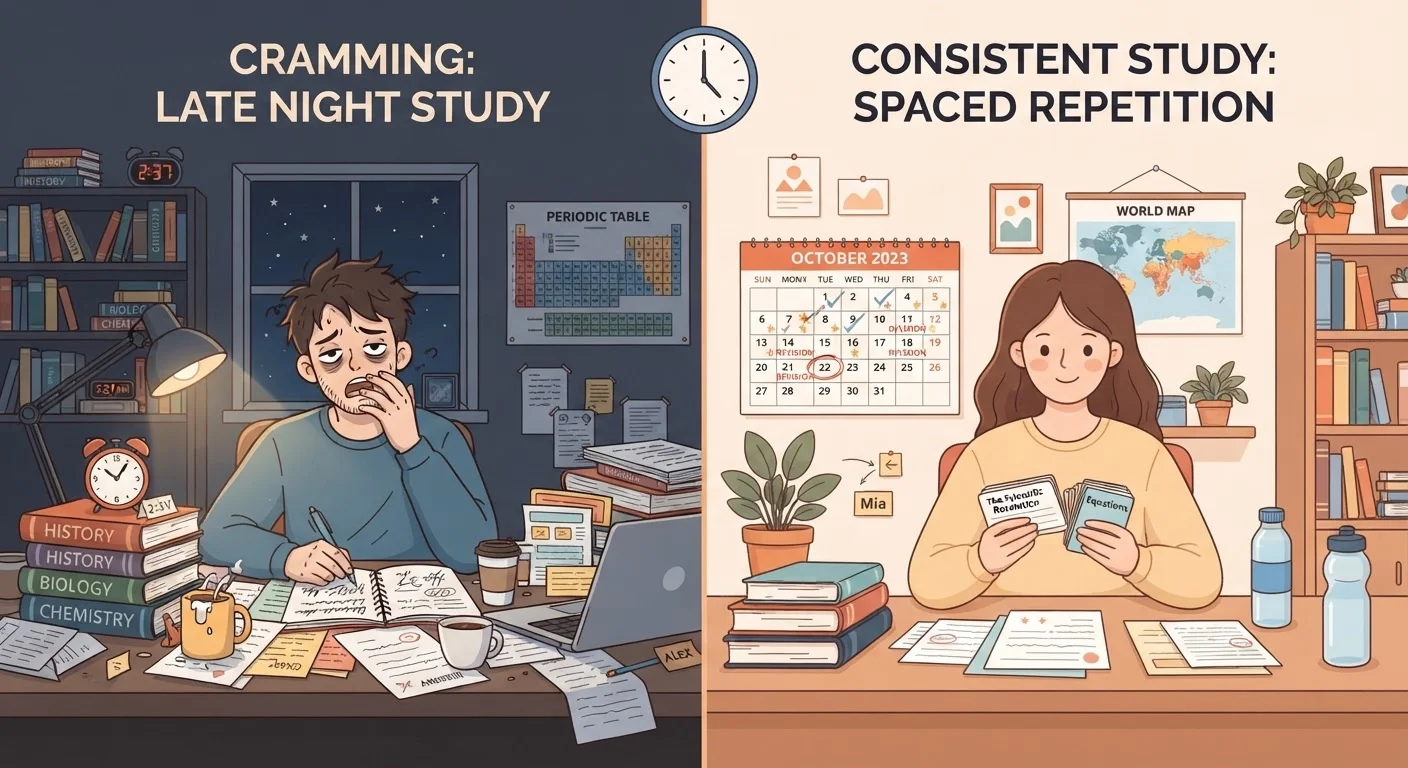
Most students know what cramming feels like: a dense, multi-hour session the night before an exam, powered by caffeine and determination. Massed practice concentrates study into one or a few back-to-back blocks. Spaced repetition, by contrast, distributes review across multiple sessions separated by deliberate gaps - hours, days, or weeks apart.
The distinction sounds simple, but its effects on memory are dramatic. Cognitive scientists refer to this as the spacing effect: the well-documented finding that memory is stronger when learning is spread out over time rather than packed into a single sitting. This effect was first described by German psychologist Hermann Ebbinghaus in the 1880s through his self-experiments on memorization, and has since been replicated across thousands of studies in laboratory and classroom settings.
Understanding why spacing works requires a brief look at how memory consolidates. Each time you revisit material after a gap, your brain must actively reconstruct the memory - a process that strengthens the underlying neural connections. Reviewing too soon (before any forgetting has begun) provides little benefit; reviewing too late (after complete forgetting) means relearning from scratch. Spaced repetition targets the productive middle ground.
What the Research Actually Shows
The evidence favoring spaced repetition over massed practice is among the most consistent findings in educational psychology. A landmark review by Cepeda and colleagues (2006, Psychological Bulletin) analyzed over 250 studies and confirmed that distributed practice reliably outperforms massed practice for long-term retention across age groups, subject areas, and material types.
| Criterion | Spaced Repetition | Massed Practice (Cramming) |
|---|---|---|
| Long-term retention | High - memory persists weeks to months | Low - rapid forgetting within days |
| Short-term recall | Good, builds steadily | High immediately after session |
| Total study time needed | Less overall for equivalent retention | More total time to relearn forgotten material |
| Scheduling flexibility | Requires advance planning | Usable at the last minute |
| Research support | Extensive - replicated across hundreds of studies | Limited to short-term outcomes |
| Risk of fluency illusion | Low - gaps reveal genuine gaps in knowledge | High - material feels familiar immediately after |
| Best suited for | Cumulative, high-stakes, or long-term learning | Low-stakes, one-time recall needs |
One key concept is Ebbinghaus's forgetting curve: without review, people forget roughly half of newly learned material within days. Spaced repetition disrupts this curve by scheduling reviews at intervals calibrated to when memory starts to weaken - not before, not after. Algorithms used in flashcard systems apply this principle computationally, adjusting review timing based on how confidently a learner recalled each item.
Massed practice, meanwhile, benefits from a cognitive illusion researchers call fluency: because material feels familiar immediately after a cram session, learners often overestimate how well they know it. This fluency fades rapidly - studies suggest significant forgetting can occur within 24 to 48 hours. For knowledge needed beyond a single test, this is a significant liability.
Pairing spaced repetition with active recall techniques multiplies the benefit. Retrieving an answer from memory - rather than passively re-reading - creates a stronger, more durable memory trace, a phenomenon called the testing effect.
How to Apply Spaced Repetition in Practice
The practical barrier to spaced repetition is scheduling: it requires planning study across days or weeks rather than relying on a single intensive session. Here's how to make it workable:
- Start early. Begin reviewing new material within 24 hours of first encountering it, then again after two to three days, then after a week, and so on. Each successful recall extends the ideal next-review interval.
- Use retrieval, not re-reading. Quiz yourself on each item rather than simply reading notes. Cover the answer and try to produce it independently before checking.
- Break sessions into short blocks. Research supports the effectiveness of focused 20-40 minute sessions over multi-hour marathons. Shorter sessions reduce fatigue and preserve attentional resources.
- Track what you struggle with. Items you miss or answer slowly deserve shorter review intervals; items you recall confidently can be spaced further apart.
For building a realistic schedule that integrates these habits across a full semester, see this research-informed guide to structuring your study time.
It is also worth noting that spaced repetition is a principle, not a single product or tool. The underlying scheduling logic can be applied with handwritten flashcards, a notebook review system, or digital tools - what matters is the deliberate distribution of review over time. For a fuller look at how spaced repetition and related strategies work together, this overview of complementary study techniques is a helpful companion read.
Knowing When Each Approach Is Appropriate
Despite the clear advantages of spaced repetition for long-term goals, it is worth being honest about when massed practice might be a pragmatic choice. If you genuinely have only one evening before a low-stakes quiz and the material will not appear again, a focused cram session is not irrational. The problem arises when cramming becomes a habitual substitute for distributed study - particularly for cumulative subjects like mathematics, science, or a foreign language, where early material is foundational for everything that follows.
Learners often underestimate the compounding cost of poor retention. Re-learning forgotten material each semester takes more total time than maintaining it through regular, spaced review. Research in deliberate practice further reinforces this point: how you structure effort matters as much as the amount of time invested.
The most effective learners tend to reserve massed practice as an occasional, tactical tool - and build their default habits around spacing. Understanding this distinction is itself a foundational step toward smarter, more efficient learning across any subject.