

Key Takeaways
Why the Learning Styles Myth Persists
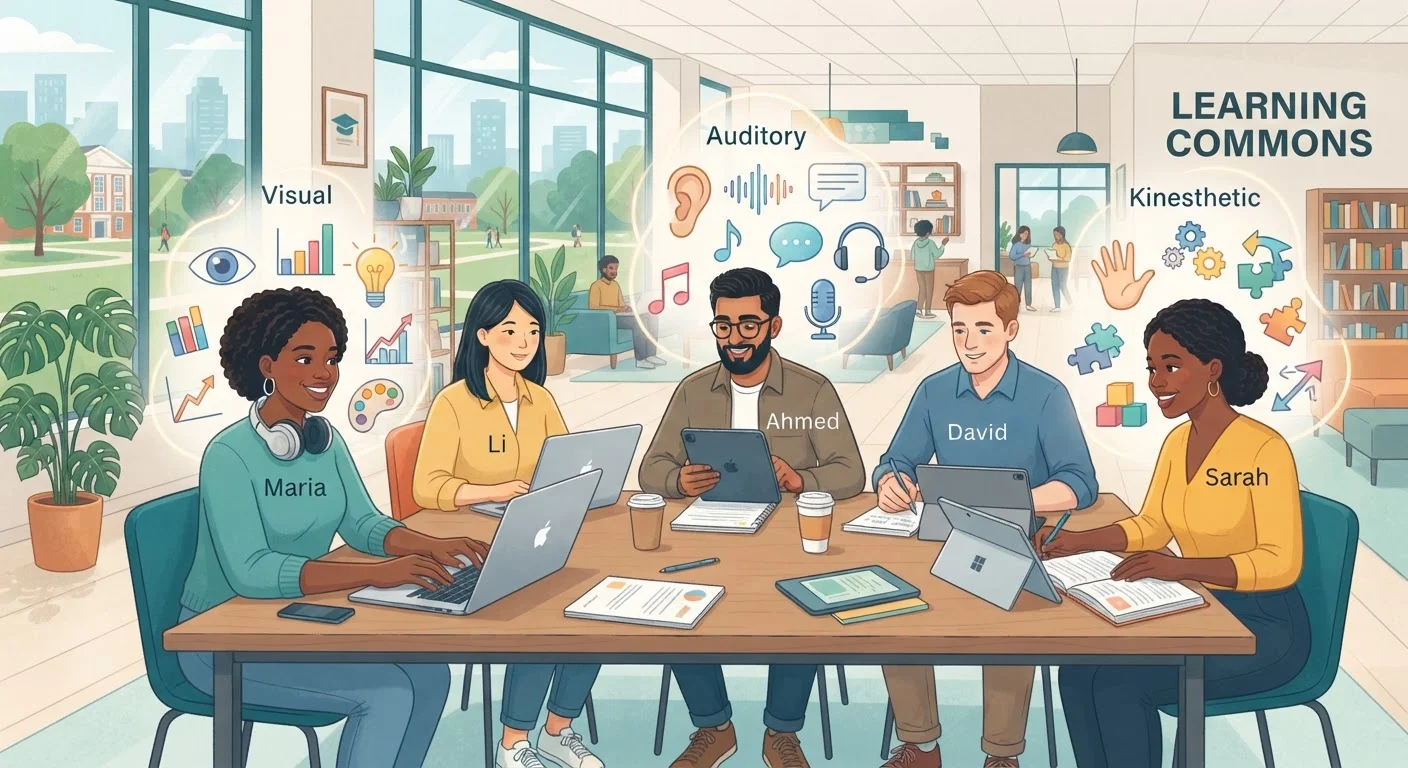
Ask almost anyone how they learn best, and many will confidently answer: "I'm a visual learner" or "I need to hear things to understand them." The idea that people fall into distinct sensory categories - most famously the VARK model (Visual, Auditory, Reading/Writing, Kinesthetic) - has been embedded in teacher training programs and corporate onboarding for decades.
The appeal is obvious: it feels personalised, it's easy to self-diagnose, and it gives educators a simple framework. But popularity is not the same as validity. Researchers in cognitive psychology have repeatedly found that matching instruction to a student's self-identified learning style does not produce better learning outcomes compared to instruction that mixes formats.
A widely cited 2018 analysis published in Anatomical Sciences Education found that the majority of students who identified as visual learners still performed better when they studied using strategies not aligned with that preference - contradicting the core prediction of learning-styles theory. For a deeper look at what the evidence actually shows, see what cognitive research reveals about learning styles.
Myth
People are born as visual, auditory, or kinesthetic learners, and they absorb information best in their dominant style.
Fact
No credible body of research confirms that matching instruction to a self-reported sensory preference improves learning outcomes.
The learning-styles hypothesis makes a specific, testable prediction: learners taught in their preferred modality should outperform those taught in a mismatched modality. When researchers design experiments to test this, the predicted interaction rarely appears. A 2018 review by Rogowsky, Calhoun, and Tallal found no significant relationship between preferred and presented modality and comprehension scores. Most cognitive scientists now classify VARK-style categorisation as a neuromyth - an idea that sounds plausible but isn't supported by the evidence.
Myth
If an online course uses lots of videos, visual learners will naturally get more out of it than other students.
Fact
Video benefits all learners when it's well-designed, because it reduces cognitive load by combining complementary channels - not because some students are inherently "visual."
Cognitive load theory, developed by educational psychologist John Sweller, explains why well-produced video works: our working memory processes verbal and visual information through separate channels. A diagram paired with a spoken explanation uses both channels efficiently without overloading either. This is the multimedia principle - it applies to everyone, not to a subset of visual learners. Poorly designed video (text on screen read aloud word-for-word, for example) impedes learning for all viewers due to redundancy effects.
Myth
If you struggle with a course, switching to your preferred learning style will fix the problem.
Fact
Struggle in learning often signals productive difficulty, not a format mismatch - and the remedy is usually better study strategies, not a different sensory delivery.
Research on desirable difficulties (a concept developed by psychologist Robert Bjork) shows that conditions that make learning feel harder in the short term - like testing yourself before you feel ready - often produce stronger long-term retention. When an online learner feels lost, the instinct to find content in a "more comfortable" format can actually bypass the productive struggle that cements knowledge. A better first step is to try active recall, revisit foundational concepts, or ask for feedback - not to seek a video version of a reading-heavy module simply because reading feels less natural. See our academic success hub for concrete study strategies grounded in this research.
Myth
Online courses should let learners choose only the media type that matches their learning style for maximum efficiency.
Fact
Exposure to multiple well-integrated formats - text, visuals, audio, and practice - typically produces stronger understanding than single-modality instruction.
The modality principle in educational psychology suggests that combining narration with relevant graphics outperforms either alone. Restricting a learner to one format based on self-reported preference removes complementary information channels and can actually reduce comprehension. Good online course design deliberately layers text, visuals, and interactive practice - not to accommodate every learning style, but because the content is represented through multiple encoding pathways, making it easier to retrieve later. Learners who skip sections because they assume those formats don't suit them may unknowingly undermine their own retention.
What Cognitive Science Actually Recommends for Online Learners
Setting aside learning-style labels does not mean all instructional approaches are equal. Cognitive science offers several well-supported strategies that benefit virtually all learners, regardless of sensory preferences.
Retrieval practice - actively recalling information through quizzes, flashcards, or free recall - consistently outperforms passive re-reading in studies on long-term retention. Most online platforms offer quiz features; using them deliberately is one of the highest-leverage habits you can build.
Spaced repetition distributes study sessions over time rather than cramming. Even short review sessions spread across days produce markedly stronger retention than marathon sessions. Many learning management systems now include spaced review tools - to understand how these platforms shape your study experience, see our guide on how learning management systems work.
Interleaving - switching between related topics or problem types within a single session - feels harder in the moment but strengthens the ability to distinguish and apply concepts. These strategies are explored further in the science of skill acquisition.
89%
Teachers who believe in learning styles
A 2012 survey published in the British Journal of Educational Psychology found approximately 89% of teachers in several countries agreed that students learn better when taught in their preferred learning style - despite the lack of supporting evidence.
~1.5x
Retention boost from retrieval practice
Research synthesised by Roediger and Butler (2011) in Perspectives on Psychological Science found retrieval practice produced roughly 50% better long-term retention compared to restudying the same material.
For online learners, the practical implication is clear: choose course formats based on the nature of the content, not a self-identified learning style. A programming course benefits from hands-on coding exercises; a music theory course benefits from audio examples - not because of who you are, but because of what the subject demands.
Understanding these principles is equally relevant whether you are evaluating synchronous versus asynchronous learning formats or deciding between online and in-person instruction. The evidence-based strategies covered here apply across both. For a broader look at misconceptions in digital education, see common myths about online learning, and explore the full range of academic success strategies for students at every level.