

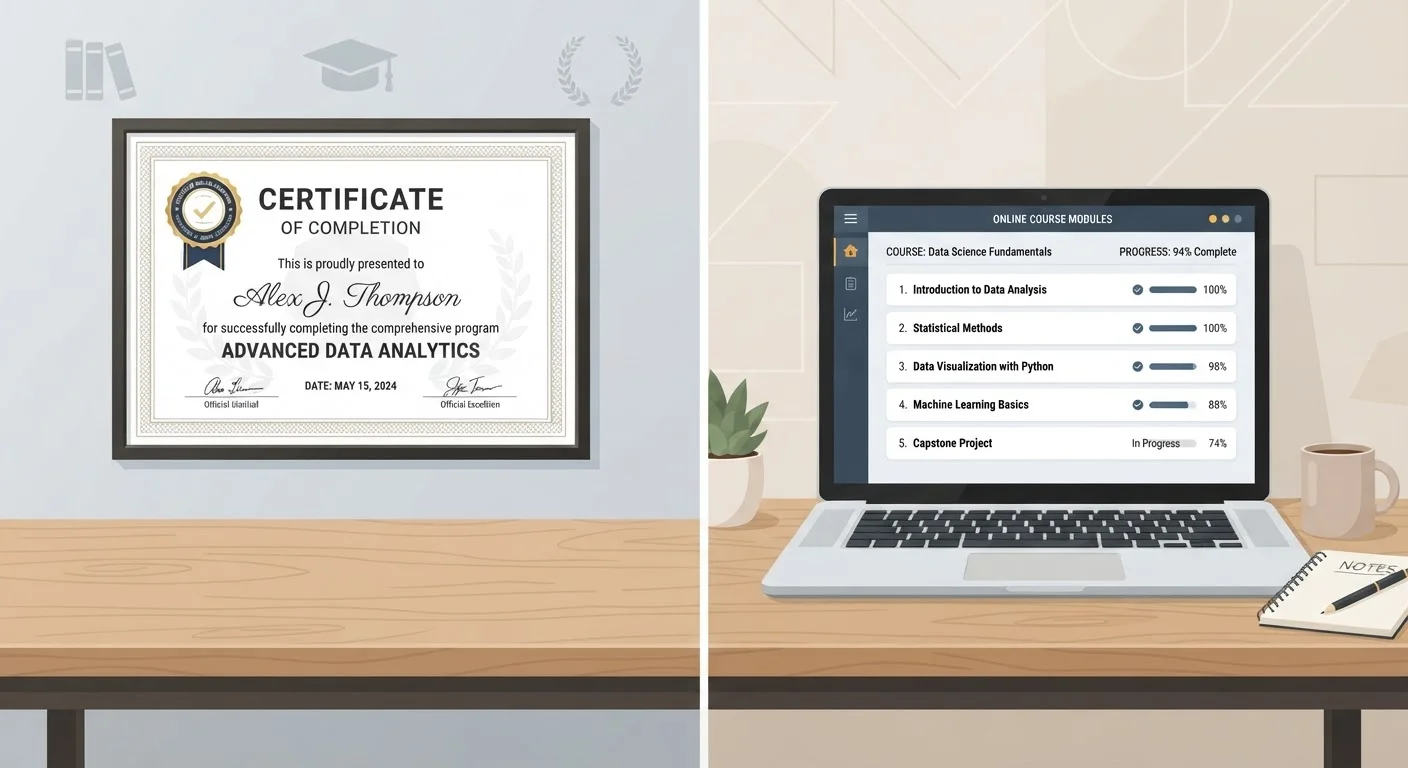
Key Takeaways
Option A
Accredited Online Degree
The structured, employer-recognized credential path.
Best for: Learners seeking career entry, advancement, or graduate school admission who need a regionally or nationally accredited qualification.
Option B
MOOC (Massive Open Online Course)
The flexible, low-barrier way to build specific skills fast.
Best for: Curious learners, working professionals, and career-explorers who want targeted knowledge without a multi-year time or financial commitment.
If you need a credential recognized by employers or graduate schools
Accredited Online Degree
Accreditation signals that an institution meets established academic standards, which is what most employers and admissions offices look for when screening candidates formally.
If you want to learn a new tool, language, or concept quickly
MOOC
MOOCs let you dive into a focused topic within days, making them ideal for skill top-ups, career exploration, or supplementing existing credentials without a major time investment.
If you are in a regulated profession such as nursing, engineering, or law
Accredited Online Degree
Licensed professions require accredited degrees by law or professional board standards; no MOOC certificate substitutes for these requirements.
If you are evaluating your interest in a field before committing financially
MOOC
Completing a MOOC in a subject area first is a low-risk way to confirm genuine interest before enrolling in a multi-year, tuition-based degree program.
If you need continuing education credits or professional development documentation
MOOC
Many professional associations accept documented course completion for continuing education, and MOOCs from recognized platforms can satisfy these requirements in some fields - though always verify with your specific licensing body.
What Each Path Actually Represents
An accredited online degree is a qualification awarded by a college or university that has been evaluated and recognized by a government-approved accrediting body. Regional accreditation - the most rigorous type in the United States - means the institution meets standards covering faculty qualifications, student services, curriculum design, and financial stability. The degree itself, whether a bachelor's, master's, or doctorate, carries the same legal standing as one earned on campus. For a deeper explanation of how these distinctions work, see how accreditation works in online education.
A MOOC - Massive Open Online Course - is a self-contained learning module designed to reach thousands or millions of learners simultaneously. Major platforms host courses created by universities, companies, and independent instructors. Completion typically earns a digital certificate of participation rather than academic credit. These certificates can demonstrate initiative and skill to an employer, but they sit in a fundamentally different category from an accredited degree. To understand what those digital certificates actually signal, the article digital credentials explained breaks down the differences clearly.
Comparing the Two Side by Side
The table below captures the core differences across the dimensions that matter most to learners making this decision.
| Criterion | Accredited Online Degree | MOOC |
|---|---|---|
| Credential weight | Recognized by employers, grad schools, licensing boards | Certificate of completion; limited formal recognition |
| Typical cost | $10,000-$60,000+ total tuition | Free to ~$300 per course |
| Time commitment | 2-4 years | Hours to a few weeks |
| Admissions process | Application, transcripts, sometimes tests | Open enrollment; no prerequisites typically |
| Academic credit | Yes - transferable credits | Rarely; some platforms offer limited credit pathways |
| Instructor interaction | Direct faculty contact, advising, office hours | Forums, peer review; direct access varies widely |
| Structured curriculum | Comprehensive, multi-course program | Single topic or short series |
Cost and time are the most obvious gaps, but the credential weight column is often the deciding factor. Employers in fields such as finance, healthcare, and engineering routinely filter applications by degree type and accreditation status during initial screening - a distinction that a MOOC certificate does not bridge, however rigorous the course itself may be.
When a MOOC Is the Smarter Choice
MOOCs shine in three specific situations. First, when you need a targeted, demonstrable skill - learning a data visualization tool, a programming language, or a project management methodology - a well-designed MOOC can get you there in weeks. Second, MOOCs work well as a low-cost screening device: spending a few hours in a course helps you decide whether a full degree in that field is worth pursuing. Third, for professionals already holding recognized credentials, MOOCs provide continuing education and portfolio additions without the overhead of re-enrolling in a degree program.
Not all MOOCs are equal, however. Course depth, instructor expertise, and peer-review mechanisms vary enormously. Before committing time to a course, it is worth learning the hidden signals that tell you an online course is worth your time. You may also want to consider the broader question of format fit - online learning vs. in-person instruction explores when digital formats serve learners best.
When an Accredited Degree Is Non-Negotiable
Certain outcomes simply require an accredited degree. Licensed professions - registered nursing, civil engineering, teaching certification, social work - are governed by state boards that mandate specific accredited credentials. Graduate school admissions offices similarly verify undergraduate accreditation as a baseline eligibility requirement. And while attitudes are shifting, a majority of human resources departments in large organizations still use degree requirements as first-pass filters in applicant tracking systems.
Cost and time are real barriers. Online degree programs range from under $10,000 to well above $50,000 in total tuition depending on institution and level, and most take two to four years to complete. That investment makes sense when the credential is the explicit requirement for the career you want. It does not make sense as a substitute for curiosity-driven learning that a MOOC serves better and more efficiently. For broader context on what research says about online learning quality and perception, see common myths about online learning.
If budget is a primary concern, reviewing free vs. paid online courses can help you map what you actually receive at each price point before committing.