

Key Takeaways
Option A
The 50/30/20 Rule
The structured, low-maintenance framework for budgeting beginners.
Best for: People who want a simple, flexible percentage-based guide that doesn't require tracking every dollar.
Option B
Zero-Based Budgeting
The meticulous, intentional approach for maximum spending control.
Best for: People who want to assign every dollar a specific purpose and leave nothing unaccounted for each month.
If you're budgeting for the first time and want a quick-start framework
The 50/30/20 Rule
The percentage-based categories are easy to calculate and don't require itemizing every expense, making it far less intimidating for new budgeters.
If you have irregular or variable income each month
Zero-Based Budgeting
Starting from zero each month lets you reallocate dollars based on exactly what came in, rather than relying on fixed percentages that may not reflect your reality.
If you're trying to aggressively pay down debt or build savings faster
Zero-Based Budgeting
Assigning every dollar intentionally surfaces discretionary waste and makes it easier to redirect money toward high-priority financial goals.
If you have a steady paycheck and limited time to manage finances
The 50/30/20 Rule
Simple percentage splits require only a monthly check-in rather than line-by-line reconciliation, making it sustainable for busy households.
If you find yourself overspending in specific categories repeatedly
Zero-Based Budgeting
Category-level planning forces you to confront and set limits on problem spending areas before the money is spent, not after.
How the 50/30/20 Rule Works
The 50/30/20 rule is one of the most widely referenced budgeting frameworks in personal finance. It divides your after-tax income - the money that actually lands in your bank account - into three broad buckets:
- 50% for needs: Rent or mortgage, utilities, groceries, insurance, minimum debt payments, and other expenses you cannot reasonably avoid.
- 30% for wants: Dining out, entertainment, subscriptions, hobbies, and other discretionary spending that improves your life but isn't essential.
- 20% for savings and debt repayment: Emergency fund contributions, retirement savings, and paying down debt beyond the minimum.
The appeal is simplicity. You don't need a spreadsheet with 40 line items - you need to know your monthly take-home pay, do three quick calculations, and check whether your spending broadly fits the ratios. For a detailed look at common budgeting vocabulary, see our plain-language glossary of budgeting terms.
One honest limitation: 50% for needs is unrealistic in many high-cost cities where housing alone can consume more than half of take-home pay. Think of the percentages as a target benchmark, not a rigid rule - and adjust based on your real circumstances.
How Zero-Based Budgeting Works
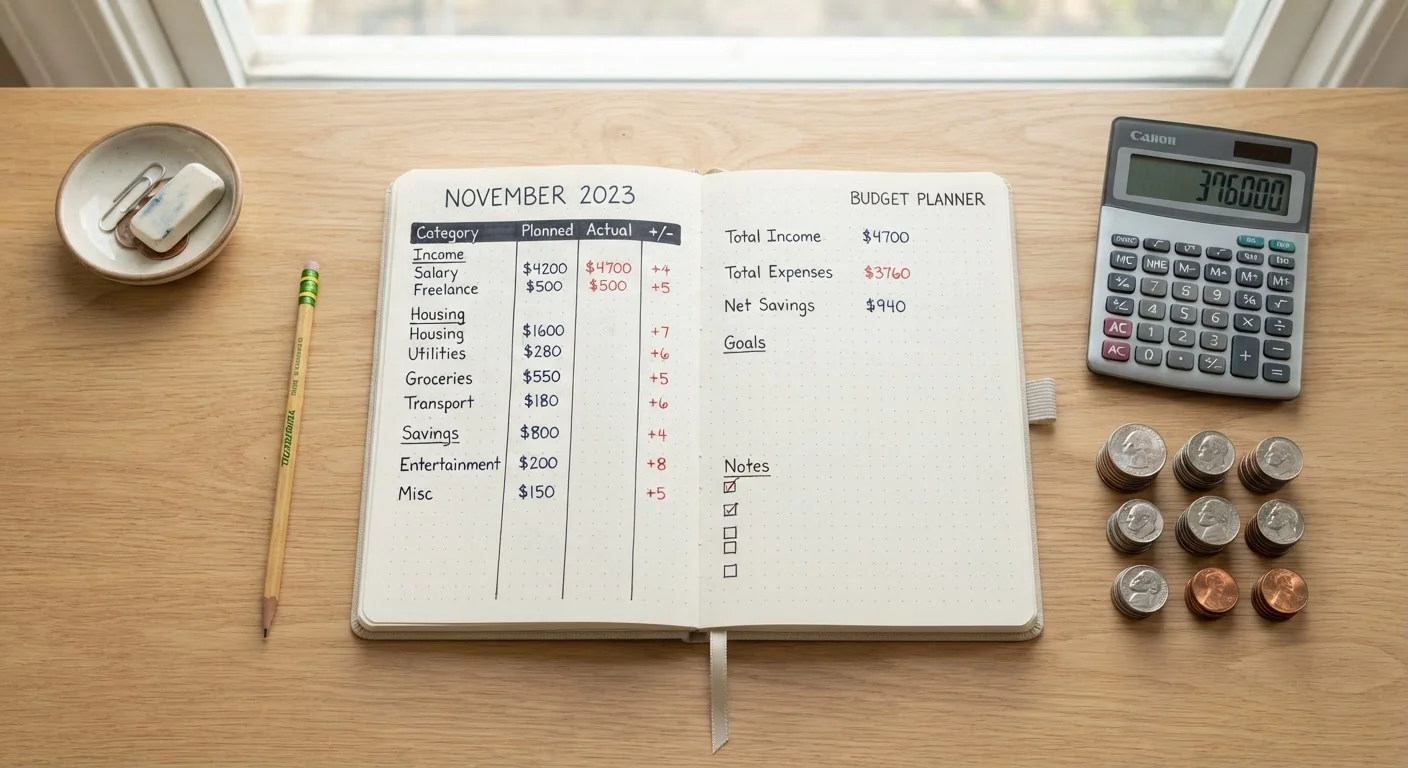
Zero-based budgeting (ZBB) operates on a different philosophy: every dollar of income gets a job. At the start of each month, you list all expected income and then allocate that total across specific spending categories - rent, groceries, gas, savings, entertainment, and so on - until income minus all allocations equals exactly zero. No dollar is left unassigned.
This doesn't mean you spend everything. A zero-based budget can (and should) include savings and investments as named line items. The goal is intentionality, not emptying your account.
The process requires more upfront effort: you'll need to build out your full budget each month, revisit it mid-month if circumstances shift, and reconcile actual spending against your plan. Tools like budgeting apps or a simple spreadsheet can reduce the manual burden considerably. For an overview of your options, our guide to budget tracking methods walks through the most practical approaches.
ZBB is particularly powerful for people with variable income - freelancers, gig workers, or anyone whose paycheck changes month to month - because each budget is built fresh from the actual dollars expected, rather than assumed percentages.
Head-to-Head: Key Differences
Both frameworks share the same ultimate goal - spending less than you earn and directing money toward what matters - but they get there differently. Here's a direct comparison across the factors that most affect everyday budgeters:
| Criterion | 50/30/20 Rule | Zero-Based Budgeting |
|---|---|---|
| Setup time | Low - three calculations | High - full category list required |
| Monthly maintenance | Minimal check-in | Regular reconciliation needed |
| Spending control | Broad, category-level | Granular, line-item level |
| Best income type | Stable, predictable paycheck | Variable or irregular income |
| Flexibility | High - percentages are guides | Lower - requires monthly rebuild |
| Savings clarity | Bundled into one 20% bucket | Itemized by goal |
| Learning curve | Gentle - ideal for beginners | Steeper - suits detail-oriented people |
Neither framework is objectively superior. Your income stability, personality, and available time are better guides to the right choice than any universal ranking. If you want to explore the broader philosophy behind spending deliberately, intentional spending principles offer useful context for either method.
Savings and Debt: Where Each Method Fits
One area where the two methods diverge meaningfully is how they handle savings and debt repayment. The 50/30/20 rule bundles both into a single 20% bucket - which is straightforward but can create vagueness. Are you saving for retirement, an emergency fund, or a vacation? Are you paying the minimum on your credit card or aggressively attacking the balance? The framework doesn't specify.
Zero-based budgeting forces those distinctions. You'd create separate line items for an emergency fund, a car repair sinking fund, and extra credit card payments - which makes trade-offs explicit and real. For a deeper look at how emergency funds and savings goals coexist within a monthly budget, see our piece on emergency funds vs. savings goals.
If building savings is a priority, both methods can support it - the difference is that zero-based budgeting makes your savings intention visible and trackable from day one, while the 50/30/20 rule leaves the specifics to you. Both approaches connect to broader saving and debt strategies that are worth understanding as your financial picture grows more complex.
This article is for general informational and educational purposes only. It does not constitute personalized financial advice. For guidance specific to your situation, consider consulting a qualified financial professional.