

Key Takeaways
Monthly Budget
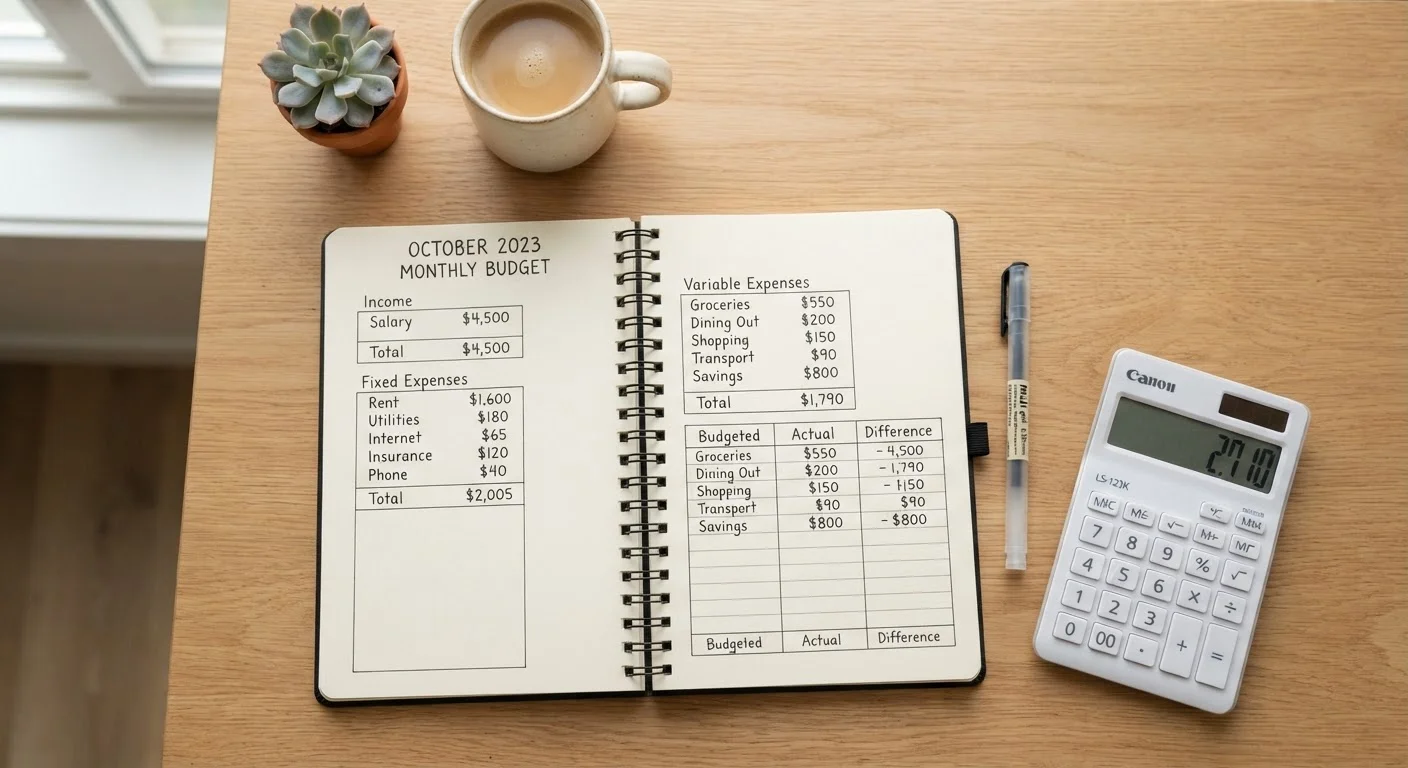
A monthly budget is a plan that maps out how much money you expect to receive and how you intend to spend or save it over a single month. It gives every dollar a purpose before the month begins, so you can make deliberate choices instead of guessing. Think of it as a financial snapshot - not a set of rules designed to punish you for spending.
In personal finance, a budget is formally defined as a forward-looking estimate of income and expenditures for a set period. It differs from a spending tracker, which records what already happened.
What a Monthly Budget Actually Does
A monthly budget does one fundamental thing: it tells your money where to go before the month begins, rather than wondering where it went afterward. That's it. There's no magic formula, no rigid spreadsheet required, and no lifestyle overhaul involved.
At its core, a budget has two sides:
- Income: Every dollar coming in - wages, freelance pay, benefits, or any other source
- Expenses: Every dollar going out - fixed bills, variable spending, savings contributions, and debt payments
When income minus expenses equals zero - meaning every dollar is assigned a purpose - that's what personal finance educators call a zero-based budget. Other approaches, like the popular 50/30/20 framework (50% needs, 30% wants, 20% savings and debt), divide income into broad categories instead of line items. Either method works. The goal is the same: intentionality.
What makes a budget genuinely useful is that it forces you to confront reality. Many people are surprised to discover how much they spend on irregular but recurring costs - subscriptions, quarterly insurance premiums, car registration. These are the categories that quietly drain accounts. Our guide on spending categories most budgets undercount covers exactly those blind spots.
~33%
Americans with a detailed household budget
Gallup surveys have consistently found that roughly one in three U.S. adults maintains a detailed budget, despite widespread agreement that budgeting is important.
$1,000+
Median annual irregular expense gap
Consumer finance research suggests most households underestimate irregular and annual expenses by over $1,000 per year, a key reason budgets run short mid-month.
2-3 months
Time for a budget to feel accurate
Financial educators generally note that it takes two to three full budget cycles before category estimates stabilize and the plan becomes reliably useful.
What a Monthly Budget Is Not
Misconceptions about budgeting keep a lot of people from starting one. Let's clear up the most common ones.
A budget is not a punishment. It doesn't mean you can't spend on things you enjoy. It means you decide in advance how much enjoyment spending is reasonable - and then you spend that amount without guilt.
A budget is not a guarantee. Building a budget won't automatically eliminate financial stress or prevent unexpected expenses. It's a plan, and plans need adjusting. A budget that goes sideways mid-month isn't a failure - it's feedback. Understanding why that happens is a separate skill; see why budgets fall apart mid-month for a deeper look at those structural weak spots.
A budget is not only for people in financial trouble. This is one of the most persistent myths in personal finance. In reality, people across every income level use budgets - not because they're struggling, but because awareness of cash flow is how financial goals actually get funded. If you've heard that budgets are only for people in debt, common budgeting myths breaks down why that belief keeps people stuck.
The Anatomy of a Simple Monthly Budget
You don't need software or a finance background to build one. Here's how the pieces fit together:
- Tally your monthly take-home income. Use net income - the amount that actually lands in your account after taxes and deductions. If your income varies, use a conservative estimate.
- List fixed expenses. These are consistent amounts due each month: rent or mortgage, car payment, insurance premiums, loan minimums. They're non-negotiable line items.
- Estimate variable expenses. Groceries, gas, dining out, clothing, and entertainment shift month to month. Look at two to three months of statements to find realistic averages.
- Include irregular expenses. Annual subscriptions, quarterly bills, car registration, medical copays - divide their annual cost by 12 and set that amount aside monthly.
- Add savings as a line item. Savings shouldn't be whatever's left over. Treating it as a fixed expense - even a small one - is what makes it consistent.
- Check the math. Subtract total planned expenses from income. If you're over, trim variable categories. If you have a surplus, decide intentionally where it goes.
That's the structure. Once it's built, the budget needs only a monthly review - not daily monitoring. Our end-of-month budget audit checklist walks through a simple process for doing exactly that.
Why Budgets Break Down - and What to Do Instead
Most budgets don't collapse because of bad math. They collapse because of behavior and structure. Common reasons include setting unrealistic category limits, forgetting irregular expenses, or building a budget that reflects an ideal life rather than the actual one.
“A budget is telling your money where to go instead of wondering where it went.”
— John C. Maxwell, Leadership author and speaker, widely attributed with popularizing this financial maxim
The fix is almost always the same: make the budget more realistic, not more strict. If you consistently overspend on groceries, the answer isn't to slash the category - it's to figure out why and set a number that's genuinely achievable. Budgets that reflect how you actually live are the ones you'll stick with.
It also helps to remember that a monthly budget is a living document. Income shifts, expenses change, priorities evolve. Revisiting and adjusting the plan isn't failure - it's how the tool is supposed to work. If you find your budget repeatedly breaking down in the same places, why your budget keeps failing digs into the behavioral patterns that most often get in the way.
This article is for general informational and educational purposes only and does not constitute personalized financial advice. For guidance specific to your financial situation, consider consulting a qualified financial professional.