

Key Takeaways
Impulse Purchase
An impulse purchase is an unplanned buying decision made in the moment, without prior intention or deliberate consideration. It happens when an emotional response - excitement, urgency, or desire - overrides rational evaluation. Retailers actively design environments, pricing, and messaging to trigger these spontaneous decisions.
Behavioral economists describe impulse buying as a failure of 'System 2' thinking - the slow, deliberate reasoning process - when faster, emotion-driven 'System 1' responses take over, a framework popularized by psychologist Daniel Kahneman.
How Retailers Turn Browsing Into Buying
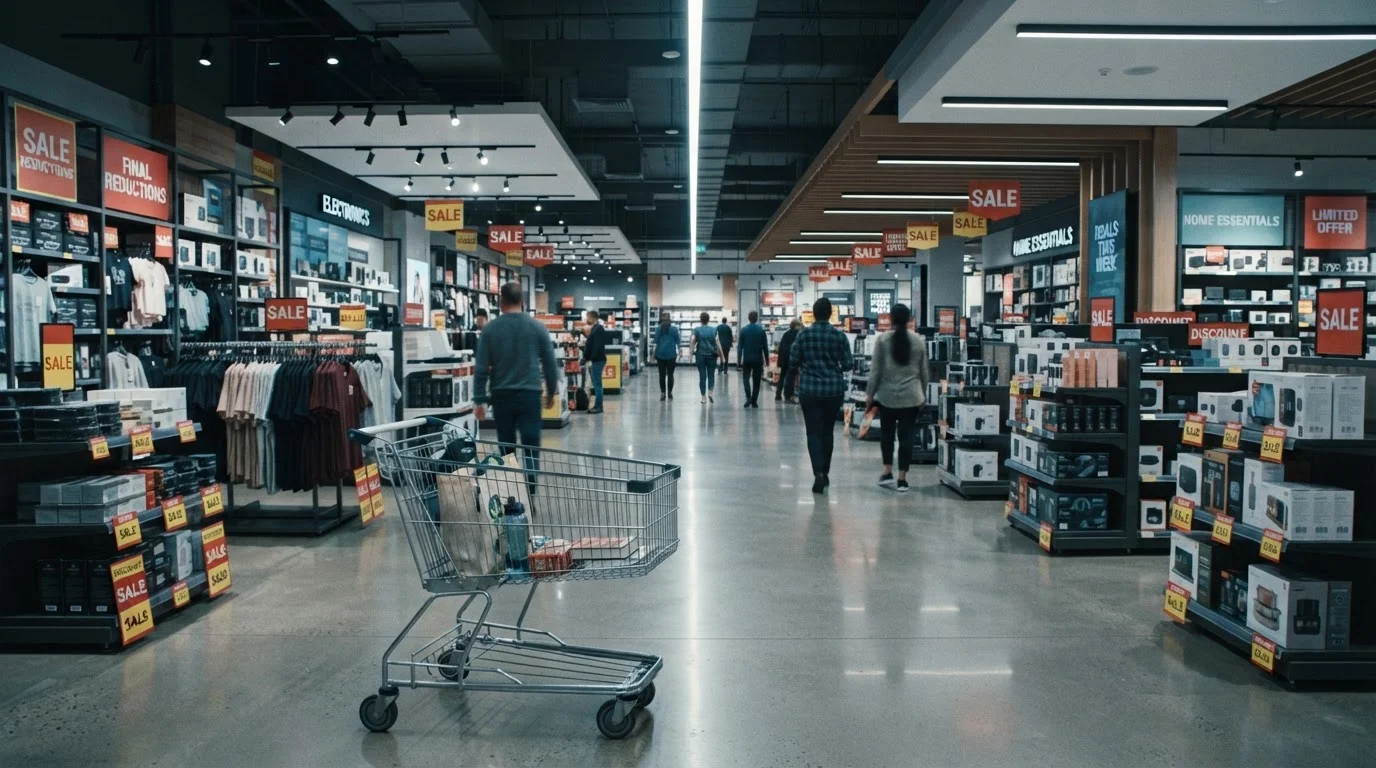
The modern retail environment - whether a big-box store or an e-commerce homepage - is not a neutral space. It is a carefully engineered persuasion system. Decades of consumer psychology research have been translated into store layouts, product placements, checkout flows, and pricing displays designed to move shoppers from browsing to buying, often without their conscious awareness.
Understanding how these systems work won't make you immune to them, but it gives you the most important tool available: awareness. Once you can name a tactic, it loses much of its power.
~40%
Share of retail purchases that are unplanned
Consumer behavior research consistently estimates that a significant portion of in-store purchases are made without prior intent, though estimates vary by category and study methodology.
3x
Faster decisions under scarcity messaging
Studies in consumer psychology find that low-stock or time-limited messages substantially compress purchase decision time, reducing deliberate evaluation.
$5,400
Estimated annual impulse spending per US household
Surveys of American consumer spending habits suggest unplanned purchases add up significantly over a year, though individual figures vary widely by income and lifestyle.
The Core Psychological Mechanisms at Work
Price Anchoring
When you see a product marked down from $120 to $79, your brain anchors to the $120 figure and evaluates the $79 as a bargain - regardless of whether $120 was ever a realistic price. Retailers deliberately set high 'original' prices to make sale prices feel like wins. Our smart spending glossary covers anchoring and related cognitive biases in plain language.
Artificial Scarcity and Urgency
Messages like 'Only 3 left in stock' or countdown timers on online sales trigger loss aversion - a well-documented tendency to fear missing out more strongly than we value equivalent gains. This emotional pressure accelerates decisions and suppresses the deliberate evaluation that might lead you to walk away.
The Decoy Effect
Retailers often present three pricing tiers - a cheap option, an expensive option, and a mid-range 'decoy' - where the middle option is strategically priced to make it feel like the obvious, rational choice. The decoy is not chosen because it's best; it's chosen because of how it's positioned relative to the others.
Social Proof
Star ratings, review counts, and 'bestseller' badges create the impression that other people have already made the smart choice. This social validation reduces the effort your brain expends evaluating the product independently - you outsource the decision to the crowd.
Store Layout and Sensory Design
Physical retail environments are designed with precision. Essential items like groceries, medications, or basic clothing are typically placed at the back of the store, requiring shoppers to walk past high-margin impulse items to reach them. Checkout lanes are stocked with small, low-cost goods that are easy to add without mental friction.
Lighting, music tempo, and even scent are used to influence mood and pace. Research in consumer behavior consistently finds that slower music and warmer lighting slow shoppers down and increase time spent - and spending - in stores.
Online environments mirror these tactics digitally: recommendation engines surface items based on browsing history, one-click purchasing removes the friction that might cause hesitation, and homepage layouts prioritize high-margin or promotional items.
Practical Tactics to Interrupt the Impulse Cycle
Awareness of these tactics is step one. Building habits that create space between the impulse and the purchase is step two. A few approaches with strong practical support:
- Use a shopping list and commit to it. A concrete list shifts your mental frame from 'open exploration' to 'task completion,' reducing susceptibility to in-store nudges.
- Apply the 24-hour rule. For any unplanned item over a self-set threshold - say, $30 - wait a full day before purchasing. Most impulse urges fade significantly.
- Remove saved payment methods from retail apps. Checkout friction is your ally. The extra thirty seconds of entering card details is enough for deliberate thinking to engage.
- Ask one clarifying question. 'Would I have come here specifically to buy this?' often reveals whether a purchase is a genuine need or a retailer-engineered want.
For readers building broader intentional spending habits, our guide to intentional spending from the ground up provides a structured framework for aligning daily purchases with financial goals. These tactics also apply well beyond routine shopping - travelers are particularly vulnerable to impulse spending, a dynamic explored in depth in our article on why travelers overspend and how to plan around it.
Try the 'Would I Come Back for This?' Test
Before adding an unplanned item to your cart or basket, ask yourself: 'If this weren't right in front of me, would I make a separate trip to buy it?' If the honest answer is no, that's useful information. This simple question shifts the frame from reactive to deliberate without requiring significant effort or willpower.
Putting It Together: Becoming a More Deliberate Consumer
Impulse purchases aren't a character flaw - they're a predictable response to sophisticated, well-funded persuasion systems. Every major retailer employs teams of behavioral designers, data scientists, and UX researchers whose explicit goal is to increase unplanned spending. Recognizing that fact reframes the challenge: it's not about willpower, it's about systems.
Building a few consistent habits - a list, a pause, a single clarifying question - creates the structural resistance that willpower alone rarely provides. For a complete framework covering everything from budgeting fundamentals to behavioral triggers, the Smart Spending complete guide is a practical next step. And if you're evaluating a significant unplanned purchase, the principles in our article on making big purchases wisely apply directly.
This article is for general informational and educational purposes only and does not constitute personalized financial advice. Consult a qualified financial professional for guidance specific to your situation.