

Key Takeaways
Why Long-Haul Comfort Deserves Serious Thought
A flight over eight hours isn't just transportation - it's a significant chunk of your trip. Arrive wrecked and you lose a day or more recovering; arrive reasonably rested and you hit the ground running. The good news is that the gap between a miserable long-haul and a manageable one usually comes down to a handful of decisions, most of them made before you ever board the plane.
These tips aren't about expensive upgrades (though a few are worth the splurge if it's in your budget). They're about understanding what actually drains you in the air - cabin pressure, dry air, immobility, disrupted sleep cues - and countering each one deliberately. For a broader view of planning a long-distance trip from the ground up, our long-haul trip planning frameworks article is a useful starting point.
Choose Your Seat With Intention
Seat selection is the single decision with the highest return on your comfort investment, and it costs nothing on most bookings if done at reservation. Window seats give you a wall to lean against and control over the window shade - both underrated for sleep. Exit rows and bulkhead seats offer real legroom but often come with fixed armrests and no under-seat storage. Avoid seats directly in front of exit rows, which frequently don't recline, and seats near galleys or lavatories where noise and foot traffic spike overnight.
Seatmap review tools (most airlines publish their own; third-party seat databases can supplement) let you see which rows have limited recline or restricted windows before you commit. Check-in often reshuffles availability, so it's worth revisiting seat selection 24 hours out.
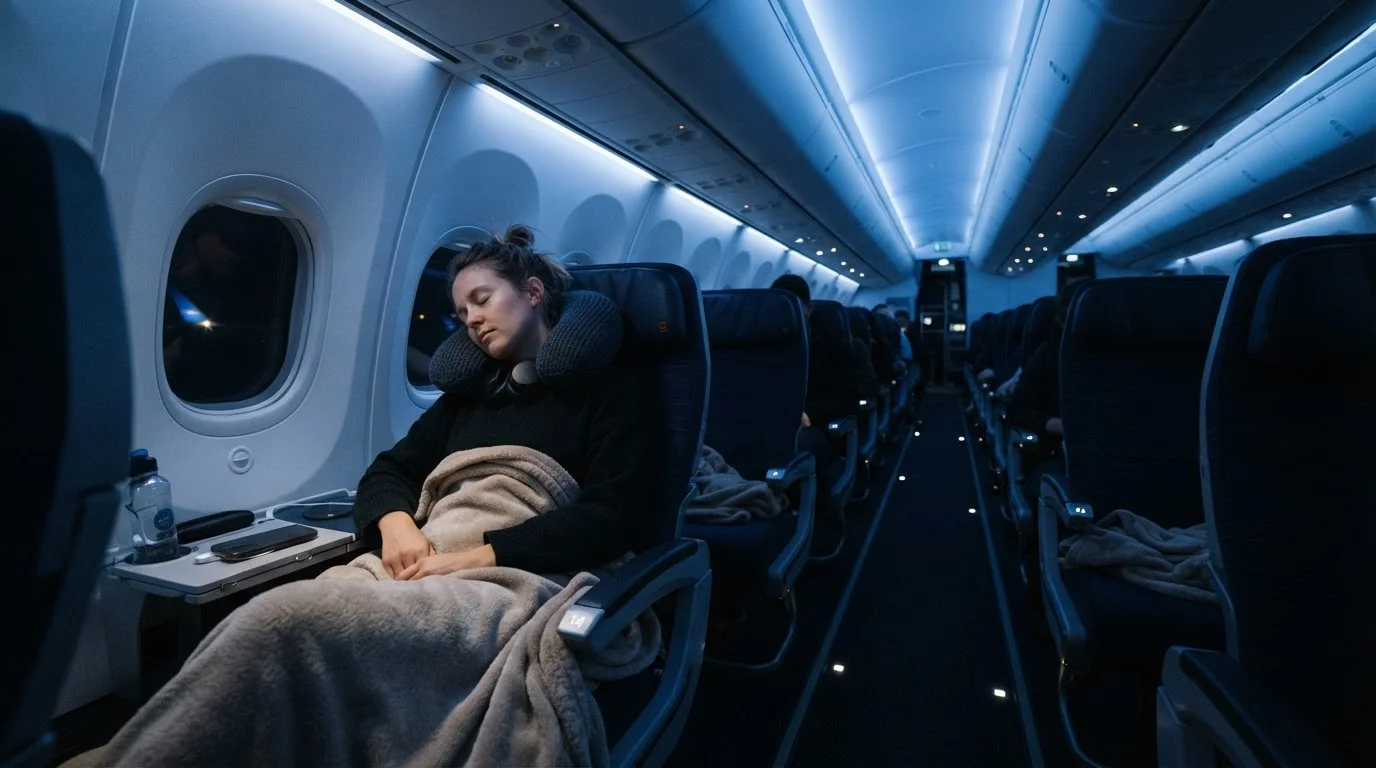
The window seat gives you a wall to lean on and control of the shade - both crucial for sleep.
Dress for the Cabin, Not the Destination
Cabin temperature is unpredictable and swings several degrees over a long flight. Layers - a breathable base, a light mid-layer, and something wind-resistant - let you adapt without relying on an airline blanket that may not arrive until cruising altitude. Compression socks are one of the most evidence-supported comfort items for long flights; they help maintain circulation in the lower legs during extended sitting, which research on prolonged sitting consistently flags as a concern. Slip-on shoes simplify security and make in-cabin swelling (which is common and normal) far less uncomfortable.
Compression socks are one of the most evidence-supported ways to support circulation during long flights.
Treat Hydration as Active Maintenance
Cabin humidity typically hovers between 10-20%, far drier than most indoor environments. That level of dryness accelerates fatigue, contributes to headaches, and worsens jet lag symptoms. The standard guidance - drink water regularly - is correct but easy to ignore when you're deep in a movie. A practical approach: set a quiet phone alarm every 60-90 minutes as a hydration reminder, and request a full bottle of water when the crew passes rather than waiting for the cart. Alcohol and caffeine both have mild diuretic effects and can fragment sleep; limiting both, especially in the first half of a night flight, generally pays off by landing.
Cabin humidity can drop below 20% - treating hydration as active maintenance, not an afterthought, is essential.
Build a Sleep Environment, Don't Just Hope for It
Quality sleep on a plane is less about sedatives and more about managing sensory inputs. A well-fitted eye mask blocks the ambient light that tells your brain it's daytime. Noise-canceling headphones or high-quality foam earplugs reduce engine drone to a level that stops triggering alertness. A neck pillow that holds your head in a neutral position prevents the jolt-awake cycle that kills deep sleep. Set your phone and any entertainment to airplane mode and dim screens an hour before your intended sleep window - blue light from screens suppresses melatonin, the hormone that initiates sleep. Some travelers find low-dose melatonin helpful for resetting their sleep timing; if you're considering this, discuss it with a healthcare provider to understand whether it suits your situation.
Managing light and noise is more effective for in-flight sleep than most over-the-counter sleep aids.
Move on a Schedule, Not Just When You Feel It
Stiffness and fatigue build gradually during a long flight, and by the time you notice them, you've already been sitting too long. A proactive movement schedule - standing and walking the aisle every 60-90 minutes when the seatbelt sign is off - keeps blood flowing and reduces the dull ache that accumulates in the lower back and hips. Simple seated stretches (ankle circles, neck rolls, seated spinal twists) can be done without leaving your seat and are especially useful during turbulence-heavy segments. Aisle seats make movement easier but sacrifice the leaning-wall advantage of window seats; weigh both depending on how much you prioritize sleep versus mobility.
Moving before you feel stiff - not after - is the habit that separates comfortable long-haul travelers from exhausted ones.
Adjust Your Clock Before You Land
One of the most effective jet lag strategies begins at boarding: set your watch to destination time and start orienting your behavior accordingly. If it's nighttime at your destination, treat the flight as nighttime - resist the urge to stay awake watching movies just because it's 2 p.m. at home. If it's daytime at your destination, try to stay alert, use window light strategically, and save the sleep mask for the appropriate window. Eating in sync with destination meal times, rather than cabin service schedules, also helps signal the time zone shift to your body. Packing your own snacks gives you flexibility to eat on your own schedule rather than the airline's, which is rarely optimized for your itinerary. For packing those snacks and everything else efficiently, our frequent flyer packing strategies offer a solid framework.
Setting your watch to destination time at boarding and behaving accordingly is one of the simplest jet lag countermeasures.
Putting It All Together
No single trick saves a long-haul flight. What works is layering several small decisions - a good seat, consistent water intake, timed movement, and deliberate light and sleep management - into a coherent in-flight routine. The more you practice these habits, the more automatic they become, which means less mental overhead every time you board.
For the recovery side of the equation, understanding the biology involved can sharpen your approach - our piece on the science behind beating jet lag explains what's actually happening to your body and what the evidence says helps most. And once you've sorted your comfort strategy, making the most of airport layovers can help you keep momentum between connections rather than losing ground in a terminal.
Pack Your Carry-On for In-Flight Access
Everything you need during the flight - headphones, eye mask, lip balm, snacks, a light layer - should be in the top of your bag or a personal item, not buried in overhead storage. Having to dig through luggage mid-flight disrupts other passengers and wastes your own rest time. Our guide on carry-on vs. checked luggage trade-offs can help you decide what to bring into the cabin in the first place.