

Key Takeaways
Option A
Antifreeze
The concentrated chemical compound at the core of the mix.
Best for: Drivers who want to understand what's actually doing the temperature-regulating work inside their engine.
Option B
Coolant
The ready-to-use fluid that goes into your vehicle.
Best for: Everyday drivers who need a practical, pour-ready solution for topping off or flushing the cooling system.
If you're topping off the reservoir between services
Coolant (pre-mixed 50/50)
Pre-mixed coolant requires no dilution and eliminates the risk of getting the water-to-antifreeze ratio wrong.
If you're performing a full cooling system flush
Antifreeze (concentrated)
Concentrated antifreeze lets you control the exact mix ratio, which is useful when flushing and refilling the entire system with distilled water.
If you live in an extremely cold climate
Antifreeze (concentrated)
A higher antifreeze concentration (up to 70%) lowers the freeze point further, offering added protection in extreme winter conditions.
If you're a casual driver with minimal mechanical experience
Coolant (pre-mixed 50/50)
Pre-mixed coolant is the most straightforward option - no calculations, no measuring, no risk of over-concentrating.
What's Actually in the Bottle
Walk down the automotive aisle of any auto parts store and you'll see the words "antifreeze" and "coolant" on nearly identical packaging - sometimes on the exact same label. The confusion is understandable, but the distinction is meaningful.
Antifreeze refers specifically to the chemical compound - most commonly ethylene glycol, though propylene glycol formulations exist - that lowers the freezing point and raises the boiling point of water. On its own, it's a concentrated liquid.
Coolant is the term for the mixture that actually circulates through your engine's cooling system. It's antifreeze combined with water, typically in a 50/50 ratio. That blend isn't arbitrary: the water is what makes the fluid an efficient heat conductor, while the antifreeze keeps it from freezing in winter or boiling over in summer.
Counterintuitively, running pure antifreeze without any water actually decreases its ability to regulate temperature. Water has a higher heat capacity than ethylene glycol, making the mixture more effective than either component alone. See our guide to your car's fluid levels for more on how each fluid interacts with engine performance.
| Criterion | Antifreeze | Coolant (Pre-Mixed) |
|---|---|---|
| Composition | Concentrated ethylene glycol | Antifreeze + distilled water (50/50) |
| Ready to use? | No - must be diluted | Yes - pour directly in |
| Typical freeze protection | Varies by dilution ratio | Down to approx. -34°F |
| Best use case | Full flush, custom ratio | Top-off, routine maintenance |
| Risk of error | Higher - ratio matters | Lower - pre-measured |
| Cost per use | Lower per volume | Slightly higher per volume |
Why the Ratio Matters - and When to Adjust It
The standard 50/50 mix works well for most US drivers year-round, protecting the engine down to approximately -34°F and up to around 265°F under pressurized conditions. But conditions vary.
In regions where winter temperatures regularly plunge well below zero, a 70/30 antifreeze-to-water ratio provides a freeze point closer to -84°F. However, this upper limit exists for a reason - exceeding roughly 70% antifreeze concentration actually raises the freeze point again, undermining protection entirely.
Distilled water, not tap water, should always be used when mixing from concentrate. Tap water contains minerals and chlorides that can corrode aluminum cooling system components over time.
Coolant Color Isn't Just Cosmetic
The color of coolant is used by manufacturers to distinguish between chemical formulations, not just for identification convenience. Green typically signals an older IAT (inorganic additive technology) formula, while orange, yellow, and pink often indicate OAT (organic acid technology) or HOAT (hybrid OAT) extended-life variants. These formulations use different corrosion inhibitors designed for different metal alloys. Mixing colors - even if the levels look fine - can cause the inhibitors to react and lose effectiveness faster.
It's also worth noting that coolant formulations are not universal. Older vehicles often used a green, inorganic additive technology (IAT) coolant. Many modern vehicles require orange, yellow, pink, or blue extended-life formulations (OAT or HOAT chemistries). Mixing incompatible types can degrade corrosion inhibitors and, over time, damage seals and metal components. Always confirm the correct specification in your owner's manual before adding any fluid.
Maintenance: What Drivers Actually Need to Do
Coolant doesn't last forever. Over time, the corrosion inhibitors in the fluid break down, leaving metal surfaces inside the engine, radiator, and water pump vulnerable to rust and scale buildup. Most manufacturers recommend a cooling system flush every 30,000 to 50,000 miles, though extended-life coolants may push that interval further - check your service schedule rather than estimating.
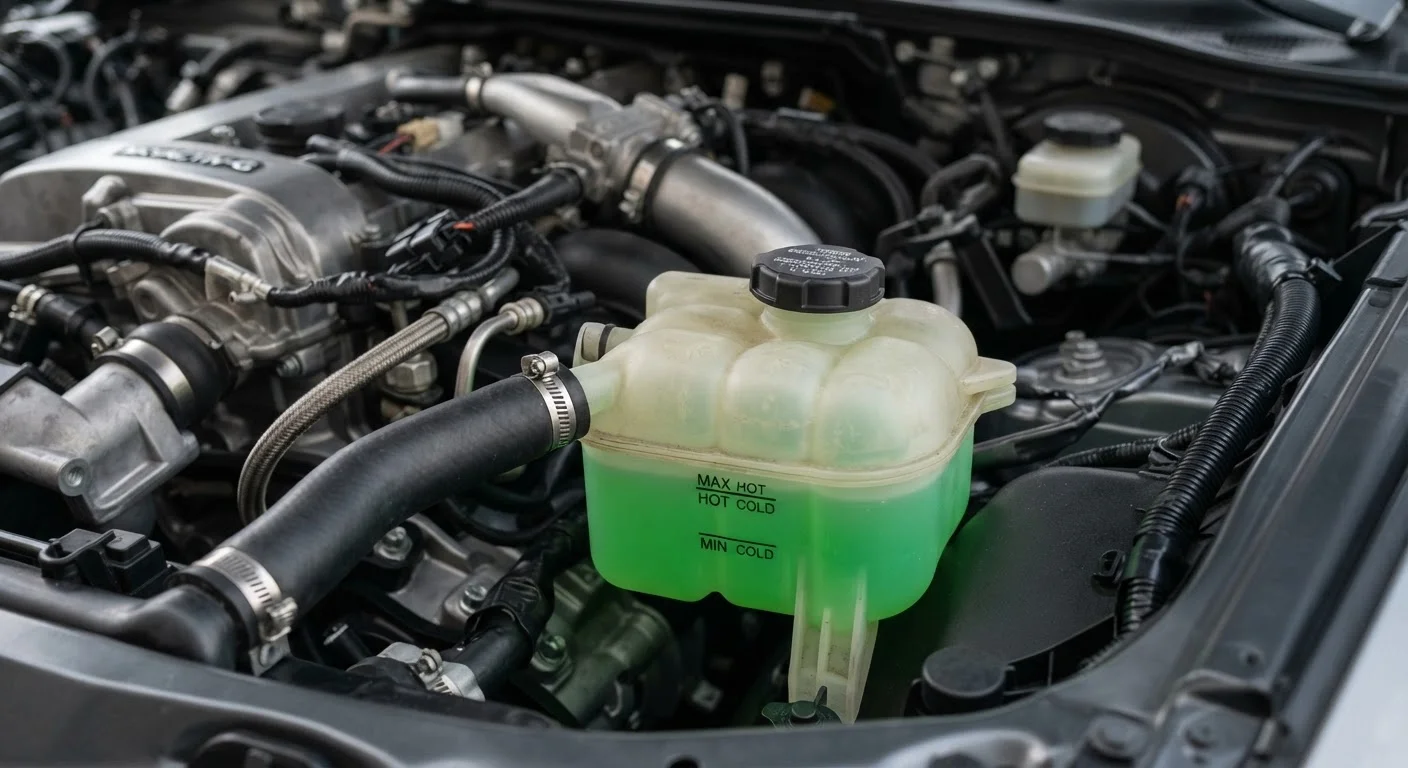
Between flushes, keep an eye on the coolant reservoir (the semi-translucent plastic tank in the engine bay) and verify that the fluid level sits between the MIN and MAX markings when the engine is cold. A consistently low level isn't just a topping-off problem - it can signal a slow leak in a hose, radiator, water pump seal, or, more seriously, a failing head gasket. If you notice the level dropping repeatedly without an obvious external leak, have a mechanic pressure-test the cooling system before further damage occurs.
When topping off, use only the formulation specified for your vehicle, and never open the radiator cap or reservoir cap when the engine is hot. Pressurized hot coolant can cause severe burns.
This article is for general informational purposes only. Always consult a qualified mechanic for diagnosis and repair of your vehicle's cooling system.