

Key Takeaways
Our Verdict
Organic fertilizers build lasting soil health and reduce environmental risk, but work slowly and require patience. Synthetic fertilizers act fast and offer precise nutrient control, making them useful for targeted interventions. The most resilient gardens often use both thoughtfully rather than treating the choice as all-or-nothing.
| Best for | Recommended |
|---|---|
| Gardeners focused on long-term soil improvement | Organic fertilizers |
| Situations requiring rapid nutrient correction | Synthetic fertilizers |
| Vegetable gardens where food safety and soil life matter | Organic fertilizers |
| Lawns or ornamentals needing a quick seasonal boost | Synthetic fertilizers |
How Each Type of Fertilizer Actually Works
Understanding fertilizers starts with a basic question: how do nutrients reach plant roots? The answer differs significantly between organic and synthetic products.
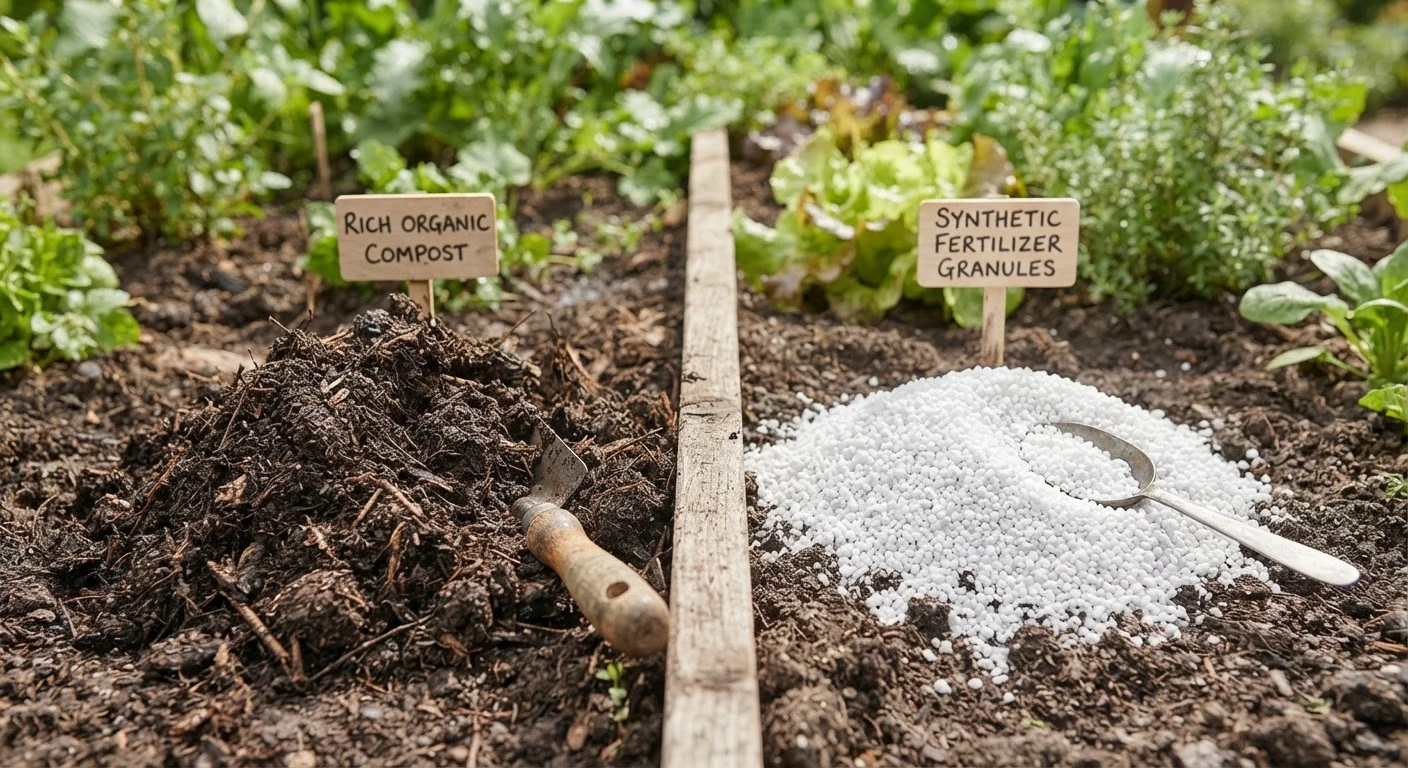
Organic fertilizers - derived from plant matter, animal byproducts, or minerals - must be broken down by soil microbes before plants can absorb nutrients. Composted manure, blood meal, bone meal, and kelp meal are common examples. This decomposition process feeds the broader soil food web, encouraging beneficial bacteria and fungi that improve soil over time. The trade-off is speed: nutrient release can take weeks or even an entire season.
Synthetic fertilizers are manufactured to deliver nutrients - typically nitrogen (N), phosphorus (P), and potassium (K) - in forms that dissolve readily in water and enter plant roots almost immediately. This is why a nitrogen-deficient lawn can green up within days of a synthetic application. The nutrients bypass the microbial middle step entirely.
For a deeper look at what your garden soil is already working with, see our Soil Health 101 guide - understanding your baseline makes fertilizer decisions far more informed.
Long-Term Effects on Soil Health
The most meaningful difference between these fertilizer types shows up not in the current growing season, but over years of use.
Regular organic amendments gradually improve soil structure - the way particles clump together into aggregates. Good structure means better drainage, better moisture retention, and more oxygen reaching roots. Organic matter also sustains microbial communities that suppress certain plant diseases and make naturally occurring soil nutrients more accessible.
Synthetic fertilizers, by contrast, deliver nutrients without contributing organic matter. Used exclusively over many seasons, they can leave soil increasingly dependent on external inputs while microbial diversity declines. Heavy or repeated synthetic applications also raise the risk of nutrient runoff, particularly nitrogen and phosphorus, which can move into stormwater and contribute to algae blooms in lakes and streams.
That said, poorly timed or over-applied organic fertilizers can also leach into waterways - source type doesn't guarantee responsible use. Application rate and timing matter regardless of which fertilizer you choose.
| Organic Fertilizers | Synthetic Fertilizers | |
|---|---|---|
| Nutrient release speed | Slow (weeks to months) | Fast (days) |
| Soil biology impact | Feeds and builds microbial life | Minimal direct benefit to microbes |
| Soil structure over time | Improves with consistent use | Neutral to declining without organic matter |
| Runoff risk | Lower, but still possible if over-applied | Higher, especially with excess nitrogen |
| Nutrient precision | Variable by source and batch | Consistent, labeled NPK ratios |
| Cost per application | Often higher upfront | Generally lower per unit of nutrient |
| Best use case | Long-term soil building | Targeted, fast nutrient correction |
Practical Situations: When Each Approach Makes Sense
Rather than declaring a winner, it helps to match each fertilizer type to the situations it handles best.
When organic fertilizers shine
- Building new garden beds: Incorporating compost or aged manure before planting sets a strong biological foundation. If you're deciding between garden setups, our guide to raised beds vs. in-ground planting explores how soil amendments factor into each approach.
- Vegetable gardens: Many gardeners prefer organics here to minimize synthetic chemical contact with edible crops, though certified products are an option either way.
- Perennial beds and shrubs: Slow-release feeding aligns well with plants that live in the same spot for years.
When synthetic fertilizers make sense
- Rapid deficiency correction: If a soil test reveals a specific, acute nutrient shortage, a targeted synthetic application can address it quickly while organic approaches build up.
- High-demand annuals and turf: Fast-growing crops and lawns often benefit from readily available nitrogen during their peak growth windows.
- Precise nutrient ratios: Synthetic products are formulated with consistent NPK ratios, making it easier to match what a soil test recommends.
Start With a Soil Test
Before buying any fertilizer, invest in a basic soil test through your local cooperative extension service. Results typically show pH, existing nutrient levels, and specific deficiencies - so you only add what's actually needed. Over-fertilizing wastes money and increases runoff risk regardless of whether your product is organic or synthetic.
A Note on Labels, Claims, and Certifications
The term organic on a fertilizer label has a specific meaning in gardening contexts: it refers to carbon-based, naturally derived ingredients - not necessarily a certified product. For certified organic growing operations, look for products approved by recognized certifying bodies such as the OMRI (Organic Materials Review Institute), which evaluates inputs for use in certified organic production.
For home gardeners not pursuing formal certification, the label matters less than understanding what's actually in the product and how it interacts with your specific soil. A soil test - available through most cooperative extension services - is the single most practical step any gardener can take before investing in fertilizer of any kind. It tells you what nutrients are actually lacking rather than guessing.
The choice between organic and synthetic fertilizers shares something with other natural-versus-processed debates in everyday life: the reality is usually more nuanced than the labels suggest. What matters most is how a product is used, not simply what category it falls into.