

Key Takeaways
Option A
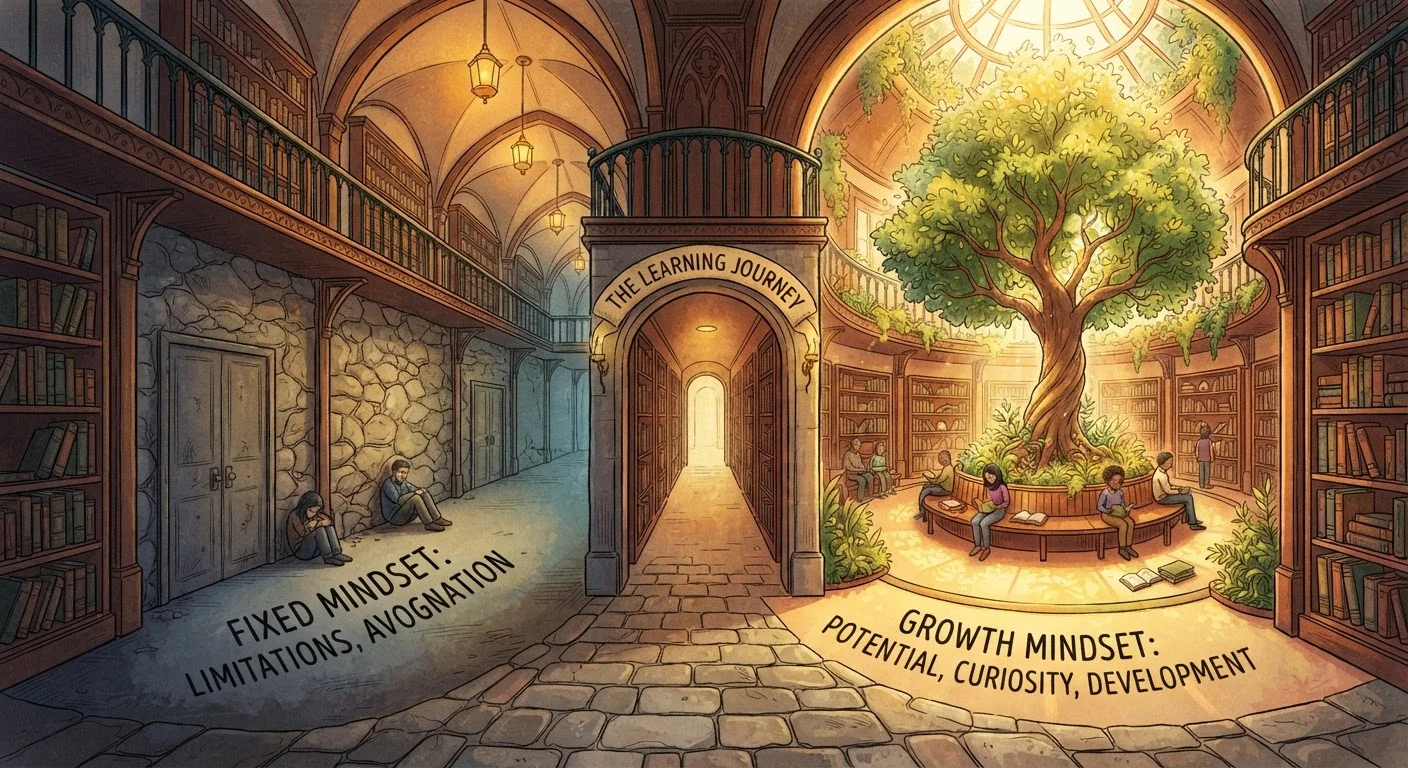
Growth Mindset
The belief that abilities expand through effort and strategy.
Best for: Students who want to build resilience, embrace challenge, and improve steadily over time.
Option B
Fixed Mindset
The belief that intelligence and talent are static, innate traits.
Best for: Understanding a common but limiting cognitive pattern - so you can recognize and move past it.
If you tend to avoid hard tasks because failure feels like proof of low ability
Growth Mindset
Reframing mistakes as feedback rather than verdicts helps you persist through difficulty and build skills over time.
If you want to understand why some students disengage after early success
Fixed Mindset
Studying fixed mindset patterns reveals how believing talent is finite can make students fragile when challenges escalate.
If you are a teacher designing feedback and praise strategies
Growth Mindset
Process-focused feedback shown in classroom research tends to improve motivation and persistence more than ability-focused praise.
If you are a lifelong learner returning to education after a gap
Growth Mindset
Embracing early-stage struggle as normal - rather than evidence of inadequacy - supports confidence and long-term commitment.
What Each Mindset Actually Means
The terms growth mindset and fixed mindset were introduced by psychologist Carol Dweck through decades of research on motivation and achievement. At their core, they describe what a person believes about the nature of their own intelligence and abilities.
A growth mindset holds that intellectual abilities are malleable - that dedicated effort, sound strategies, and openness to feedback can meaningfully improve what a person can do. A fixed mindset, by contrast, holds that intelligence is a fixed quantity: you either have it or you don't, and effort can only reveal that quantity, not change it.
These are not personality types or diagnoses. They are patterns of thinking - often context-dependent - that most people experience in varying degrees depending on the subject or situation. A student might hold a growth mindset about writing but a fixed mindset about mathematics, for example.
Understanding both patterns matters because they influence how students interpret struggle. A growth mindset learner tends to view a difficult problem as something to work through; a fixed mindset learner may interpret the same difficulty as evidence they simply lack ability. Those two interpretations lead to very different behaviors over time. See the fuller picture of how mindset fits alongside other factors in habits, environment, and mindset.
What the Research Actually Shows
Growth mindset has attracted enormous popular attention - and some of that enthusiasm has outpaced what the evidence carefully supports. A balanced reading of the research reveals both genuine findings and important caveats.
| Criterion | Growth Mindset | Fixed Mindset |
|---|---|---|
| Core belief about ability | Abilities develop through effort and strategy | Abilities are innate and largely unchangeable |
| Response to challenge | Engages and persists | Avoids or withdraws |
| Interpretation of failure | Useful feedback for improvement | Evidence of low ability |
| Reaction to others' success | Source of inspiration and strategy | Threat to self-image |
| Preferred feedback type | Process- and effort-focused | Outcome- and ability-focused |
| Effect on long-term motivation | Tends to sustain and deepen engagement | Can erode when challenges escalate |
| Research support | Modest, real benefits under right conditions | Well-documented as a barrier to persistence |
Dweck and colleagues have demonstrated in multiple studies that students who are taught to view the brain as capable of growth tend to show greater persistence and, in some cases, improved academic outcomes. A notable 2019 national randomized controlled trial published in Nature (Yeager et al.) found that a brief growth mindset intervention modestly but significantly improved grades among lower-achieving high school students - an important, if bounded, result.
However, large-scale replications have shown mixed results. Effect sizes are often small, and outcomes depend heavily on the quality of implementation, school environment, and whether structural support (such as quality teaching and adequate resources) is present. Mindset shifts alone - without accompanying changes in instructional practice - tend to produce limited gains.
The takeaway: growth mindset is a meaningful and evidence-supported concept, but it should be understood as one piece of a larger learning puzzle, not a standalone solution. It pairs well with metacognitive skills, which research consistently identifies as among the strongest predictors of academic achievement.
A Note on Overstated Claims
Growth mindset has sometimes been promoted in ways that go beyond what research supports - for example, suggesting that attitude alone can overcome resource gaps or systemic barriers. Researchers including Dweck herself have cautioned against oversimplified applications. The concept is most effective when embedded in classroom cultures that also provide meaningful challenge, constructive feedback, and genuine support structures. Mindset is a lever, not a lifeline.
Applying Mindset Principles in Practice
Whether you are a student, educator, or lifelong learner, growth mindset principles are most useful when translated into specific, concrete behaviors - not just adopted as a slogan.
- Reframe how you talk about struggle. Replacing "I'm not good at this" with "I haven't mastered this yet" is more than wordplay - it keeps the door open to future learning. The word "yet" signals that the current state is not permanent.
- Focus praise on process, not person. Research shows that praising effort, strategy, and persistence ("You tried several different approaches before finding one that worked") is more motivating than praising intelligence ("You're so smart"). The latter can actually discourage risk-taking.
- Treat errors as information. Analyzing what went wrong - and why - is a form of active learning. This connects directly to what skill research shows: expertise is built through deliberate practice and corrective feedback, not innate gift.
- Set learning goals over performance goals. Aiming to understand a concept deeply, rather than simply to score well, tends to build more durable knowledge and greater intrinsic motivation.
These habits are also transferable across life stages. Whether you are navigating early adulthood or returning to study later in life, the strategies that support a growth orientation remain consistent. Explore how learning strategies shift over time in our guide to skill building across every life stage.
~0.10-0.20
Typical effect size range in mindset intervention studies
Meta-analyses of growth mindset interventions, including a 2018 review by Sisk et al., report effect sizes that are statistically significant but modest in practical terms.
76%
Lower-achieving students showing grade improvement
In the 2019 Yeager et al. national RCT published in Nature, roughly 76% of lower-achieving students showed improved core GPA after a brief growth mindset program.
2x
Effort praise vs. ability praise for motivation
Research by Dweck and colleagues found students praised for effort were more likely to choose challenging tasks than those praised for being intelligent.