

Key Takeaways
Why Life Stage Shapes How You Learn
Skill building is not a one-size-fits-all endeavor. The cognitive resources, motivations, available time, and learning contexts you have at 22 look very different from those at 45 or 68. Understanding how these variables shift - and what research says about each phase - lets you choose strategies that actually work rather than fighting your circumstances.
Developmental psychologists distinguish between two broad types of intelligence: fluid intelligence (the speed of processing new information and solving novel problems) and crystallized intelligence (accumulated knowledge, vocabulary, and pattern recognition). Fluid intelligence tends to peak in early adulthood; crystallized intelligence continues growing well into later life. Neither type alone determines your capacity to learn - combining them strategically is what skilled adult learners do.
For a deeper look at the cognitive science, see what research says about acquiring skills faster. And if you're just starting out, starting a new skill as an adult provides a realistic, encouraging on-ramp.
70%
Adults engaged in some form of learning
A Pew Research Center survey found roughly 7 in 10 American adults describe themselves as personal learners who pursued knowledge for personal interest in the past year.
26%
Adults enrolled in formal education or training
According to the National Center for Education Statistics, roughly one in four adults participates in work-related or credential-granting education in a given year.
60+
Age at which crystallized intelligence often peaks
Research by psychologist Timothy Salthouse and colleagues suggests vocabulary and accumulated knowledge scores frequently reach their highest levels in later adulthood.
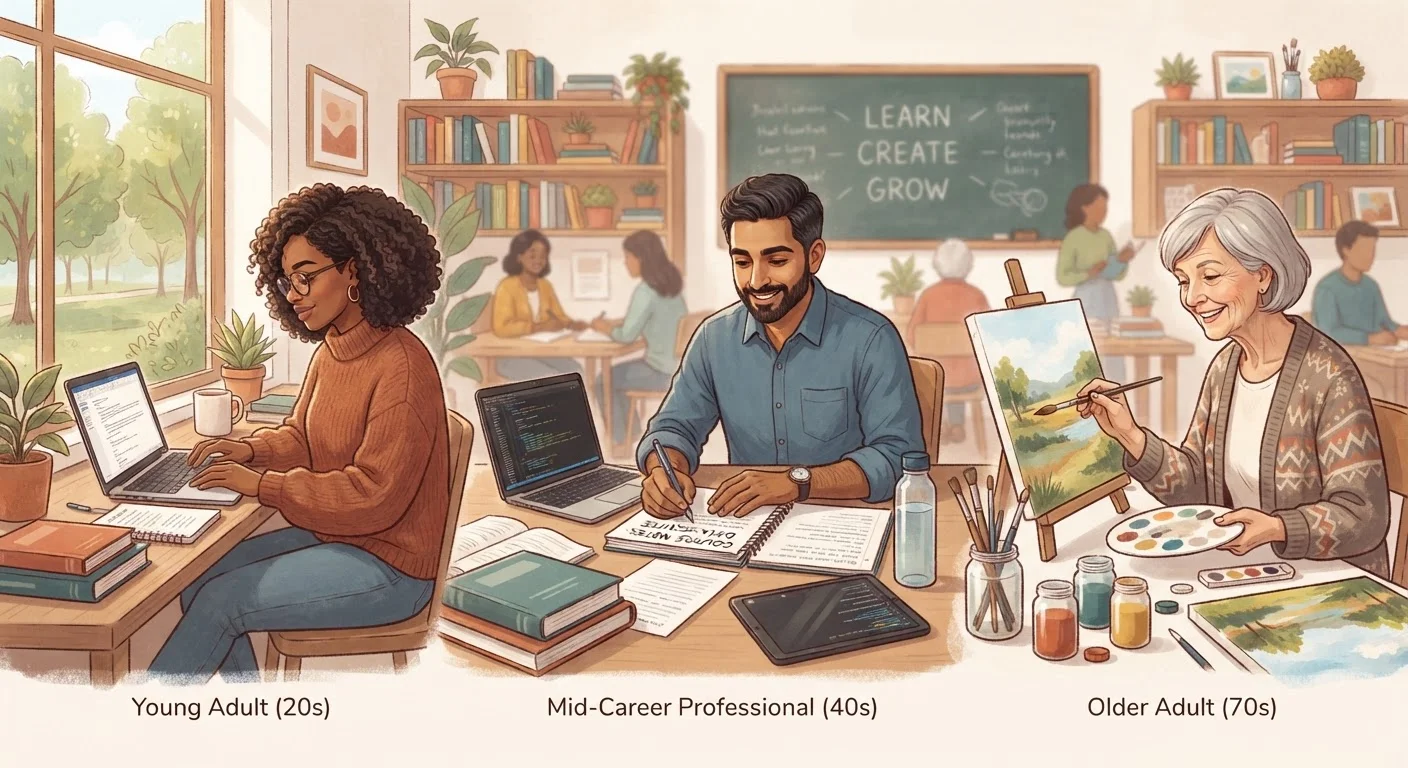
Early Adulthood (18-30): Building the Foundation
Early adulthood offers a rare convergence of neuroplasticity, flexibility, and relatively low obligation. This is typically a strong window for broad exploration - trying disciplines, discovering learning preferences, and accumulating a diverse base of skills that will compound over decades.
What works in this stage
- Deliberate experimentation: Sample widely - language learning, coding, music, physical skills. You are building a mental library that will make future learning faster.
- Structured programs: Formal education, apprenticeships, and bootcamps provide scaffolding when self-direction feels overwhelming. See academic success strategies for new students if you're in school.
- Social learning: Peer study, mentorship, and collaborative projects accelerate feedback loops in ways solo study cannot.
One underestimated advantage at this stage is the tolerance for failure - socially and practically. Use it. Skills often feel clumsy before they feel natural, and early adulthood is a low-stakes environment to be a beginner.
Middle Adulthood (30-50): Learning Around Real Constraints
By the mid-thirties, many adults are navigating career pressures, family responsibilities, and shrinking discretionary time. Broad exploration becomes harder to justify - which actually pushes many learners toward more intentional, efficient skill development.
Strategies for time-constrained learners
- Chunk learning into short sessions: Research on spaced practice suggests that multiple shorter sessions outperform single long ones for retention. Even 20 focused minutes daily compounds significantly.
- Anchor new skills to existing knowledge: Crystallized intelligence is now a genuine asset. Link new concepts to what you already know - this reduces cognitive load and speeds encoding.
- Prioritize transferable skills: Skills with cross-domain application (communication, data literacy, project management) give the highest return on limited time. How one skill accelerates the next explains the mechanism in detail.
Career changers in this stage should also explore online learning options for career changers - flexible digital formats are well-suited to busy schedules.
When time is scarce, ruthlessly protect a single consistent learning slot rather than fitting sessions in ad hoc. Consistency of schedule - even 15-20 minutes - beats volume of time that never materializes.
Habit research shows that environmental cues and fixed timing dramatically reduce the decision fatigue that derails irregular learning routines.
Before starting any new skill, spend 30 minutes mapping what you already know that might relate to it. This 'prior knowledge audit' reveals bridges that make new material stick faster.
Cognitive load theory indicates that connecting new information to existing schemas reduces working memory strain and speeds encoding - a particular advantage for mid-life and older learners with substantial crystallized knowledge.
Later Adulthood (50-65): Pivoting With Purpose
The decade or two before traditional retirement age often brings a meaningful shift in motivation. Career reinvention, encore careers, passion projects, and pre-retirement planning all create new learning demands - and new freedoms. Many adults in this stage report that learning feels more personally meaningful than it did earlier in life.
Leveraging experience as a learning asset
By 50, most adults carry extensive domain knowledge and well-developed metacognitive skills (awareness of how they learn best). These are genuine advantages. Research consistently shows that older adults who connect new learning to prior expertise demonstrate strong retention and application.
- Focus on depth over breadth - mastery of a few meaningful skills typically outserves scattered exploration at this stage.
- Consider mentorship, peer teaching, or community of practice - teaching what you know consolidates your own learning while building professional relationships.
- Physical and cognitive wellness support learning capacity. Maintaining functional movement patterns is one evidence-informed area worth attention, though always consult a healthcare professional for personal guidance.
If progress stalls, understand that plateaus are normal at any age. Strategies for breaking through skill ceilings can help you diagnose and move past them.
Retirement and Beyond (65+): Learning for Life
Retirement removes many of the time constraints that limited earlier stages - and opens the door to learning driven almost entirely by curiosity and meaning. Evidence from cognitive aging research suggests that sustained mental engagement is associated with maintained cognitive function, though individuals should always discuss health-related goals with their own healthcare provider.
Approaches that work well in this stage
- Community-based learning: Lifelong learning institutes (often affiliated with universities), senior centers, and library programs provide structure, social connection, and expert instruction.
- Online and self-paced formats: Online learning platforms offer enormous flexibility - learners can set their own pace without performance pressure.
- Project-based goals: Learning anchored to a tangible goal (writing a memoir, building a garden, learning a grandchild's language) sustains motivation far better than abstract skill-building.
One common barrier is technology anxiety. Starting with brief, guided introductions to digital tools - rather than diving into complex platforms - reduces overwhelm significantly. Many public libraries offer free digital literacy workshops specifically designed for older adults.
Principles That Apply at Every Stage
While strategies must flex with life stage, a core set of principles holds across every phase of adulthood:
- Plan deliberately. Vague intentions rarely produce sustained learning. A concrete plan with defined goals and milestones dramatically improves follow-through. Building a personal learning plan you'll actually follow walks you through a practical framework.
- Adopt a growth mindset. Believing that abilities can be developed - rather than fixed at birth - is consistently associated with greater persistence and achievement. Growth mindset vs. fixed mindset examines what the research actually supports.
- Manage the cost of learning intentionally. Time and money invested in skill-building are real resources. For guidance on spending wisely across learning investments, smart spending principles offer a useful complement to your learning strategy.
- Build a vocabulary for your own learning. Understanding terms like spaced repetition, interleaving, and metacognition helps you make sharper decisions about method. A practical glossary of skill-building concepts is a handy reference.
The thread running through every stage is this: learning is not a phase of life - it is a continuous, adaptable practice. The tools and tactics shift; the underlying capacity to grow does not disappear.