

Key Takeaways
Transferable Skills
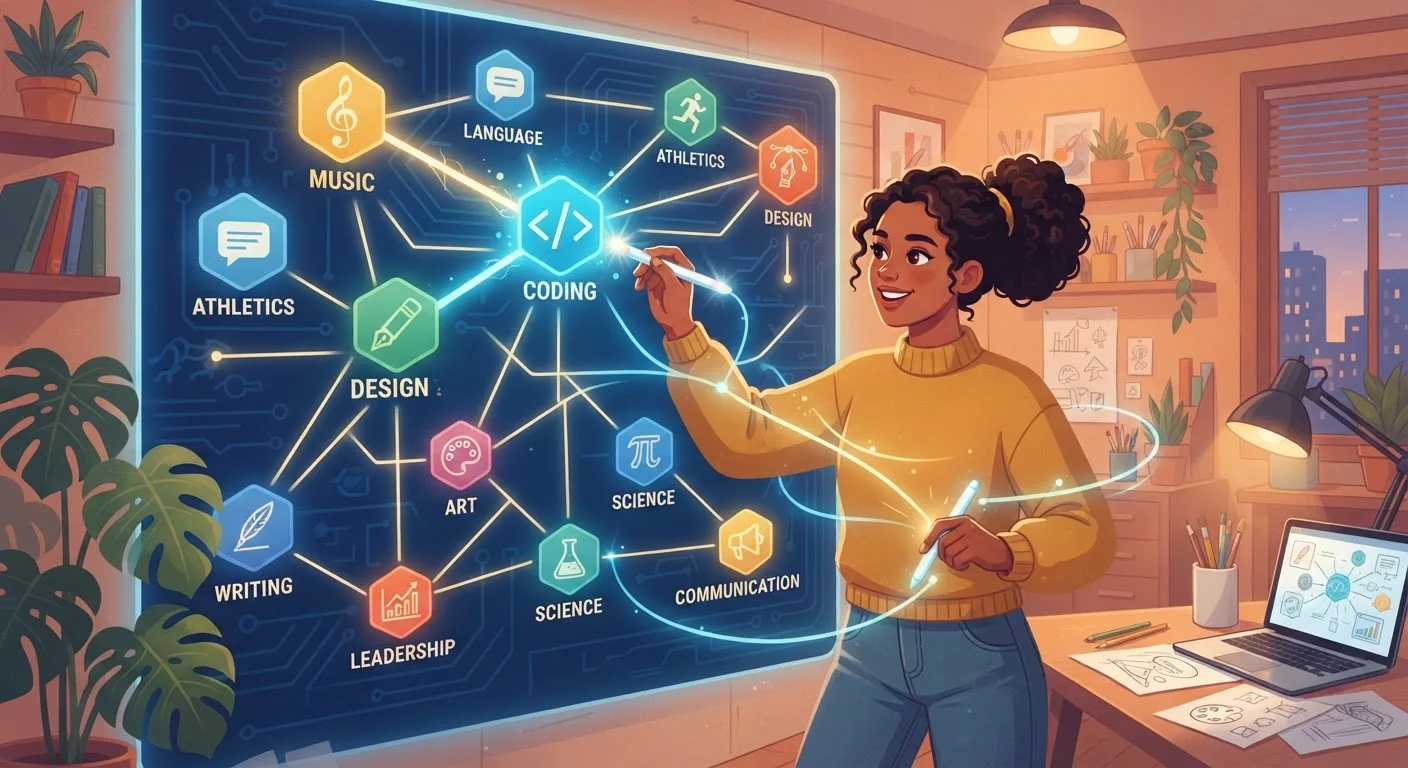
Transferable skills are abilities, habits, or mental frameworks learned in one context that can be applied - with less effort - in a new, different context. They work because many skills share underlying cognitive structures, even when the surface content looks completely different. Recognizing these shared patterns allows learners to build new competencies faster by consciously drawing on what they already know.
Learning scientists refer to this phenomenon as "transfer of learning," distinguishing between near transfer (applying skills in closely related domains) and far transfer (applying skills across very different domains). Far transfer is harder to achieve but produces the greatest acceleration.
Why Prior Learning Isn't Starting Over
When adults approach a new skill, many assume they are starting from zero. Learning science suggests otherwise. Every domain you have already invested time in leaves behind mental residue - habits of attention, tolerance for confusion, error-checking instincts, and structural schemas - that shape how quickly new material takes hold.
This is the core idea behind transfer of learning: knowledge and skill acquired in one area can ease the acquisition of knowledge in another. The effect isn't accidental. It depends on whether the two domains share underlying features, and whether the learner consciously activates the connection.
For a deeper look at the cognitive mechanisms that drive this process, see what research says about learning faster.
~40%
Faster learning in related skill domains
Educational psychology research consistently finds that learners with relevant prior knowledge acquire new related skills substantially faster than novices starting without any background.
3x
Retention boost from elaborative practice
Studies on elaborative interrogation - asking "why" and making connections to existing knowledge - show meaningfully stronger long-term retention compared to passive re-reading or simple repetition.
65%
Adults reporting skills from past jobs as useful in new roles
A Pew Research Center survey on workforce transitions found that the majority of adults who changed careers identified prior job skills as directly applicable in their new field.
Near Transfer vs. Far Transfer: A Crucial Distinction
Not all transfer is equal. Near transfer occurs when skills move between closely related domains - a spreadsheet user learning a new data-analysis tool, for instance. The surface features overlap enough that the learner immediately recognizes familiar patterns. Far transfer occurs across seemingly unrelated domains, such as a trained musician applying rhythmic pattern recognition to learning a programming language's syntax structure.
Far transfer is more cognitively demanding because the surface differences are large, even when the underlying structure is shared. Achieving it requires deliberate effort: the learner must explicitly ask, "What does this new skill have in common with something I already know?"
Understanding these distinctions is part of the broader vocabulary of skill development. Our practical glossary of skill-building concepts covers terms like metacognition and schema that are directly relevant here.
What Actually Transfers (and What Doesn't)
Three categories of skill tend to transfer most reliably across domains:
- Practice habits: Deliberate, structured practice routines - breaking a skill into sub-components, using spaced repetition, reviewing errors systematically - transfer directly. A musician who already knows how to isolate difficult passages and loop them will apply the same strategy to learning a new language's pronunciation.
- Mental models and frameworks: Abstract representations of how a system works migrate powerfully. A chess player's grasp of positional trade-offs transfers to business strategy reasoning; a writer's understanding of narrative arc transfers to structuring a presentation.
- Metacognitive skills: Knowing how you learn - recognizing when you're confused, adjusting your approach, self-testing rather than re-reading - transfers universally. These skills are sometimes called "learning to learn."
What transfers poorly: highly specific procedural knowledge tied to a single tool, domain-specific jargon with no conceptual equivalent elsewhere, and rote memorization of isolated facts without underlying structure.
If you're wondering whether your learning approach is actually effective before starting something new, the pre-learning checklist is a useful place to begin.
How to Leverage Transfer Intentionally
Transfer rarely happens automatically - it benefits from deliberate activation. Here are four concrete strategies:
- Conduct a skills audit before you begin. Before starting a new skill, list what you already know that might be structurally related. Ask yourself: Have I done anything that required similar pattern recognition? Similar self-correction loops? Similar sustained attention?
- Build bridges explicitly. When you encounter a new concept, pause and articulate its analogy to something familiar. Writing this down - even briefly - strengthens the cognitive link.
- Use varied practice contexts. Practicing a skill in multiple contexts (not just one setting or method) strengthens abstract understanding, which is the part most likely to transfer later.
- Reflect on process, not just outcome. After a practice session, note what strategies worked and why - not just whether you succeeded. This builds metacognitive awareness that generalizes across domains.
These strategies apply whether you are a student, a career-changer, or a lifelong learner. For a grounded guide to what the early stages of adult skill learning actually feel like, see starting a new skill as an adult.
Make the Connection Explicit Before You Begin
Before your first session with a new skill, spend five minutes writing down two or three things you already know that might be structurally related to it. This simple pre-learning step - sometimes called "activating prior knowledge" - primes your brain to notice relevant patterns as they appear, rather than treating everything as unfamiliar. It's one of the lowest-effort, highest-return habits in any learner's toolkit.
Transfer Across Life Stages
The capacity for transfer doesn't diminish sharply with age - what shifts is the volume and variety of prior experience available to draw on. Older learners often have richer schema libraries, meaning more potential connection points for new material. The challenge is that experienced adults may also be more prone to interference - where old habits conflict with new requirements.
Being aware of this trade-off is itself an advantage. When a well-established habit doesn't apply cleanly to a new domain, labeling it explicitly («this is where my old approach breaks down») prevents interference and accelerates recalibration.
For a broader view of how learning strategy should adapt across adulthood, skill building across every life stage offers stage-by-stage guidance. And if you've ever wondered whether a plateau in one skill area might be affecting your progress in another, strategies that break through skill ceilings addresses that directly.