

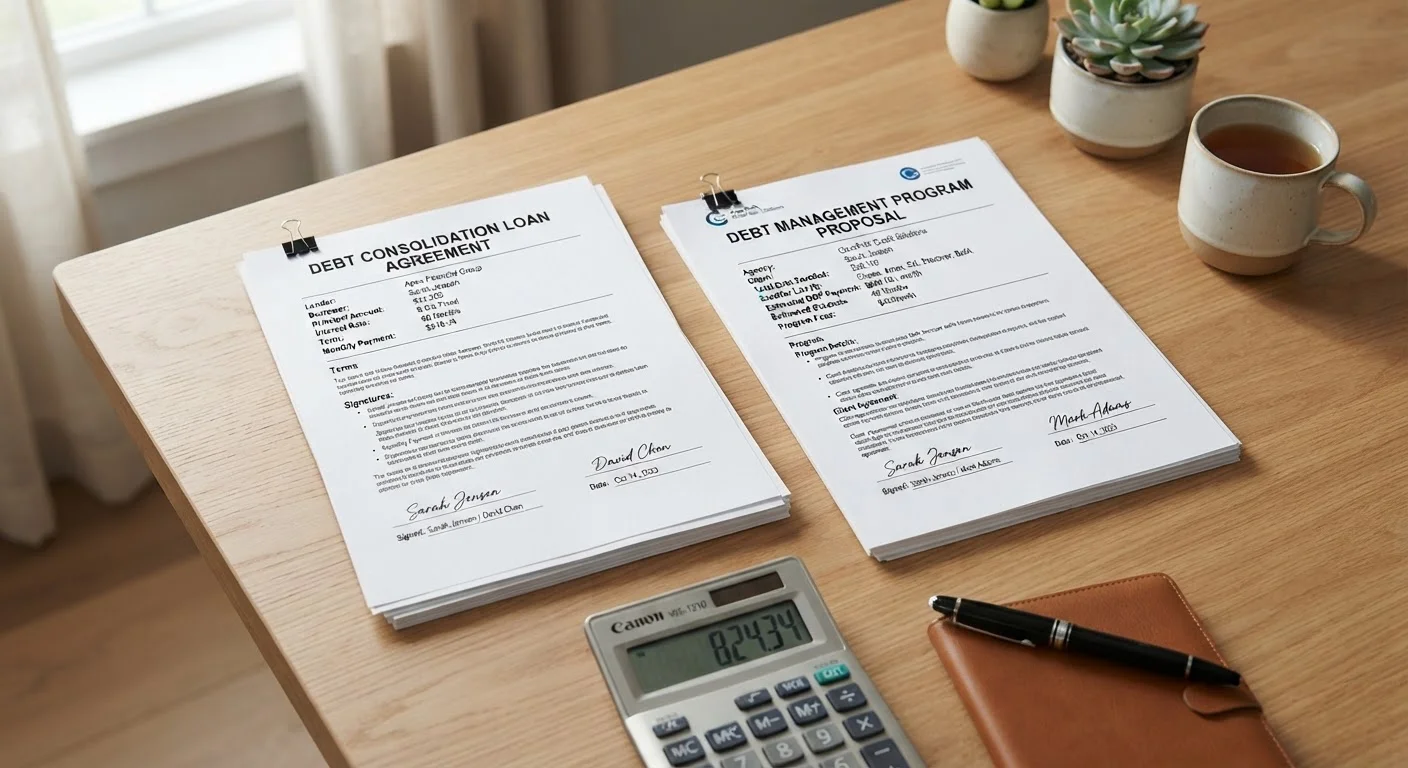
Key Takeaways
Option A
Debt Consolidation
The lump-sum loan approach to simplifying multiple debts.
Best for: Borrowers with a solid enough credit profile to qualify for a lower-interest personal loan or balance transfer.
Option B
Debt Management Plan (DMP)
The structured, counselor-guided repayment program.
Best for: People who need negotiated interest rates and accountability but do not qualify for favorable new credit.
If you have good credit and want full control over repayment
Debt Consolidation
A personal loan or balance-transfer option may offer competitive interest rates and no third-party involvement, giving you flexibility to manage the loan on your own terms.
If your credit score is too low to qualify for favorable loan terms
Debt Management Plan (DMP)
Nonprofit credit counseling agencies can often negotiate reduced interest rates directly with creditors, making repayment more manageable without requiring new creditworthiness.
If you struggle with consistency and want built-in accountability
Debt Management Plan (DMP)
DMPs route a single monthly payment through a counseling agency that distributes funds to creditors, creating a structured process that limits the chance of missed payments.
If you want to preserve flexibility for emergency savings alongside repayment
Debt Consolidation
A consolidation loan is a straightforward creditor relationship, so any extra cash you free up can be directed toward an emergency fund without agency restrictions.
If you carry mostly high-interest credit card balances and cannot qualify for new credit
Debt Management Plan (DMP)
Agencies frequently secure reduced APRs from card issuers - sometimes significantly lower than what a borrower could negotiate alone - which reduces total interest paid over the plan's life.
How Each Approach Is Structured
Debt consolidation and debt management plans (DMPs) are often mentioned in the same breath, but they work through fundamentally different mechanisms. Understanding those differences is the first step toward choosing the right path. If some of the terminology here is unfamiliar, our plain-language debt term reference covers key concepts like APR and amortization.
Debt Consolidation: A New Loan Replaces Old Ones
With debt consolidation, you apply for a new financial product - most commonly a personal loan or a balance-transfer credit card - and use it to pay off multiple existing balances. You then owe a single creditor, ideally at a lower interest rate than the average you were paying before. The debt itself does not shrink; it is reorganized. You remain in a direct lending relationship, make payments to the new lender, and the original accounts are closed or paid off in full.
Debt Management Plans: Restructuring Without New Credit
A DMP is a service offered by nonprofit credit counseling agencies. Rather than lending you money, the agency negotiates with your creditors on your behalf - often securing reduced interest rates or waived fees. You make one monthly payment to the agency, which then distributes funds to each creditor according to the negotiated schedule. Your existing loan accounts remain in place; you are simply repaying them through a managed intermediary. Enrollment typically requires a formal counseling session and a modest monthly administration fee.
| Criterion | Debt Consolidation | Debt Management Plan (DMP) |
|---|---|---|
| Mechanism | New loan pays off old debts | Agency negotiates and distributes payments |
| Credit requirement | Good-to-fair credit typically needed | Available regardless of credit score |
| Who you pay | Your new lender directly | Nonprofit agency (then to creditors) |
| Interest rate reduction | Depends on loan rate you qualify for | Negotiated by agency, often significant |
| Typical timeline | 2-7 years (loan term) | 3-5 years (structured plan) |
| Fees | Origination fee + interest on loan | Small monthly admin fee (regulated) |
| Credit card use during repayment | Original accounts paid off; new card use possible | Enrolled cards frozen or closed |
| Flexibility | High - manage loan independently | Lower - structured agency oversight |
Eligibility, Credit Impact, and Costs
The two approaches differ sharply in who can access them and what they cost over time.
Eligibility
Debt consolidation requires qualifying for new credit. Lenders assess your credit score, income, and existing debt load. Borrowers with damaged credit may face high interest rates that negate the benefit - or may be denied outright. DMPs, by contrast, are generally available regardless of credit score because no new lending is involved. A nonprofit counselor reviews your budget and income, but creditworthiness is not the deciding factor.
Credit Score Effects
Both routes can temporarily lower your credit score. Consolidation involves a hard inquiry and may reduce the average age of your accounts. DMPs typically require you to stop using enrolled credit cards, which reduces available credit and raises your utilization ratio. Neither impact is permanent, and consistent on-time payments under either structure tend to improve scores over time.
Costs
Consolidation costs are embedded in the loan's interest rate and any origination fees. A DMP charges a small monthly administration fee - regulated by state law for nonprofit agencies - plus potential setup fees. Over a multi-year repayment window, the negotiated interest-rate reductions a DMP secures can offset those fees significantly. Always calculate the total cost of repayment under each scenario, not just the monthly payment amount.
Verify the Agency Is Truly Nonprofit
Not all credit counseling agencies operate with the same standards. Look for agencies accredited by the National Foundation for Credit Counseling (NFCC) or the Financial Counseling Association of America (FCAA). These organizations hold member agencies to defined service and fee standards. Avoid any agency that guarantees results, charges large upfront fees, or pressures you to enroll before reviewing your budget in full.
Balancing Debt Repayment With an Emergency Fund
Whichever route you choose, the question of whether to save simultaneously is a real one. Carrying high-interest debt while holding cash in savings can feel contradictory, but most financial educators recommend maintaining at least a small emergency buffer - often suggested as one month of essential expenses - even while aggressively paying down debt. Without it, a single unexpected expense can force you back into high-cost borrowing. Our comparison of savings accounts versus paying off low-interest debt explores the math behind this trade-off in more depth.
Under a DMP, your monthly payment is fixed and managed by the agency, which can make budgeting for savings more predictable. With a consolidation loan, you have more flexibility - any gap between the loan payment and your previous combined minimums can be redirected toward a small emergency fund. Either way, building that cushion alongside repayment reduces the risk that your debt payoff plan gets derailed by life's unpredictability. See our article on warning signs your repayment plan is off track for patterns that stall progress before they compound.
It is also worth reviewing common assumptions about how debt repayment works. Our piece on debt payoff myths addresses misconceptions that can lead people to choose the wrong strategy or underestimate their progress. And for practical tactics once your structure is in place, strategies that move the needle on credit card debt covers targeted payment approaches worth considering alongside either route.
This article is for general informational and educational purposes only and does not constitute personalized financial, legal, or tax advice. Consult a qualified financial professional before making decisions about debt repayment strategies specific to your situation.