

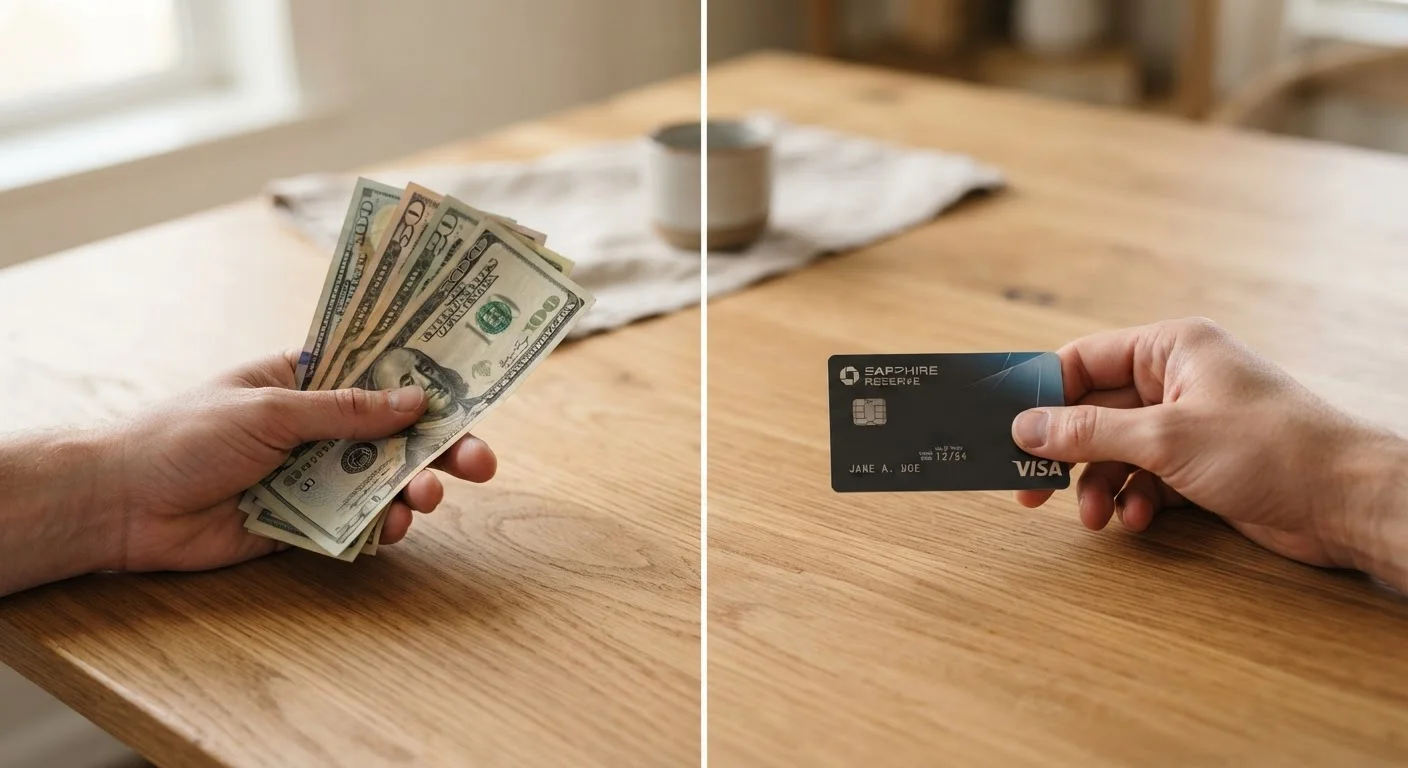
Key Takeaways
Option A
Paying with Cash
The straightforward, spend-what-you-have approach.
Best for: Shoppers who want to eliminate interest costs and keep spending viscerally tied to available funds.
Option B
Using Credit
The flexible, rewards-eligible approach - with strings attached.
Best for: Financially disciplined buyers who pay balances in full and want to build credit history or earn rewards.
If you tend to carry a balance month to month
Paying with Cash
Interest charges on carried balances - often 20% APR or higher - can dramatically inflate the real price of purchases. Paying cash removes that risk entirely.
If you reliably pay your full statement balance each month
Using Credit
You avoid interest while gaining purchase protections, fraud liability limits, and potential rewards - making credit a net positive for disciplined users.
If you're working to build or repair your credit score
Using Credit
Responsible credit use - low utilization, on-time payments - is one of the most reliable ways to establish a positive credit history over time.
If you're on a tight budget and prone to overspending
Paying with Cash
Research consistently shows that paying with physical money creates a stronger psychological connection to spending, which can help curb impulse purchases.
Why This Decision Is About More Than Convenience
At checkout, swiping a card and handing over bills feel identical. But the financial consequences of that choice ripple forward in ways most people don't fully account for - affecting your interest costs, credit profile, consumer protections, and even your spending psychology.
This isn't a simple "cash good, credit bad" or vice versa conversation. The real cost of each method depends on how you use it. What follows is an honest, side-by-side breakdown to help you understand what you're actually choosing. For a look at how these dynamics play out with a major purchase, see our article on how financing terms shape what a car actually costs you.
| Criterion | Paying with Cash | Using Credit |
|---|---|---|
| Interest cost | None | Zero if paid in full; high if balance carried |
| Fraud protection | None - lost cash is gone | Strong federal protections on most cards |
| Purchase dispute rights | Limited; depends on merchant | Chargeback rights under federal law |
| Credit score impact | None - no history built | Positive if used responsibly |
| Rewards earned | None | Cash back or points (card-dependent) |
| Overspending risk | Low - limited to available funds | Higher - spending feels less concrete |
| Security risk | Physical theft risk for large amounts | Card number theft possible; liability limited |
The Real Cost of Cash
Paying cash means spending money you already have. That eliminates one significant cost immediately: interest. You will never pay 22% APR on a grocery run if you paid with a $20 bill.
But cash has its own hidden costs. It offers no fraud protection - lost or stolen cash is simply gone. It earns no rewards, builds no credit history, and leaves no purchase record to dispute if an item is defective or never delivered. For large purchases, carrying cash also introduces security risk.
There's also an opportunity cost angle worth understanding: money sitting in a low-yield checking account specifically to fund cash purchases isn't working as hard as it could elsewhere. That said, this consideration is minor for everyday spending and shouldn't drive decisions on its own. Our guide to hidden costs buyers routinely overlook explores this idea further.
One genuine strength of cash: psychological friction. Studies in consumer behavior consistently find that people spend less when using physical money versus cards, because handing over bills makes the transaction feel more real.
The Real Cost of Credit
Credit is a tool - and like most tools, the outcome depends almost entirely on how you use it.
If you pay your full statement balance each month: you pay zero interest. You may earn rewards (cash back, travel points) and you benefit from federal consumer protections - including the right to dispute charges for goods or services not delivered as promised. You're also building credit history, which affects your ability to secure loans, rent housing, and in some cases pass employment checks.
If you carry a balance: the picture changes dramatically. Most credit cards carry high annual percentage rates (APRs). Carrying even a modest balance month over month means the purchase price compounds quickly. A $500 balance at 22% APR, with only minimum payments made, can take years to pay off and cost significantly more than the original purchase.
~20-29%
Typical credit card APR range
According to the Federal Reserve, average credit card interest rates have climbed significantly in recent years, making carried balances increasingly costly.
~50%
US cardholders who carry a balance
The Consumer Financial Protection Bureau (CFPB) has reported that roughly half of credit card users carry a balance from month to month, incurring interest charges.
$50
Maximum liability for fraudulent card charges
Under the Fair Credit Billing Act, cardholders are protected from unauthorized charges above $50 - and many issuers offer zero-liability policies beyond that.
It's also worth noting that credit card rewards are only genuinely valuable if you're not paying interest to earn them. Rewards programs are designed to be profitable for issuers - understanding this helps you use them on your terms rather than theirs. For a deeper look at managing the debt side of this equation, see our piece on paying off debt early.
Credit Scores: The Long-Term Dimension Most Cash Users Miss
One cost of never using credit is often invisible: a thin or nonexistent credit file. Your credit score - calculated from payment history, credit utilization, account age, and other factors - influences the interest rate you qualify for on a mortgage or auto loan, and whether a landlord will rent to you.
Cash users who avoid credit entirely may find themselves in a catch-22 when they need financing: no credit history means lenders have no data to judge, which can mean higher rates or outright denial. Building credit responsibly - using a card for routine purchases and paying the balance in full - is one of the most practical ways to establish a score without incurring debt. You can learn more about how this plays out with vehicle purchases in our overview of car ownership costs.
Credit Utilization and Your Score
Credit utilization - the percentage of your available credit limit you're using - is one of the most influential factors in most credit scoring models. Keeping utilization below 30% of your total limit is a widely cited general guideline. For example, if your credit limit is $1,000, carrying a balance above $300 may begin to negatively affect your score. Paying in full each month keeps utilization low and typically supports a healthy score.
If you're weighing a cash-only lifestyle more broadly, our article on the case for and against cash-only spending offers a balanced look at the trade-offs.
This article is for general informational purposes only and does not constitute personalized financial advice. Consult a qualified financial professional regarding decisions specific to your situation.