

Key Takeaways
Option A
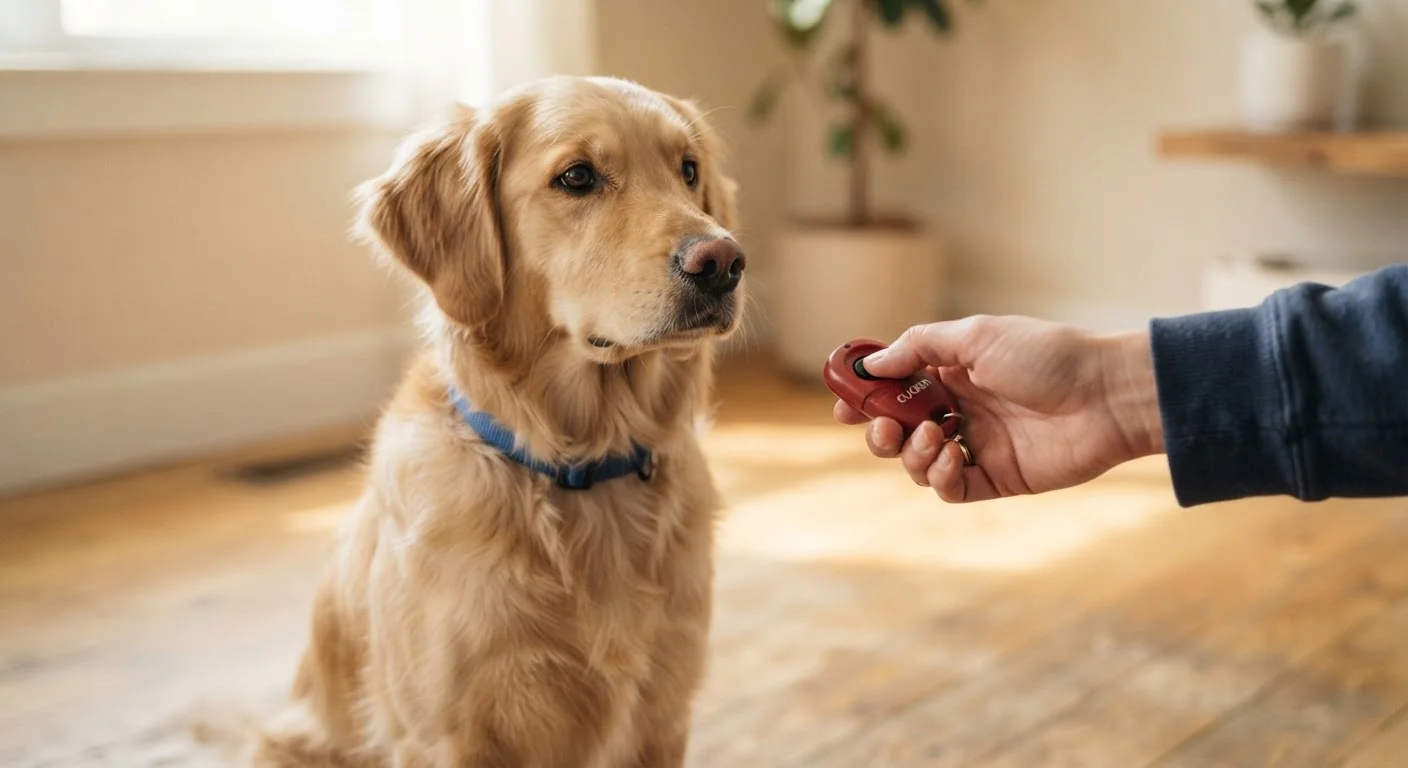
Clicker Training
The precise, consistent mechanical marker.
Best for: Owners who want an ultra-clear, standardized signal that sounds identical every single repetition.
Option B
Verbal Markers
The hands-free, always-available cue word.
Best for: Owners who want a built-in marker they can use anywhere without carrying equipment.
If you want maximum precision for shaping complex or subtle behaviors
Clicker Training
The clicker's sharp, unique tone is easier to deliver at an exact millisecond, reducing ambiguity when capturing a precise body position or micro-movement.
If your hands are often occupied or you train in unpredictable environments
Verbal Markers
A spoken cue like 'yes' requires no equipment and is never left at home, making it far more practical for real-world situations like leash walks or group classes.
If your pet is noise-sensitive or startles easily
Verbal Markers
Some dogs and cats are momentarily unsettled by the click's sharp sound; a calm, consistent voice cue avoids this friction during early training.
If you're working with a hearing-impaired pet
Clicker Training
A clicker can be paired with a tactile signal (such as a light touch) or a visual flash device, making it more adaptable than voice alone for deaf animals.
What Makes a Marker Signal Work
A marker - whether a click or a spoken word - functions as a bridge between the exact moment your pet performs the desired behavior and the reward that follows. Through repetition, the neutral signal becomes meaningful: the pet learns that the marker predicts something good is coming. This process is called classical conditioning, and it underpins both tools equally.
The critical variable isn't which marker you use - it's timing. The signal must land within roughly one second of the target behavior to communicate clearly. Late or inconsistent marking teaches the pet to guess, which slows learning. For a deeper look at why this matters, see the science behind positive reinforcement.
Both markers must be conditioned before they carry meaning. In early sessions, you pair the sound with a treat repeatedly - click, treat, click, treat - until the pet visibly anticipates the reward upon hearing the signal. Only then does the marker become a genuine communication tool.
Clicker Training: Strengths and Limitations
The clicker's main advantage is acoustic consistency. Every click sounds identical, regardless of your mood, vocal tone, or energy level. This removes a variable that can otherwise muddy communication - a word said with excitement sounds different from the same word said while distracted, and pets notice.
Clickers are especially useful when shaping behaviors that require pinpoint accuracy: capturing a precise head position, a single paw lift, or a duration sit. The sharp, distinct sound is also harder for the pet to confuse with ambient conversation, giving it a signal-to-noise advantage in noisy households.
The trade-offs are real, though. You need a free hand. The device can be dropped, forgotten, or unavailable during spontaneous training moments. And for noise-sensitive animals - particularly cats or anxious dogs - the click's abruptness can cause a flinch or momentary disengagement, requiring a gradual desensitization process before training can proceed normally.
| Criterion | Clicker Training | Verbal Markers |
|---|---|---|
| Signal consistency | Identical every time | Varies with voice and mood |
| Convenience | Requires carrying a device | Always available, no equipment |
| Timing precision | Mechanical - easy to be exact | Depends on verbal reflexes |
| Noise sensitivity risk | Can startle sensitive pets | Generally lower risk |
| Adaptability for deaf pets | Pairable with visual/tactile cues | Limited without hearing |
| Learning curve for owner | Moderate - coordination needed | Low - familiar tool (voice) |
| Tonal flexibility | Single-sound only | Multiple words possible |
Verbal Markers: Strengths and Limitations
A verbal marker - commonly a short, sharp word like "yes" or "good" - is always with you. There's nothing to carry, charge, or drop. This convenience compounds over time: you can reinforce good behavior during a walk, at the vet, or mid-play without pausing to reach for a tool.
Verbal markers also allow for tonal nuance. Trainers sometimes use a calm, drawn-out "goooood" to mark duration behaviors (like a sustained stay) and a crisp "yes" to mark the end of a behavior. This flexibility isn't available with a single-function clicker.
The limitation is human inconsistency. Our voices shift based on emotion, fatigue, and context. If your "yes" sounds different on a frustrated day versus an enthusiastic one, your pet receives an inconsistent signal. Deliberate practice - delivering the marker word with the same tone and volume each time - is necessary to compensate. For practical guidance on building consistent habits into your sessions, see training session principles that make learning stick.
Choosing the Right Marker - or Using Both
Neither marker is objectively superior. The right choice depends on your pet's temperament, your daily routine, and the behaviors you're working on. A few practical guidelines can help you decide:
- Start with a verbal marker if you're a first-time trainer - one less piece of equipment simplifies early sessions.
- Switch to or add a clicker if you're working on precise shaping tasks, such as teaching a complex trick or a tight heel position.
- Observe your pet's reaction in the first session. If a dog perks up and orients toward you at the click, it's working. Flat or anxious responses are worth noting.
- Use both strategically - some trainers use a clicker for new skill acquisition and a verbal marker for maintaining known behaviors in real-world settings.
If you're unsure about which format of training to pursue overall, it's worth reading about group classes versus private sessions versus self-guided training - your training environment can also influence which marker is most practical.
One common pitfall: confusing a recall failure with a marker issue. If your dog isn't coming back to you reliably, the marker signal itself is rarely the culprit. See why recall keeps failing and the habits that undermine it for a closer look at that specific problem.
The Marker Is Not the Reward
A common early mistake is assuming the click or word itself is the motivator. The marker only works because it reliably predicts a reward - food, play, or praise. If reinforcement delivery becomes inconsistent or delayed, the marker loses its power over time. Always follow your marker with the promised reward, especially during the conditioning phase.