

Key Takeaways
Group classes build real-world distraction tolerance
Practicing commands around other dogs and handlers helps dogs generalize their skills beyond the quiet of your living room, which is often where training breaks down in everyday life.
Peer learning benefits owners significantly
Watching other handlers work through the same challenges - and hearing a trainer's feedback on multiple dogs - gives owners a richer understanding of timing and technique than instruction alone.
Group classes are typically the most affordable format
The per-session cost is shared across participants, making structured professional guidance accessible to owners on tighter budgets.
Private sessions are fully tailored to your dog's needs
A trainer can observe your dog in their actual environment, address specific problem behaviors, and adjust the plan in real time based on what they see rather than a generic curriculum.
Self-guided training offers maximum scheduling flexibility
Owners can train at whatever time of day works for their dog's energy levels and their own schedule, without coordinating with a trainer or commuting to a facility.
Combining formats accelerates and reinforces learning
Using private sessions for foundational skills and group classes for generalization creates a more complete training experience than any single format can provide on its own.
Group classes can overwhelm reactive or fearful dogs
A dog who is already anxious or reactive around other animals may find a group setting too stimulating to learn effectively, and pushing them into that environment prematurely can worsen the behavior.
Instructors can't address every individual dog's needs
Group class pacing is set for the average participant; dogs who need slower introductions or different reinforcement strategies may fall behind or develop frustration.
Private sessions carry significantly higher cost
One-on-one professional time is expensive, and complex behavioral cases often require multiple sessions, making the total investment substantial for many households.
Self-guided training lacks real-time feedback
Without a professional to observe your mechanics, errors in timing or criteria can compound undetected for days, potentially teaching the dog the wrong association.
Self-guided formats require high owner motivation and discipline
Without scheduled appointments creating external accountability, many owners train inconsistently, which undermines the repetition dogs need to solidify new behaviors.
No format compensates for inconsistency between sessions
Even the best trainer or resource cannot produce lasting results if the dog receives conflicting signals or unintentional reinforcement of unwanted behaviors the rest of the week.
Our Verdict
All three training formats can produce real results when matched thoughtfully to the dog and owner involved. Group classes build social confidence and teach owners alongside peers; private sessions deliver targeted, flexible support; and self-guided training works well for motivated owners with relatively easy-going dogs. Most owners will benefit from a mix rather than committing exclusively to one format.
Owners who take time to honestly assess their dog's temperament, their own schedule, and their specific training goals before choosing a format - rather than defaulting to the most convenient or least expensive option.
Why Format Matters as Much as Method
When people think about dog training, they focus on technique - rewards versus corrections, luring versus shaping. But the format in which training happens shapes outcomes just as much. A perfectly sound technique delivered in the wrong setting can stall progress, frustrate the owner, and confuse the dog.
The three main formats available to most US dog owners are group classes, private sessions with a professional trainer, and self-guided training using books, videos, or apps. Each has a different structure, cost profile, and learning environment. Before signing up or downloading a curriculum, it's worth understanding what each format actually demands - from you and from your dog. See our readiness checklist for new owners to confirm you have the right tools and mindset in place before your first session.
Group Classes: Social Learning With Real Trade-Offs
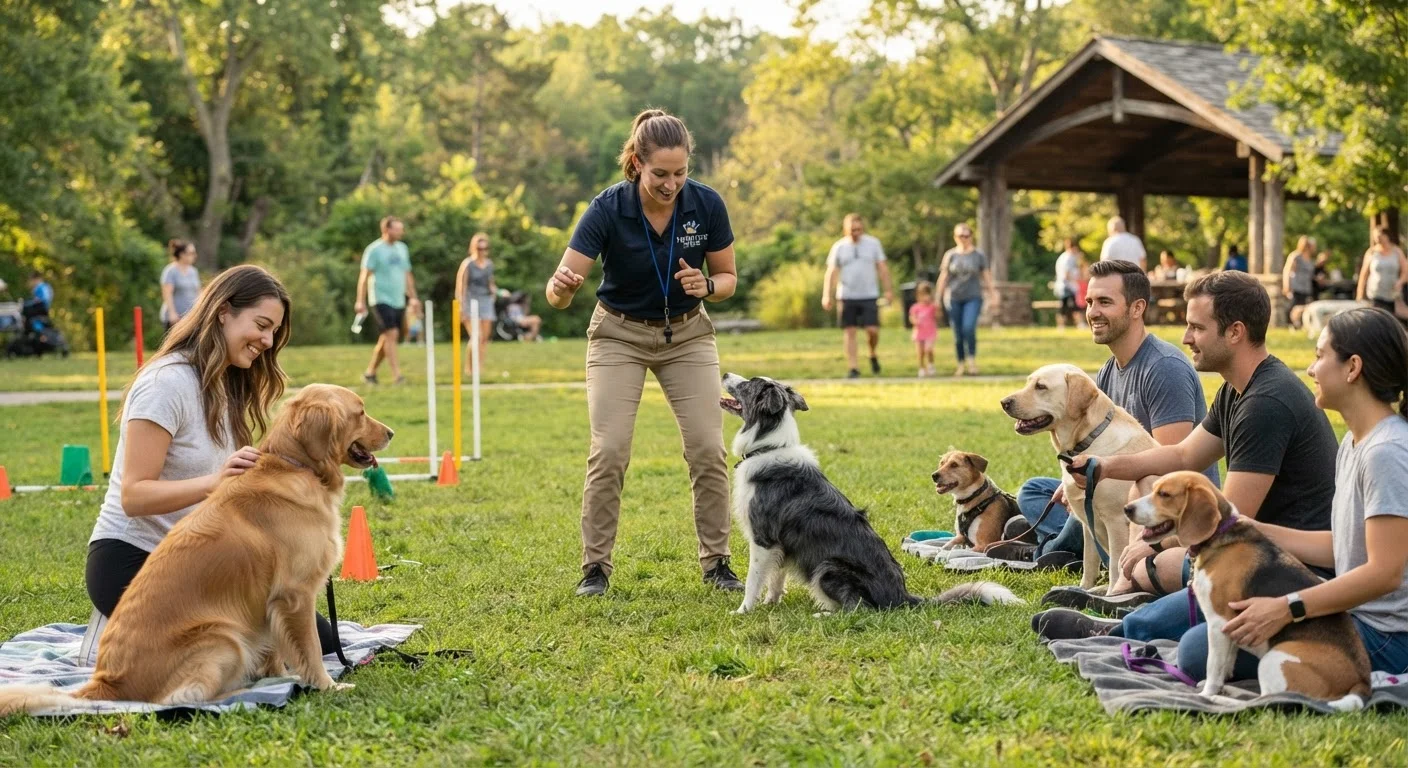
Group obedience classes - typically held at training facilities, pet supply stores, or parks - place your dog alongside several other dogs while a trainer guides the whole class through exercises. This format has genuine advantages, but it isn't right for every dog.
Group classes build real-world distraction tolerance
Practicing commands around other dogs and handlers helps dogs generalize their skills beyond the quiet of your living room, which is often where training breaks down in everyday life.
Peer learning benefits owners significantly
Watching other handlers work through the same challenges - and hearing a trainer's feedback on multiple dogs - gives owners a richer understanding of timing and technique than instruction alone.
Group classes are typically the most affordable format
The per-session cost is shared across participants, making structured professional guidance accessible to owners on tighter budgets.
Private sessions are fully tailored to your dog's needs
A trainer can observe your dog in their actual environment, address specific problem behaviors, and adjust the plan in real time based on what they see rather than a generic curriculum.
Self-guided training offers maximum scheduling flexibility
Owners can train at whatever time of day works for their dog's energy levels and their own schedule, without coordinating with a trainer or commuting to a facility.
Combining formats accelerates and reinforces learning
Using private sessions for foundational skills and group classes for generalization creates a more complete training experience than any single format can provide on its own.
The biggest asset of group classes is built-in distraction. Dogs trained only at home often struggle to perform reliably in the real world because they haven't practiced around movement, noise, and other animals. Group classes replicate that real-world complexity from the start. There's also a social benefit for owners: watching other handlers make and correct mistakes in real time is a powerful learning tool.
The limitation is equally important to understand. Instructors in a group setting must pace the class for the average participant. If your dog is reactive to other dogs, anxious around strangers, or needs a slower introduction to any given skill, a group environment can be actively counterproductive - and sometimes unsafe for other attendees.
Group classes can overwhelm reactive or fearful dogs
A dog who is already anxious or reactive around other animals may find a group setting too stimulating to learn effectively, and pushing them into that environment prematurely can worsen the behavior.
Instructors can't address every individual dog's needs
Group class pacing is set for the average participant; dogs who need slower introductions or different reinforcement strategies may fall behind or develop frustration.
Private sessions carry significantly higher cost
One-on-one professional time is expensive, and complex behavioral cases often require multiple sessions, making the total investment substantial for many households.
Self-guided training lacks real-time feedback
Without a professional to observe your mechanics, errors in timing or criteria can compound undetected for days, potentially teaching the dog the wrong association.
Self-guided formats require high owner motivation and discipline
Without scheduled appointments creating external accountability, many owners train inconsistently, which undermines the repetition dogs need to solidify new behaviors.
No format compensates for inconsistency between sessions
Even the best trainer or resource cannot produce lasting results if the dog receives conflicting signals or unintentional reinforcement of unwanted behaviors the rest of the week.
Group classes tend to work best for sociable, relatively confident dogs and owners who benefit from structured accountability. If your dog pulls hard, barks persistently at other dogs, or has a known bite history, start with private sessions first.
Private Sessions: Personalized but at a Price
One-on-one sessions with a qualified trainer - conducted in your home, yard, or a neutral location - allow the training plan to revolve entirely around your dog's specific needs and your household's real-life context. This is the most flexible format, and often the most effective for addressing specific problems.
A skilled trainer can observe exactly how your dog behaves in the environments where problems actually occur, rather than in a controlled facility. They can adjust timing, criteria, and reinforcement rate on the fly based on what they see. For dogs with fear-based behavior, resource guarding, or reactivity, this tailored approach is often the only format that produces meaningful progress. For guidance on making each session count, see principles for effective practice.
The primary barrier is cost. Private sessions are significantly more expensive per hour than group classes, and the total investment can add up quickly for complex cases requiring multiple sessions. Progress also depends heavily on whether owners practice consistently between appointments - a trainer who visits once a week cannot compensate for six days of unintentional reinforcement of unwanted behaviors.
Self-Guided Training: Flexible but Demanding
Self-guided training - using books, video courses, podcasts, or structured app-based programs - puts the owner fully in the driver's seat. There are no scheduled appointments, no commutes, and no per-session fees. For owners with strong intrinsic motivation and dogs without significant behavioral challenges, it can be genuinely effective.
Self-Guided Training Works Best With a Strong Foundation
Self-directed programs are most productive when owners already understand the basics of positive reinforcement - what counts as a reward, how timing affects learning, and how to break a behavior into small steps. If those concepts are new to you, consider at least one session with a professional before going fully independent. Video content can demonstrate technique, but it cannot watch you practice and correct what you're doing in the moment.
The core challenge is feedback. When something isn't working in a group class or private session, a professional can identify the cause. When training at home alone, most owners can't reliably tell whether their timing is off, their criteria are too high, or their dog needs a different reinforcement strategy. Errors can compound over days before an owner realizes training has gone sideways. Self-guided training is most effective when reinforcement signals are well understood and owners are willing to read critically rather than just follow instructions on autopilot.
Self-guided formats pair well with the earlier stages of basic skills - sit, down, name recognition, loose-leash walking foundations - but rarely substitute for professional input when behavior problems are involved. Building reliable skills like a solid stay requires a level of mechanical precision that video alone often can't fully convey to a new trainer.
How to Decide: A Practical Framework
Rather than picking a format based on price or convenience alone, use these questions to guide your decision:
- Does your dog have existing behavior concerns (reactivity, fear, aggression, separation anxiety)? Start with private sessions.
- Is socialization with other dogs a goal? Group classes serve this directly.
- Are you a confident, self-directed learner with a relatively easygoing dog? Self-guided resources can carry a lot of the load.
- Do you need external accountability to stay consistent? Scheduled classes or sessions provide that structure.
6-8 weeks
Typical duration of a group obedience class series
Most structured group class programs run for six to eight weekly sessions, giving dogs repeated, graduated exposure to the group environment.
3-5 min
Recommended training session length for young or new dogs
Animal behavior guidelines widely recommend keeping training sessions short and frequent rather than long and infrequent, especially for puppies or dogs new to a skill.
Many experienced trainers recommend a combination approach: beginning with a private session or two to establish a baseline, moving into group classes once the dog can handle the environment, and supplementing with self-guided practice in between. The format is a tool, not the destination. What matters most is that learning - for both you and your dog - actually sticks.