

Key Takeaways
Leash Pulling
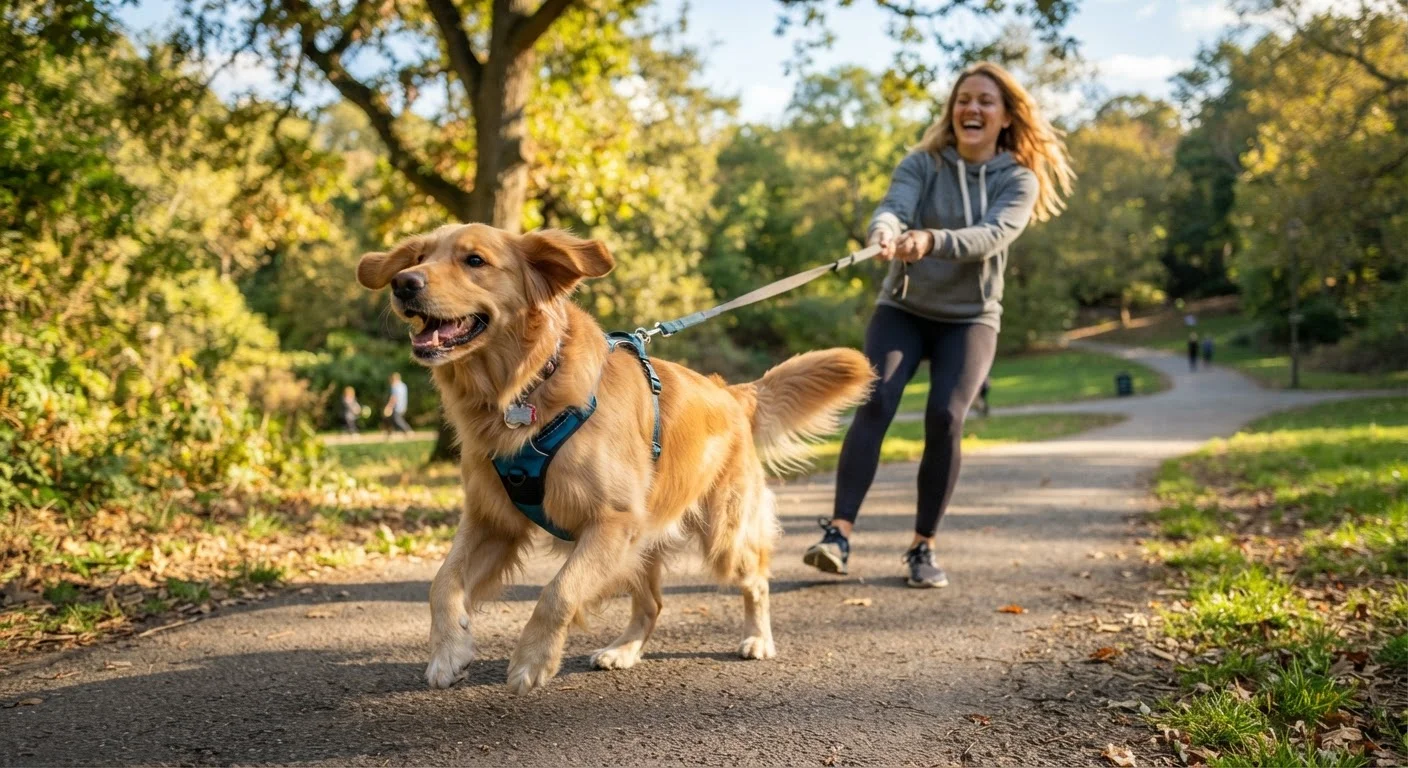
Leash pulling is when a dog moves ahead of its handler and applies forward tension on the leash during a walk. It's not a sign of dominance or bad character - it's a natural behavioral response rooted in a dog's instincts, sensory drive, and learned reinforcement history. Understanding the underlying cause is the first step toward addressing it effectively.
In behavioral science terms, pulling is often described as an appetitive behavior - one driven by the anticipation of a reward (reaching an interesting smell or location). It's frequently self-reinforcing, meaning the behavior persists because the dog gets what it wants simply by pulling.
Dogs Weren't Designed for the Human Pace
When you clip on a leash and head out the door, you and your dog have fundamentally different agendas. You're planning a 20-minute neighborhood loop. Your dog is stepping into a world that's been changing all day - new scents, sounds, and movement cues that their brain is wired to investigate immediately.
Dogs process the world primarily through smell. A single fire hydrant or patch of grass can carry information about dozens of animals that passed by hours earlier. The instinct to reach that information quickly isn't stubbornness - it's sensory drive that predates domestication by thousands of years. Your dog isn't ignoring you; they're responding to evolutionary programming that says move toward interesting things, fast.
Add to this the fact that a dog's natural trotting pace is typically faster than a human walking pace, and the tension on the leash becomes almost inevitable without deliberate training.
~80%
Dog owners who cite pulling as a top walk complaint
Leash pulling is consistently ranked among the most common behavioral issues reported by dog owners in veterinary and training surveys.
100,000+
Leash-related injuries reported annually in the US
Research published in journals tracking emergency department visits has found tens of thousands of injuries each year linked to dog leashes, with falls being the most common mechanism.
4-6x
Faster than human walking pace for a trotting dog
Dogs' natural trotting speed is several times faster than the average human walking pace, making loose-leash walking a learned compromise rather than a natural behavior.
The Reinforcement Loop Most Owners Don't Notice
Here's the behavioral mechanism at the core of leash pulling: every time a dog pulls and reaches what they were moving toward, the pulling behavior gets stronger. This is called positive reinforcement through self-reward - the dog doesn't need a treat from you because the environment is already paying them back.
On Day 1 of a puppy's first walk, they lunge toward a smell and the owner follows. The puppy files that away: pulling = getting there. By month six, the behavior is deeply conditioned, and the dog has no idea a different outcome is possible.
This is why understanding the science behind reinforcement matters so much before choosing a training approach. Positive reinforcement training works precisely because it redirects what gets rewarded - teaching the dog that a loose leash is what earns forward movement, not a tight one.
What Leash Tension Does to a Dog's Brain
There's another layer that many owners miss: leash tension itself can increase a dog's arousal state. When a dog feels resistance at the collar or harness, it can trigger a reflexive opposition reflex - a physiological response where the body pushes back against pressure. This means that the harder you pull backward, the more your dog may strain forward, not out of defiance, but as a physical reflex.
High arousal also narrows a dog's ability to focus on you. A dog in an excited or anxious state has fewer cognitive resources available for learning. This is part of why reactive dogs - those who bark or lunge at stimuli - are especially hard to redirect mid-pull. Their nervous system is already in overdrive.
Punishment-based corrections applied at this moment don't address the arousal or the motivation. They can actually layer anxiety onto the walk experience, which may worsen the problem over time or contribute to stress behaviors like those described in our piece on separation anxiety in dogs.
Lower Arousal Before You Ask for Focus
If your dog is already pulling and highly excited, asking them to 'watch me' or 'heel' is unlikely to work - their brain isn't in a state to process complex cues. Instead, pause, create distance from the trigger if possible, and wait for a moment of calm before reinforcing and moving on. Training that happens below the dog's arousal threshold sticks far better than corrections applied in the heat of the moment.
What This Means for Your Training Approach
Knowing why pulling happens points directly to what effective training needs to accomplish: it has to change what the dog expects to happen when they move ahead on the leash. That requires patience, consistency, and a clear understanding of what you're reinforcing moment by moment.
If you've recently brought a new dog home, establishing leash habits early matters enormously. The patterns formed in the first weeks often set the template for years of walks - something covered in depth in our guide on bringing a new dog home.
For dogs where pulling is already established, the goal isn't to suppress the behavior with force - it's to systematically teach that keeping the leash loose is the most reliable way to get where they want to go. That shift in contingency, practiced consistently, is what changes the behavior for good.
Walking on a loose leash is a learnable skill for virtually every dog. But it starts with owners understanding that pulling was never about dominance, attitude, or disrespect - it was always about a dog doing exactly what their instincts and reinforcement history taught them to do.