

Key Takeaways
Our Verdict
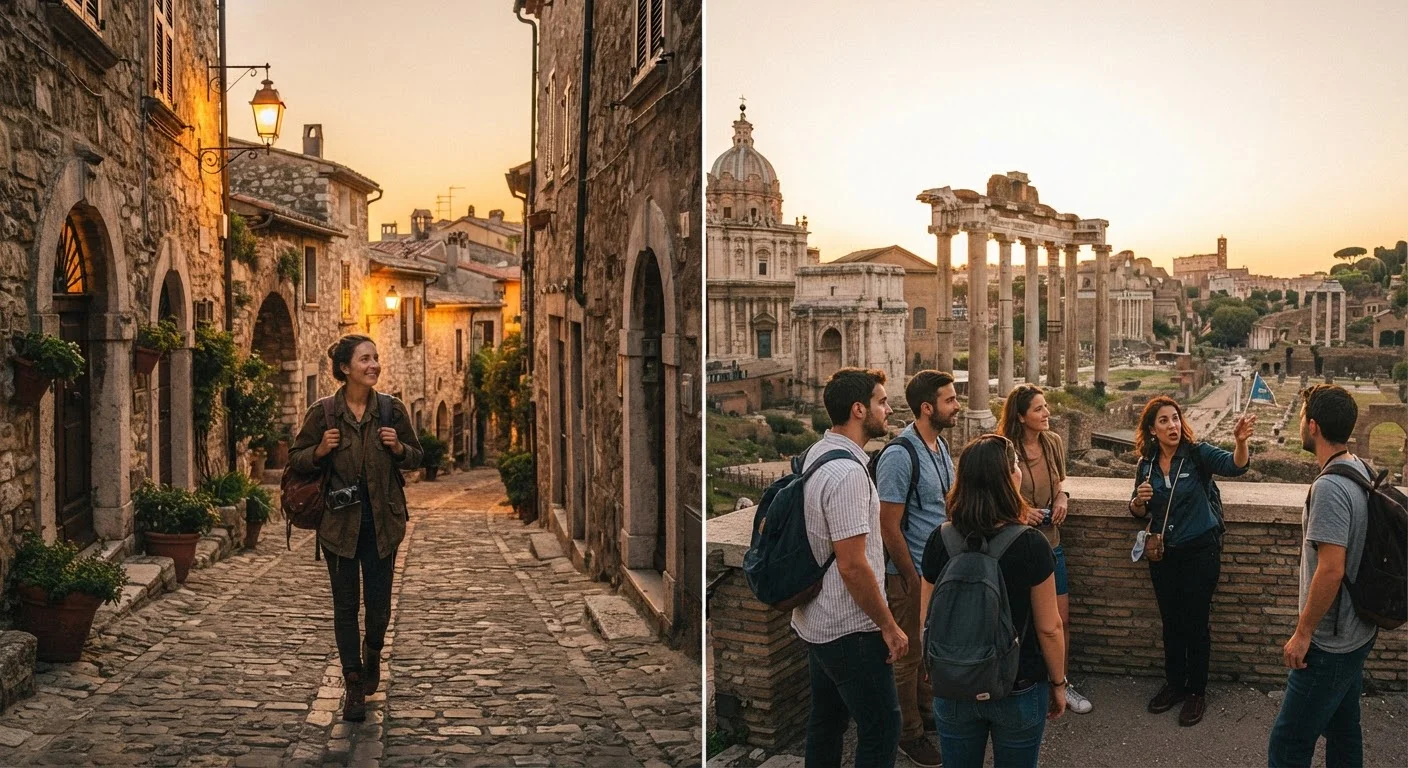
Solo travel rewards those who value spontaneity and deep personal immersion, while group tours shine when destination complexity, safety, or access to expert context would be hard to replicate independently. The smartest travelers don't commit to one format for life - they assess each trip on its own terms and choose accordingly.
| Best for | Recommended |
|---|---|
| Travelers prioritizing flexibility and self-paced exploration | Solo Travel |
| First-timers visiting logistically complex or remote destinations | Group Tours |
| Those seeking structured social connection on the road | Group Tours |
| Experienced travelers returning to a well-documented destination | Solo Travel |
The Real Trade-Off: Control vs. Convenience
The debate between solo travel and group tours isn't really about personality type - it's about what a specific trip demands. Some destinations reward spontaneous wandering; others have layers of cultural, logistical, or safety complexity that a knowledgeable guide can cut through in ways no guidebook fully replicates.
Solo travel puts every decision in your hands: where to eat, how long to linger, when to change course entirely. That freedom is genuinely thrilling, but it carries a cost in research time, cognitive load, and the occasional wrong turn that eats a full afternoon. Group tours flip the equation - logistics are handled, context is provided, and you're rarely stranded - but your itinerary is shared, and the pace is set for the group, not for you.
Before defaulting to a habit, it's worth examining the actual variables at play. Our trip planning framework breaks down exactly which decisions carry the most weight when building any journey from scratch.
| Solo Travel | Group Tours | |
|---|---|---|
| Flexibility | Complete control over pace and itinerary | Fixed schedule shared with group |
| Logistics burden | Fully on the traveler | Handled by the operator |
| Cost predictability | Variable; requires careful budgeting | Upfront, all-inclusive pricing |
| Local context & access | Self-sourced; guidebooks and research | Expert guide with local knowledge |
| Social experience | Solitude-forward; connection by chance | Built-in group dynamic |
| Best destination fit | Well-documented, tourist-friendly places | Complex, remote, or language-barrier destinations |
| Ideal traveler experience level | Comfortable with uncertainty and planning | First-timers or those short on prep time |
When Solo Travel Is the Smarter Move
Independent travel thrives in destinations with solid tourism infrastructure, clear signage, and widely spoken languages. Western Europe, Japan, Southeast Asia's backpacker trails, and major US national parks are examples where going solo is genuinely straightforward - transport options are abundant, accommodation is easy to book on short notice, and itinerary pivots cost nothing but a few taps on a phone.
Solo travel also wins when you have niche interests. If you want to spend three hours in a single museum room or detour to an obscure village because you read one compelling paragraph about it, no group schedule will accommodate that. The experience becomes genuinely yours.
Cost can go either way. Solo travelers avoid paying a group-tour premium, but they also lose the buying power that comes from shared transport and accommodation. Comparing real-world costs honestly - not just headline tour prices - is essential. See our breakdown on building a trip component by component vs. booking a package for a clearer picture of where savings actually appear.
When a Group Tour Earns Its Place
Group tours genuinely shine in three scenarios: logistically complex destinations, places where local context is hard to access independently, and regions where safety or language barriers create real friction.
Consider somewhere like Morocco, where medina navigation, vendor dynamics, and cultural nuance can overwhelm a first-time visitor quickly. Having a guide who knows the difference between a genuine artisan quarter and a tourist trap changes the quality of the experience fundamentally. Our piece on traveling in Morocco lays out exactly why local knowledge matters so much in that context.
Group tours also solve the solo-travel social gap. Extended solo trips can get lonely, and structured group dynamics - while occasionally limiting - provide built-in connection. That said, "group tour" covers enormous ground: a 40-person bus tour and a small-group adventure operator of eight people deliver very different experiences. Always clarify group size and pace before committing.
Try a Hybrid Approach on Complex Trips
You don't have to choose one format for an entire journey. Consider booking a structured tour for the first two or three days in a destination you're unfamiliar with - this builds local knowledge, orientation, and confidence quickly. From there, you can transition to independent exploration with a much stronger foundation. Many operators offer short city-entry or day-tour options that fit neatly into a larger self-planned itinerary.
Matching Format to Destination - A Practical Framework
Rather than asking "Am I a solo traveler or a group tour person?", ask these questions about each specific trip:
- Infrastructure: Can I navigate transport, accommodation, and entry points without specialist help?
- Language: Will communication barriers significantly limit access to experiences or create safety risk?
- Safety: Are there genuine security considerations that local guides would help mitigate?
- Depth vs. breadth: Do I want to cover multiple destinations quickly, or go deep into one place at my own speed?
- Social energy: Am I seeking solitude, or is connection part of what I want from this trip?
Many travelers find that a hybrid works well - booking a structured tour for the first few days in a complex destination to build orientation and confidence, then striking out independently once they have their bearings. This is also worth considering when balancing a fixed itinerary against flexible travel days.
If you're coordinating with others rather than traveling alone, the calculus shifts again - group dynamics add their own layer of complexity that planning a group trip addresses directly.