

Key Takeaways
Why Currency Exchange Costs More Than It Should
Currency exchange is one of those travel costs that hides in plain sight. Unlike a flight or hotel, there's no clear line item - you just notice, somewhere around day three, that your wallet seems lighter than it should be. The culprit is usually the markup built into every exchange transaction, and understanding it is the first step toward not overpaying.
Every provider - airport kiosk, hotel front desk, or bank - takes the mid-market rate (the real exchange rate) and adjusts it in their favor. The difference between what you get and what the rate actually is? That's their margin, and it varies enormously by source. Airport kiosks are among the most expensive options travelers will encounter, yet they capture a disproportionate share of exchanges simply because of placement and urgency. For more on how these hidden costs fit into the bigger picture, see our guide to why travelers overspend.
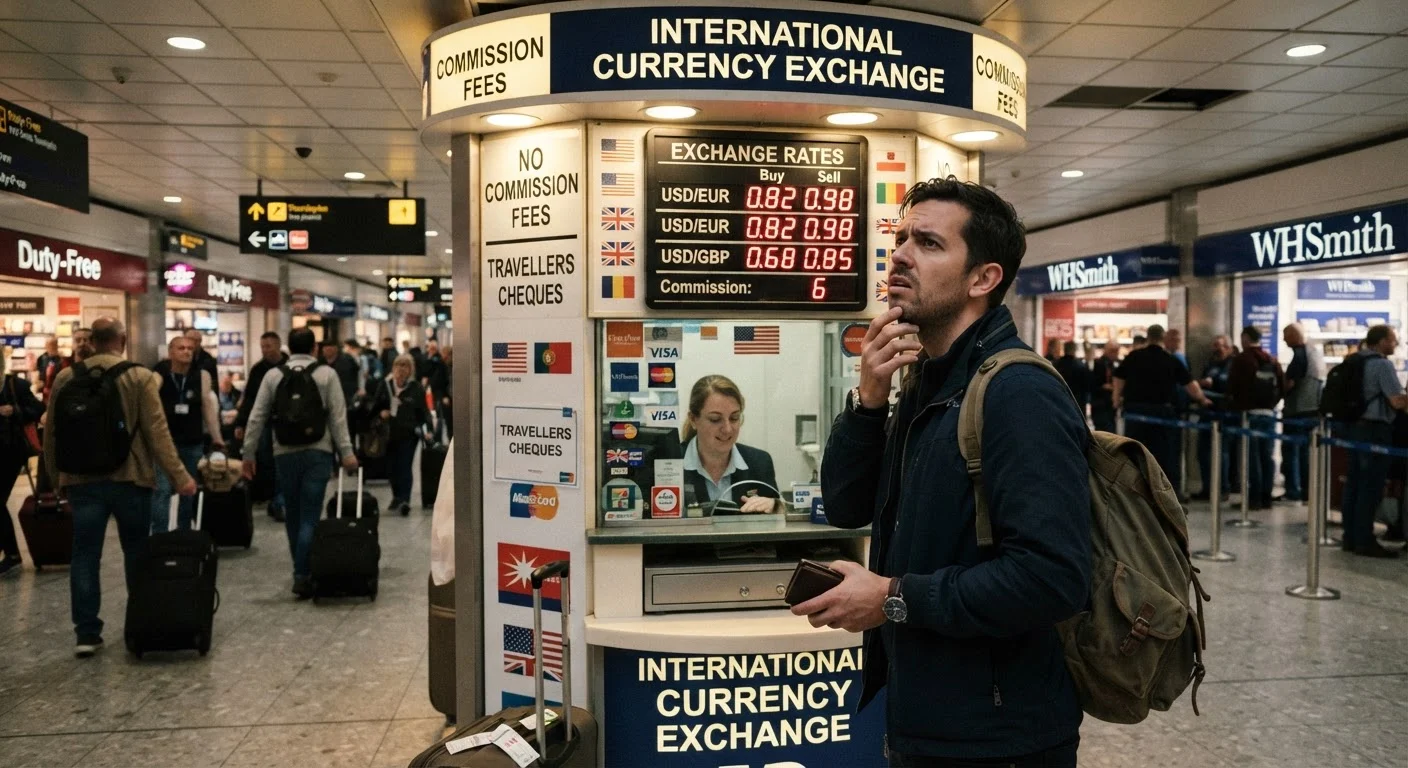
Exchanging currency at the airport kiosk because it's the first option you see.
Why it happens: After a long flight, convenience wins. Currency exchange booths are prominently placed right after customs, and travelers often exchange money before they even pick up their bags.
Accepting dynamic currency conversion (DCC) when paying by card abroad.
Why it happens: The terminal prompt is designed to sound helpful, framing it as a way to know exactly what you'll pay in dollars. Many travelers don't realize they're agreeing to a worse exchange rate.
Using a debit card abroad without knowing your bank's foreign ATM and transaction fees.
Why it happens: Travelers assume their card works the same everywhere. Foreign transaction fees (often 1-3%) and out-of-network ATM fees can quietly stack up across a two-week trip.
Forgetting to notify your bank or card issuer before international travel.
Why it happens: It's easy to overlook in the rush of packing. Banks sometimes flag foreign transactions as suspicious and freeze the card, leaving travelers stranded without accessible funds.
Exchanging large amounts of cash at a single unfavorable location.
Why it happens: Travelers want to avoid running out of local currency and over-exchange in one go - often at the worst-rate provider available to them at that moment.
Smarter Alternatives Worth Knowing About
Once you understand where the worst rates cluster, the path to better options becomes clearer. Local ATMs connected to major international networks typically offer rates much closer to the mid-market benchmark than any kiosk - though your own bank's fees still apply on top. Withdrawing at a bank-branded ATM (rather than a standalone kiosk ATM in a tourist area) tends to carry lower surcharges.
Some travelers exchange a modest amount through their home bank's currency desk before departure, accepting a small markup in exchange for having local cash the moment they land. This sidesteps the airport kiosk entirely. Others rely almost entirely on credit cards that carry no foreign transaction fees, using cash only where cards aren't accepted.
Always Decline Dynamic Currency Conversion
When a card terminal or ATM abroad asks whether you'd like to pay in your home currency instead of the local one, always choose the local currency. Dynamic currency conversion (DCC) hands the exchange calculation to the merchant or ATM operator, who typically applies a markup of 3-7% on top of your card's normal foreign transaction fee. The screen may frame it as a convenience, but it almost never works in your favor.
None of these approaches is universally perfect - the right mix depends on your destination, the cash culture there, and how your specific bank structures its fees. The key is making an informed choice before you arrive, not a panicked one at the exchange booth. Pairing a solid currency strategy with realistic spending categories is exactly what a well-built travel budget is designed to support. You might also find it worth questioning popular travel money myths before locking in your approach.