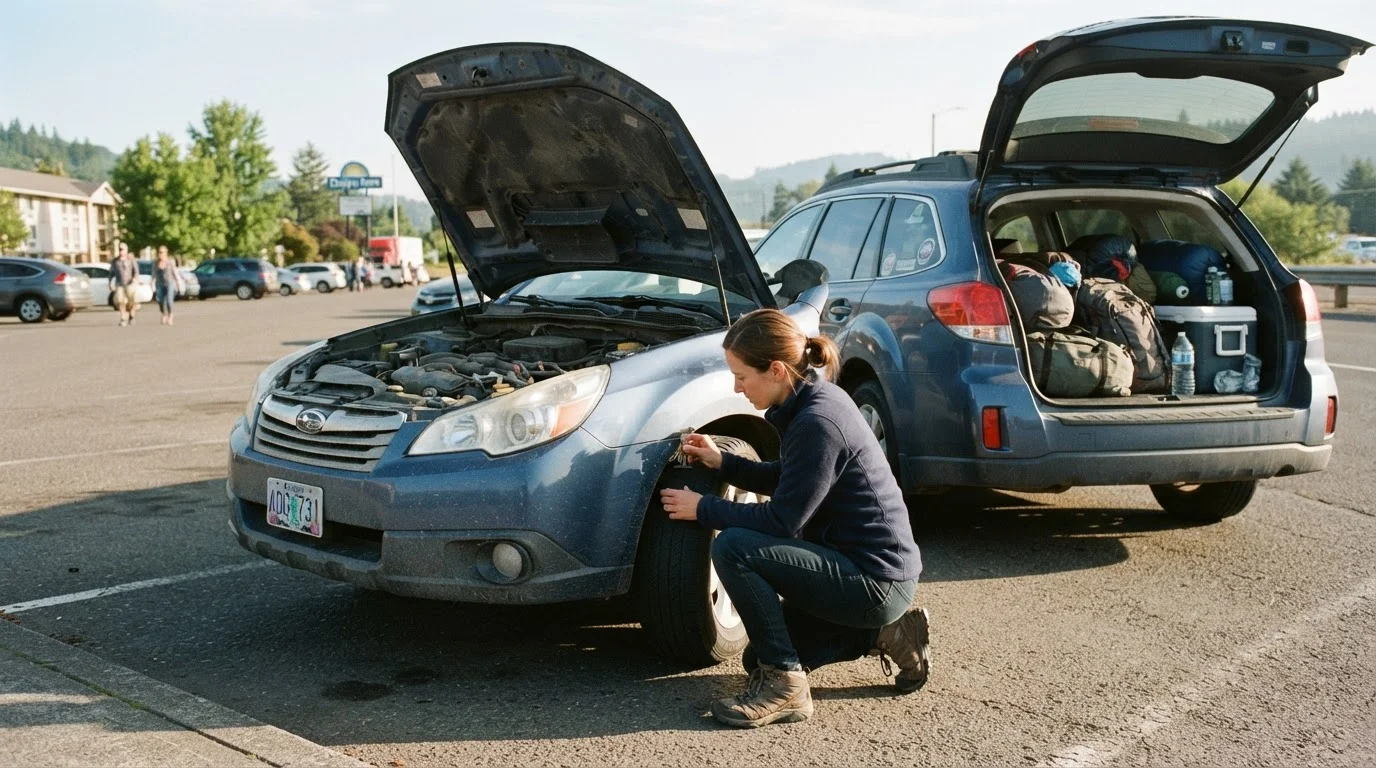
Tires, brakes, and fluids are the highest-priority checks before any long drive.
Most pre-trip inspections take under 45 minutes and require no special tools.
A roadside emergency kit should already be in your car before you leave the driveway.
Lights, wipers, and mirrors are quick checks that significantly reduce accident risk.
Catching a small issue before departure is far less costly than a breakdown mid-trip.
20–45 min
Summary
22 items · 20-45 minutes
Why a Pre-Trip Walkthrough Matters
Most roadside breakdowns aren't random - they're predictable. A low tire, a failing belt, or near-empty washer fluid rarely gives warning on the road; it gives warning in your driveway, if you take a moment to look. A structured pre-departure walkthrough is one of the highest-return habits any driver can build.
This checklist is designed for any road trip - weekend getaway or cross-country haul - and complements broader trip preparation. Once your vehicle checks out, pair this with the pre-departure traveler checklist to make sure nothing else slips through the cracks.
Work through the groups below in order. The first time takes 30-45 minutes; with practice, most drivers complete it in 20.
Required
Tire pressure gauge
Accurately measure PSI in each tire - digital or dial-type gauges are more reliable than pencil-style.
Required
Flashlight or work light
Illuminate engine bay components and underneath the vehicle when inspecting in low light.
Required
Penny (tread depth check)
A simple, no-cost tool for a quick visual tread depth test on all tires.
Required
Clean rag or paper towels
Wipe dipstick and fluid reservoirs for accurate readings.
Optional
Owner's manual
Reference the correct fluid specs, PSI ratings, and service intervals specific to your vehicle.
The Full Safety Checklist
These checks are organized from the ground up - starting with what's touching the road and working inward. Flag anything that looks worn, low, or uncertain, and have a qualified mechanic evaluate it before you depart if you're unsure.
Tires
Check tire pressure on all four tires (plus the spare) using a reliable gauge and inflate to the PSI listed on the driver's door jamb sticker - not the tire sidewall.Must
Inspect tread depth visually or with a penny test: insert a penny with Lincoln's head facing down - if you see the top of his head, the tread is too shallow for safe highway driving.Must
Look for visible sidewall cracks, bulges, or embedded objects that could cause a blowout at highway speed.Must
Confirm the spare tire is present, properly inflated, and that the jack and lug wrench are accessible.Should
Brakes & Steering
During a slow roll in a parking area, apply the brakes firmly and listen for grinding, squealing, or pulling to one side - any of these warrants a mechanic inspection before departure.Must
Check brake fluid level in the reservoir under the hood; the fluid should be between the MIN and MAX lines and appear light amber, not dark brown.Must
Test steering feel at low speed - excessive looseness or vibration can signal worn tie rods or low power steering fluid.Should
Fluids
Check engine oil level with the dipstick when the engine is cold; top off if it's low, and note if it's due for a change before the trip.Must
Inspect coolant (antifreeze) level in the overflow reservoir - never open a hot radiator cap.Must
Fill windshield washer fluid to the top; at highway speed, a single bug-splattered windshield can become a visibility hazard fast.Should
Verify transmission fluid and power steering fluid are within their recommended ranges if your vehicle allows user inspection.Nice to have
Lights & Visibility
Walk around the vehicle and confirm all exterior lights work: headlights (low and high beam), taillights, brake lights, turn signals, and reverse lights.Must
Test windshield wipers for streaking or chattering - replace blades that don't clear water cleanly in a single pass.Must
Adjust all mirrors before leaving the driveway, including any blind-spot mirrors if equipped.Should
Under the Hood & Belts
Visually inspect the serpentine belt for fraying, cracking, or glazing - a broken belt on a highway can disable the alternator, power steering, and cooling system simultaneously.Must
Check the battery terminals for corrosion (a white or bluish crust around the posts) and confirm the battery is securely mounted.Should
Look for any visible fluid leaks on the ground beneath the vehicle before pulling out of the driveway.Should
Emergency Preparedness
Confirm your roadside emergency kit is in the vehicle and stocked with jumper cables or a jump starter pack, reflective triangles or flares, and a basic first-aid kit.Must
Ensure your phone is charged and you have a car charger or power bank accessible for navigation and emergency calls.Must
Verify your roadside assistance membership or insurance coverage is active and note the contact number before you leave cell service areas.Should
Download offline maps for your route in case signal is unavailable in rural areas.Nice to have
Never Open a Hot Radiator Cap
Coolant in a hot engine is under pressure. Removing the radiator cap while the engine is warm or hot can cause scalding fluid to eject forcefully. Always check coolant levels when the engine has been off for at least 30 minutes, and use the overflow reservoir - not the radiator cap - to gauge the level.
What to Keep On Board
Running through this checklist confirms your car is road-ready, but preparation doesn't stop there. Even a well-maintained vehicle can encounter unexpected situations - a nail in the tire, a dead battery from a dome light left on, or an overheating incident in stop-and-go traffic.
Make sure your emergency supplies are stocked before you leave. The roadside readiness guide covers exactly what's practical to carry, from a quality jumper cable set to a basic first-aid kit. For ongoing vehicle health between trips, the seasonal car maintenance checklist is a useful companion - it maps what to inspect as conditions change through the year. Everything starts with a well-kept vehicle; the car maintenance hub is a good home base for building that habit.
Don't Delay on Brake or Tire Concerns
If you notice brake grinding, a spongy pedal, a tire bulge, or a visible fluid leak during your walkthrough, do not dismiss it and drive anyway. These are not "monitor it on the road" situations - they are genuine safety risks that should be evaluated by a qualified mechanic before departure. Rescheduling a trip is far less disruptive than a highway emergency.
Cars & Driving Editorial Team is the collective byline for our editorial team and contributor network. Articles published under this byline or an editorial pen name are researched, written, and reviewed according to our editorial standards for clarity, consistency, and independence before publication.
Disclaimer: The content provided on our blog site traverses numerous categories, offering readers valuable and practical information. Readers can use the editorial team’s research and data to gain more insights into their topics of interest. However, they are requested not to treat the articles as conclusive. The website team cannot be held responsible for differences in data or inaccuracies found across other platforms. Please also note that the site might also miss out on various schemes and offers available that the readers may find more beneficial than the ones we cover.