

Key Takeaways
Distracted Driving
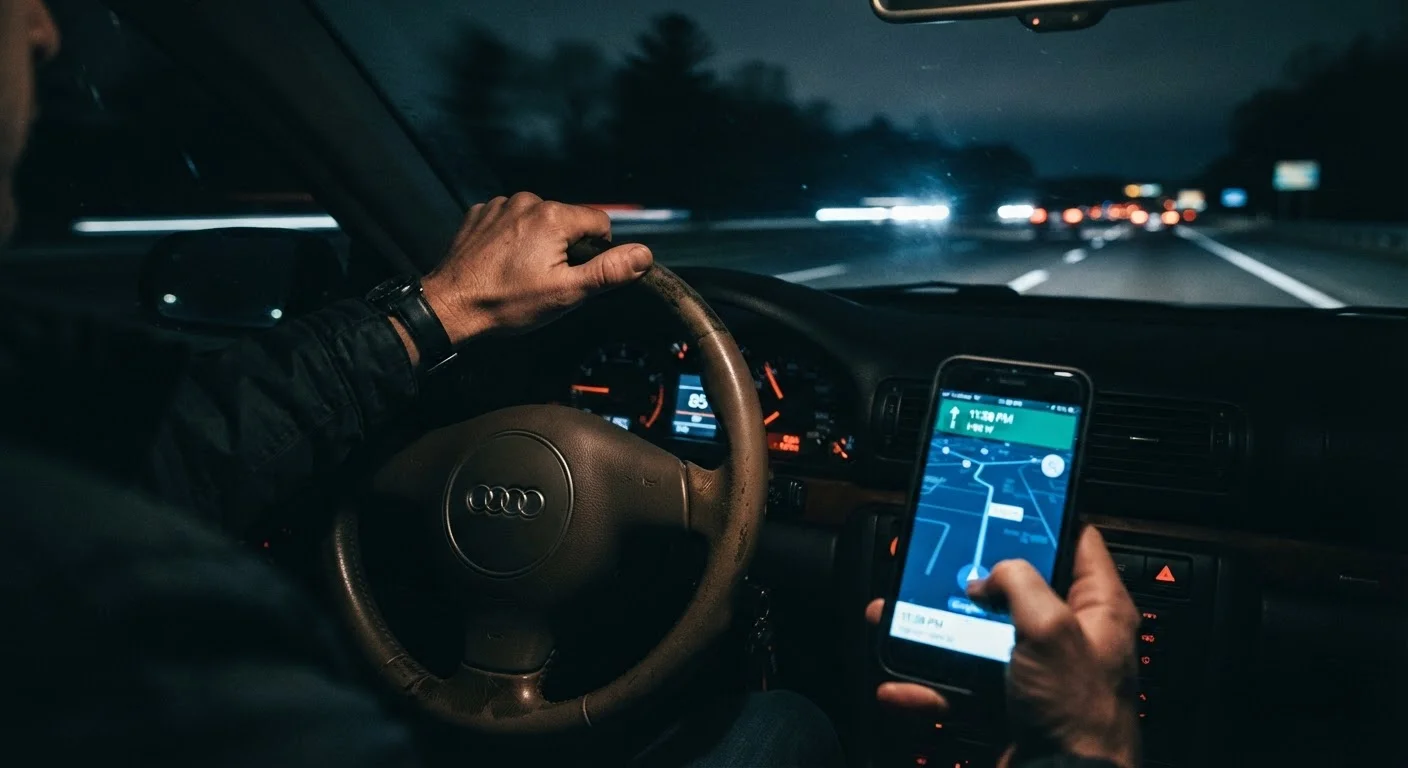
Distracted driving occurs any time a driver diverts attention away from the primary task of operating a vehicle. Distractions fall into three overlapping categories: visual (eyes off the road), manual (hands off the wheel), and cognitive (mind off driving). Smartphone use is uniquely dangerous because it often triggers all three types simultaneously.
Researchers call this triple-category engagement a 'triaxial distraction.' Cognitive distraction alone - such as a hands-free phone call - can slow reaction times measurably even when a driver's eyes remain on the road.
The Five-Second Problem
The analogy is stark but accurate: reading a text message at 55 mph for five seconds is roughly equivalent to driving the full length of a football field with your eyes closed. This figure, widely cited by the National Highway Traffic Safety Administration (NHTSA), captures something that raw crash statistics sometimes obscure - distraction is not a momentary lapse, it is a sustained blackout.
Modern smartphones amplify this risk in ways earlier in-car distractions (changing a radio station, reading a paper map) did not. A notification creates a conditioned response. The brain registers an unread message as an unresolved task, and that unresolved tension pulls cognitive resources away from driving even before the driver picks up the device.
Understanding stopping distances and reaction time makes this even clearer: at highway speeds, a driver who is visually distracted for two seconds may need an additional car length or more to stop safely - eliminating the buffer that would have prevented a collision.
Three Types of Distraction - and Why Phones Hit All Three
Traffic safety researchers classify driving distractions into three distinct categories:
- Visual distraction: Eyes leave the road - reading a text, checking a map, glancing at a notification banner.
- Manual distraction: Hands leave the wheel - holding a phone, typing, swiping.
- Cognitive distraction: Mental focus leaves the task of driving - following a conversation, processing content, composing a reply mentally.
Most in-car distractions hit one or two categories. Smartphone use - particularly texting or scrolling - routinely engages all three at once. That is what makes it categorically more dangerous than adjusting the climate controls or talking to a passenger.
~100 yards
Distance traveled blind in 5 seconds at 55 mph
Cited by the National Highway Traffic Safety Administration to illustrate how far a vehicle travels during a brief phone glance.
27 seconds
Elevated cognitive load after a voice task
AAA Foundation for Traffic Safety research found mental workload remains impaired for up to 27 seconds after completing a voice-activated command.
3-in-1
Distraction categories triggered by texting
Texting while driving simultaneously engages visual, manual, and cognitive distraction - a combination most other in-car activities do not produce.
Notably, cognitive distraction persists even when the phone is put down. Research published by the American Automobile Association (AAA) Foundation for Traffic Safety indicates that mental workload can remain elevated for up to 27 seconds after completing a voice-activated task - meaning even a 'quick' voice command at a red light can leave a driver cognitively impaired well into the next block.
Hands-Free Is Not Distraction-Free
A common misconception is that switching to a hands-free setup eliminates distraction risk. It eliminates manual distraction and part of the visual distraction - but cognitive distraction remains largely intact. Phone conversations, unlike conversations with passengers, lack a shared situational context. A passenger naturally pauses when traffic thickens or a hazard appears; a caller on the other end of the line does not, and the driver feels social pressure to keep engaging.
Driving simulator studies have consistently found that drivers on hands-free calls show reduced peripheral awareness, slower hazard detection, and delayed braking responses compared to undistracted controls. This applies to integrated Bluetooth systems as much as to earpiece setups.
The same principle applies to voice-command infotainment systems. Some systems tested by AAA generated higher cognitive demand scores than texting by hand - a counterintuitive finding that underscores how mental workload, not just physical engagement, is the core problem.
For drivers navigating fast-moving environments, these gaps matter most. Highway driving demands a different attention profile than city driving, and any cognitive impairment reduces the ability to react to sudden lane changes, merging vehicles, or debris.
Who Is Most at Risk - and Why Experience Doesn't Protect You
NHTSA data consistently shows that drivers under 20 are overrepresented in distraction-related fatal crashes. Younger drivers have less automated driving behavior - meaning they rely more heavily on conscious attention to manage the vehicle itself, leaving less cognitive capacity to spare. Adding a phone interaction overloads the system faster.
But assuming experience confers immunity is a measurable error. Veteran drivers often underestimate how much their attention has degraded during a distracted interval, a phenomenon linked to the same overconfidence that makes them vulnerable to other preventable accidents. Familiarity with a route can make the problem worse: drivers on well-known roads report higher rates of phone use, partly because the routine feels manageable.
Distraction risk also compounds with other impairments. Night driving already taxes perception and reaction time - adding cognitive load from a phone interaction narrows the margin for error further.
Put the Phone Out of Reach Before You Drive
Research consistently shows that physical separation - placing your phone in a bag, glove box, or back seat - is more effective than relying on willpower alone. Notification cues compete for your attention even when you intend to ignore them. A simple habit before every trip can meaningfully reduce in-drive temptation.
Practical Strategies That Research Supports
The most reliable mitigation strategy, according to behavioral safety research, is physical separation: placing the phone somewhere inaccessible before starting the engine. Relying on willpower alone - knowing the risks but keeping the phone in the cupholder - is demonstrably less effective because notification cues continue to compete for attention even when a driver intends to ignore them.
Additional evidence-backed approaches include:
- Do Not Disturb While Driving modes: Available on most modern smartphones, these suppress notifications automatically when the device detects vehicle motion. They are not foolproof but reduce the frequency of the cue-response cycle.
- Pre-trip preparation: Setting navigation, selecting music, and sending any necessary messages before the vehicle moves eliminates the in-trip need to interact with a device.
- Passenger accountability: Passengers can serve as a social check on phone use - and can handle navigation or communication on the driver's behalf.
The cognitive parallels extend beyond driving. Research on multitasking in other high-attention contexts consistently shows that the human brain does not truly multitask - it task-switches, and each switch carries a cost. Behind the wheel, that cost is measured in reaction time and stopping distance, not grades.
This article is for general informational purposes only and does not constitute legal or safety certification advice. Always follow applicable traffic laws in your state.