

Key Takeaways
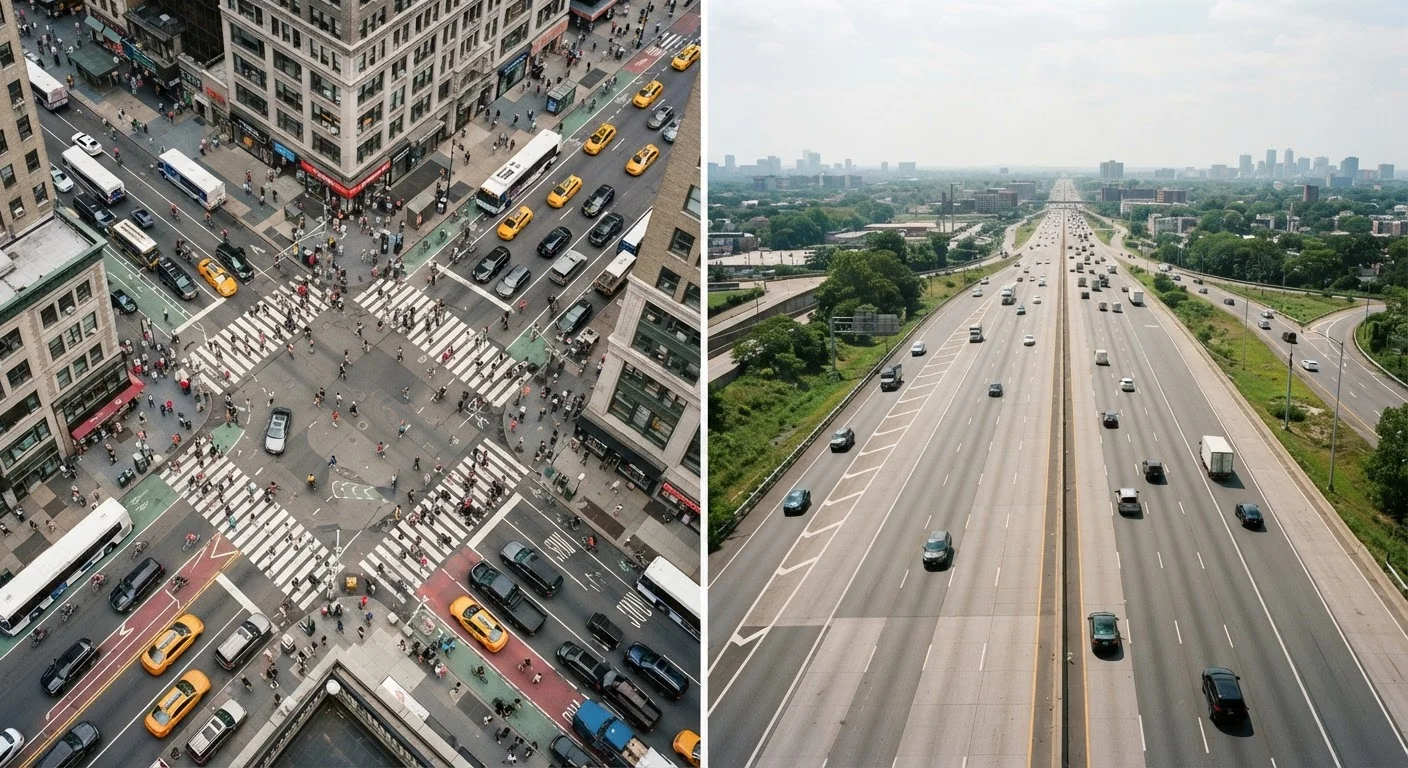
Option A
Highway Driving
High-speed, lower-complexity but unforgiving when errors occur.
Best for: Drivers who need to cover long distances efficiently and can maintain sustained focus at speed.
Option B
City Driving
Lower speeds, but relentlessly unpredictable and cognitively demanding.
Best for: Drivers who are alert, patient, and comfortable processing multiple hazards simultaneously in dense traffic.
If you're a new driver building foundational skills
City Driving (practice first)
Lower speeds give beginners more reaction time. Mastering city hazard scanning builds awareness that transfers directly to the highway.
If fatigue or drowsiness is already a concern
City Driving
Highway monotony accelerates driver fatigue; urban stop-and-go keeps engagement higher, though it introduces its own risks.
If you're uncomfortable with high-speed merging or lane changes
Practice Highway Driving deliberately
Merging anxiety is a learnable skill. Targeted practice on quieter highway stretches builds the speed-judging instincts needed for safe lane management.
If pedestrian and cyclist interactions feel stressful
Review City Driving habits
Understanding road-user expectations reduces conflict. See our guide to sharing the road for structured strategies.
The Core Risk Difference: Frequency vs. Severity
City driving and highway driving are dangerous in fundamentally different ways. Urban environments produce more crashes per mile traveled - intersections, pedestrians, delivery vehicles, and cyclists create a constant stream of potential conflicts. Highways, by contrast, have fewer collision events per mile, but when crashes do occur, the higher speeds involved make them far more likely to cause serious injury or death.
This distinction matters because it shapes what skills deserve the most attention. A city driver needs rapid hazard identification and precise slow-speed vehicle control. A highway driver needs sustained concentration, proper following distance, and the judgment to merge or change lanes at speed. Neither set of skills is more advanced - they're simply different, and gaps in either become dangerous in their respective environment.
Research from the National Highway Traffic Safety Administration (NHTSA) consistently shows that intersection-related crashes are among the leading collision types nationally, reflecting the complexity city drivers navigate every day. Meanwhile, high-speed rear-end collisions and run-off-road incidents dominate highway fatality statistics, pointing to the attention demands of sustained freeway travel. Understanding why even experienced drivers crash often comes down to environment-specific blind spots.
Highway Driving: What Safety Actually Requires
The biggest misconception about highway driving is that it's inherently easier because the variables seem simpler - no stop signs, no cyclists cutting across, no parallel parkers. That simplicity, however, is a trap. The uniform, repetitive nature of freeway travel suppresses alertness through a phenomenon sometimes called highway hypnosis - a state where the brain disengages from conscious driving decisions while the body continues operating the vehicle on autopilot.
Safe highway driving centers on three disciplines:
- Following distance: At 65 mph, a vehicle travels roughly 95 feet per second. The three-second following rule - choosing a fixed point and counting three seconds between when the car ahead passes it and when yours does - is a minimum baseline. In poor conditions, that buffer should double or triple. See our guide to driving in adverse weather for how stopping distances change in rain or snow.
- Merging and lane changes: These require accurate speed matching, not just signal use. Entering a freeway too slowly creates a compression point behind you; cutting across lanes without matching traffic speed is one of the most common causes of multi-car highway pileups.
- Fatigue management: Fatigue degrades reaction time in ways that closely mirror alcohol impairment. Taking breaks every two hours on long drives isn't a suggestion - it's a functional safety measure. Night driving adds another layer of risk because fatigue compounds with reduced visibility.
| Criterion | Highway Driving | City Driving |
|---|---|---|
| Typical speed range | 55-80 mph | 15-45 mph |
| Crash frequency (per mile) | Lower | Higher |
| Crash severity risk | Higher | Lower |
| Primary cognitive demand | Sustained attention, fatigue resistance | Simultaneous hazard processing |
| Top skill: lane management | Speed-matched merging, following distance | Tight maneuvering, intersection timing |
| Pedestrian/cyclist risk | Minimal | High and constant |
| Fatigue risk | High (monotony-driven) | Moderate (engagement offsets fatigue) |
| Weather impact on risk | Dramatically increases stopping distance | Reduces visibility; adds skid risk |
City Driving: Managing Information Overload
Urban roads are cognitively demanding in a way that has no real highway equivalent. A driver approaching a busy intersection may simultaneously process: traffic signal timing, a cyclist approaching on the right, a pedestrian stepping off the curb, a truck blocking the sightline, and a driver behind who is following too closely. Each element requires a fraction of attention, and the interaction between them shifts constantly.
The foundational skill for city driving is systematic scanning - a deliberate, practiced habit of checking mirrors, checking intersections well before reaching them, and identifying escape routes if a hazard materializes. Reactive drivers wait until danger is close; skilled urban drivers build awareness early enough that most situations resolve before a defensive response is needed.
Speed management in cities is equally critical. Lower speed limits exist partly because stopping distances at 25-35 mph are dramatically shorter than at highway speeds, giving drivers a meaningful chance to avoid pedestrian conflicts. Speeding between traffic lights - often called jackrabbit driving - eliminates that margin without providing any useful time savings in dense traffic.
City drivers should also stay conscious of how cyclists and pedestrians move - their behavior follows different logic than vehicle traffic, and anticipating it correctly reduces conflict significantly.
~40%
Of all US crashes occur at intersections
According to NHTSA data, intersection-related collisions account for a significant share of total reported crashes, reflecting the density of city-driving hazards.
3 sec
Minimum safe following distance at highway speed
Traffic safety authorities broadly recommend a minimum three-second gap at highway speeds, extending to six or more seconds in adverse conditions.
2 hrs
Maximum recommended continuous drive time
Road safety guidelines from multiple transportation agencies advise taking a break every two hours on long highway drives to counter the effects of fatigue.
Transferable Skills - and Where Each Environment Falls Short
Drivers who spend years exclusively in one environment often develop subtle blind spots in the other. Longtime rural or highway commuters moving to a city frequently underestimate intersection complexity and over-rely on right-of-way assumptions. Longtime urban drivers who rarely use freeways may feel anxious about speed-matching during merges or lose focus on longer highway stretches where stimulus is low.
The good news is that core safe driving principles are universal: smooth inputs, appropriate following distance, early hazard identification, and avoiding distraction. Building deliberate experience in whichever environment is less familiar is the most effective way to close those gaps. New drivers especially benefit from structured exposure to both settings before they're encountered under pressure.
Keeping your vehicle in reliable condition supports safety in both environments - brake response, tire condition, and mirror adjustment all matter whether you're braking for a crosswalk or a sudden highway slowdown. Our car maintenance hub covers the routine checks that keep those systems performing as expected.
Weather Changes the Equation in Both Environments
Rain, snow, ice, and fog don't affect city and highway driving equally. On highways, reduced visibility and longer stopping distances at high speed create exponentially greater risk. In cities, wet pavement extends braking distance into crosswalks and intersections where reaction time is already compressed. Before driving in challenging conditions, reviewing how each type of weather affects vehicle control is worthwhile. Our article on driving in rain, snow, ice, and fog breaks down the adjustments each condition requires.