

Key Takeaways
Why Night Driving Is Statistically More Dangerous
Traffic volume is lower after dark, but crash severity and fatality rates climb sharply. According to the National Safety Council, traffic fatality rates per mile driven are roughly three times higher at night than during the day. That's not just about drunk driving or reckless behavior - it reflects fundamental limits of human vision, physiology, and vehicle design that daytime experience simply doesn't prepare most drivers for.
The hazards below aren't rare edge cases. They're predictable, well-documented conditions that catch even experienced drivers off guard. Understanding them is the first step toward managing them - and the gap between knowing these risks and acting on them is where most night-driving accidents begin. As we explore in why experienced drivers still get into accidents, familiarity with the road doesn't automatically confer immunity to its dangers.
Reduced Visual Acuity and Contrast Sensitivity
The human eye is poorly optimized for low-light driving. In darkness, the eye shifts from cone-based (color, detail) to rod-based (motion, low contrast) vision - and rods don't deliver the sharpness needed to read road hazards at speed. Most drivers notice they can't see as far ahead, but fewer realize their ability to distinguish contrast - a dark animal against a dark road, for instance - drops dramatically.
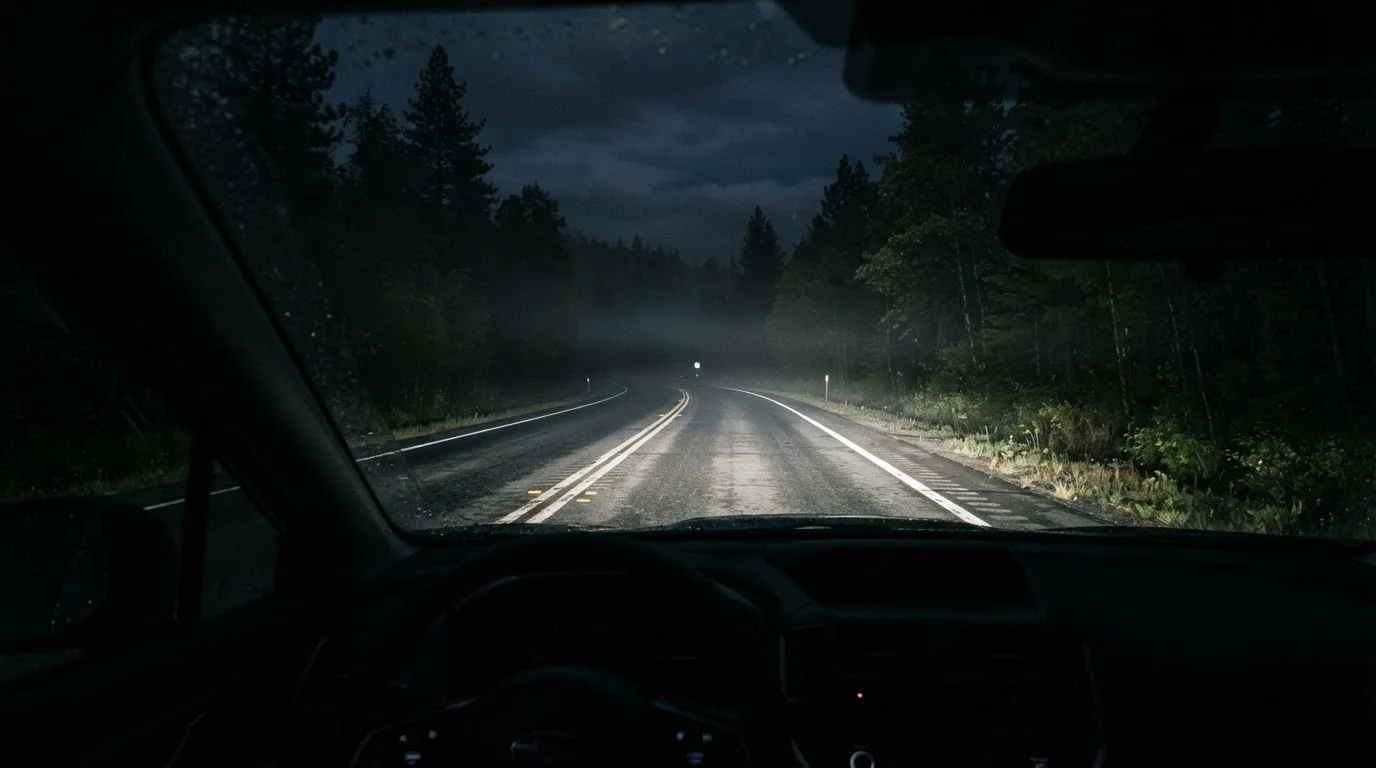
Standard low-beam headlights typically illuminate about 160 feet ahead. At 60 mph, your stopping distance can exceed 200 feet, meaning you're routinely driving beyond what your lights reveal. This is sometimes called "overdriving your headlights," and it's more common than most drivers recognize.
At 60 mph, stopping distance can exceed what standard low-beam headlights illuminate ahead.
Driver Fatigue and Circadian Rhythm Disruption
Fatigue is one of the most underreported factors in nighttime crashes. The body's circadian rhythm creates two natural low-alertness windows: roughly 2-5 a.m. and 1-3 p.m. Late-night driving lands squarely in the more dangerous of these zones, when the urge to sleep is physiologically strongest - regardless of how rested you feel.
The problem is that fatigued drivers are often poor judges of their own impairment. Studies on sleep deprivation consistently show that people overestimate their own alertness after extended wakefulness. If you're yawning repeatedly, struggling to maintain lane position, or finding it hard to recall the last few miles, these are signs that pulling over is the appropriate response - not pushing through.
Fatigued drivers routinely overestimate their own alertness, making fatigue one of night driving's most deceptive risks.
Glare from Oncoming Headlights
Modern vehicles equipped with high-intensity discharge (HID) or LED headlights produce significantly more lumens than older halogen systems. For the oncoming driver, that means a stronger glare stimulus hitting eyes that are already adapted to relative darkness. Recovery from bright glare can take several seconds - long enough to miss a pedestrian, animal, or road hazard.
Looking slightly to the right edge of your lane when headlights approach is a standard defensive technique that keeps your lane tracking visible while reducing the direct glare impact. Dirty or pitted windshields scatter light and can amplify glare considerably - a simple fix that many drivers overlook until conditions make the problem obvious.
Glare recovery after bright oncoming headlights can take several seconds - enough time to miss a critical hazard.
Pedestrians and Cyclists Are Nearly Invisible
Studies on pedestrian visibility consistently show that drivers detect pedestrians in dark clothing at night from very short distances - sometimes under 100 feet - even with functioning headlights. Cyclists without adequate lighting or reflective gear present a similar detection problem. The challenge is compounded by the fact that pedestrians near but not in a lit intersection may fall into the gap between streetlight pools.
This is a distinct concern from daytime driving because the visual cues that flag pedestrian presence - shadow, color contrast, silhouette against background - largely disappear after dark. As covered in understanding blind spots, vehicles already have structural visibility gaps; darkness extends and deepens those gaps significantly.
Pedestrians in dark clothing may only be visible from under 100 feet away at night, even with working headlights.
Impaired Depth Perception and Speed Judgment
Depth perception depends heavily on binocular vision and visual reference points - both of which are compromised at night. Without clear road edges, lane markings, and environmental landmarks, judging the distance to another vehicle or obstacle becomes measurably less accurate. This affects following distance, gap estimation when merging, and the ability to judge whether an intersection is clear.
Speed also tends to feel lower than it actually is at night, because fewer visual reference points are rushing past in your peripheral field. This is one reason drivers sometimes inadvertently creep above their intended speed on dark rural roads - there's simply less visual feedback to anchor their sense of motion. Distraction compounds this problem significantly; divided attention on an already information-limited road is a compounding risk.
Darkness strips away the visual cues drivers rely on for accurate speed and distance judgment.
Wildlife and Road Debris Appear Without Warning
Deer, raccoons, and other wildlife are far more active between dusk and dawn, and they don't behave predictably near roads. A deer crossing isn't a single event - where one crosses, others often follow. Spotting eye-shine in your headlights is useful but not reliable, since animals low to the ground or in roadside vegetation may not be visible until they're in the road.
Debris - from blown tire fragments to fallen cargo - is similarly harder to detect and judge at night. Object size, distance, and surface texture are all harder to read without sunlight. Slowing down in unfamiliar rural areas and scanning further ahead than feels necessary are practical habits that give you more reaction time when something unexpected appears.
Where one deer crosses a road at night, others often follow - treat the first sighting as a warning, not a clearance.
Driving Smarter After Dark
Most of these hazards can't be eliminated entirely - but they can be managed with deliberate habits. Slow down enough that your headlights can actually illuminate a problem before you reach it. Give yourself more following distance than you think you need. Keep your windshield and headlight lenses clean, and have your headlight aim checked if you're not sure it's calibrated correctly.
Check Your Headlights Before Night Trips
Oxidized or cloudy headlight lenses can reduce light output by more than half compared to clean, clear lenses. Inspect and clean your lenses regularly, and verify that both low and high beams are functioning before extended night driving. If your headlights seem dimmer than they once were, a mechanic can check alignment and bulb condition - proper aim makes a measurable difference in illuminated range.
Night driving also intersects with other high-risk conditions. Fog, rain, and ice all amplify the visibility and reaction-time problems described above - something worth revisiting in how road conditions change driving dynamics. And if you frequently switch between highway and city driving after dark, the different risk profiles of each environment are worth understanding in their own right.
Night driving demands more from you - not because it's exotic, but because your body and your car are both working with less information. Respecting that deficit is what separates cautious night drivers from those who rely on luck.