

Key Takeaways
Why Road Conditions Change the Rules
Most drivers learn to operate a vehicle in favorable conditions - dry pavement, daylight, clear visibility. But adverse weather doesn't just make driving harder; it fundamentally changes the physics at play. Grip decreases. Stopping distances grow. The margin for error shrinks. And the inputs that work perfectly on dry asphalt can trigger a skid or spinout on a wet or icy surface.
Understanding how each weather type affects your vehicle - and what adjustments actually help - is one of the most practical things any driver can do. This guide breaks down the four most common hazardous conditions and explains what's happening beneath your tires at each one.
For a broader picture of how environment shapes driving demands, see our article on highway vs. city driving safety skills.
Driving in Rain: Traction Loss and Hydroplaning
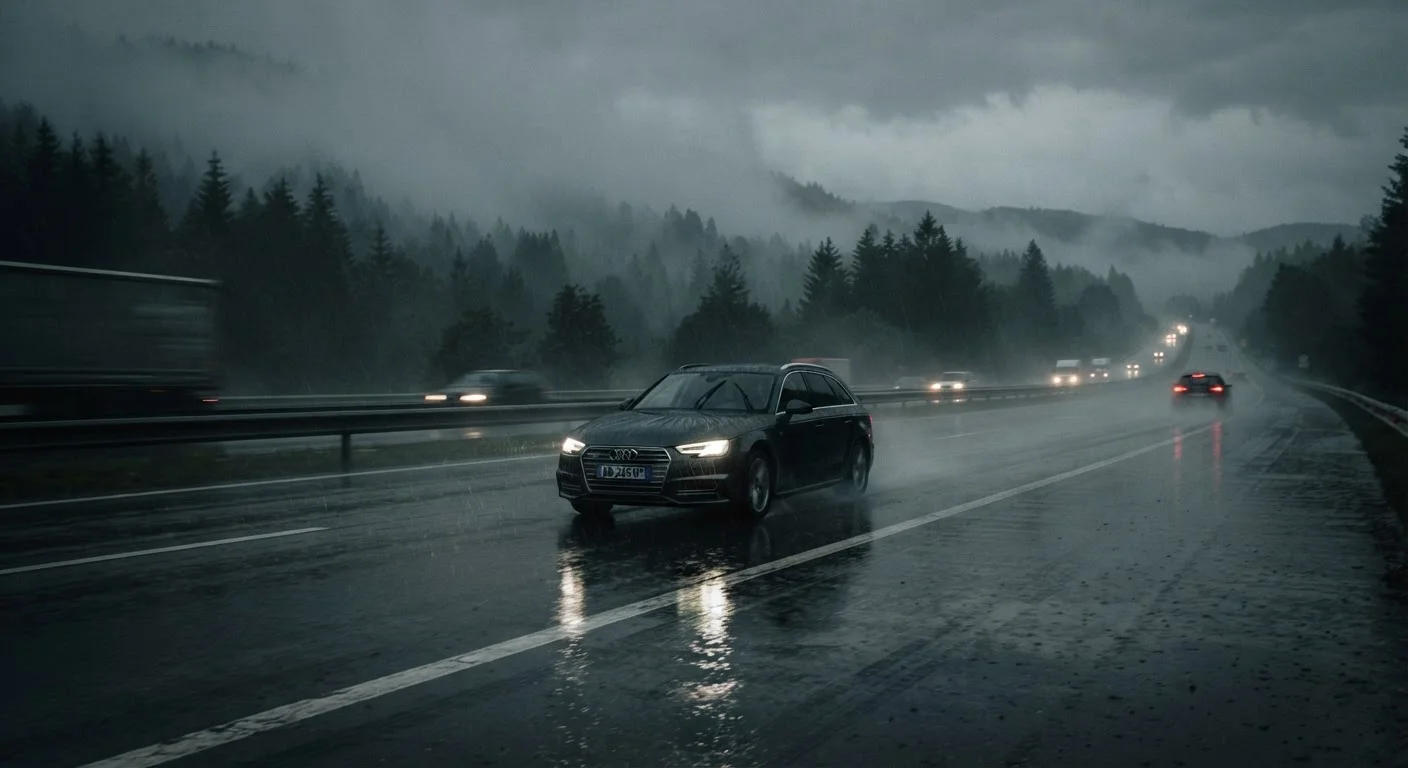
Rain is the most frequently encountered hazard, and also one of the most underestimated. Water doesn't just make the road slippery - it can create a film between your tires and the pavement that lifts your vehicle off the surface entirely. This is called hydroplaning, and it happens more easily than most drivers expect, particularly at highway speeds with worn tires.
Wet roads can increase stopping distances by roughly 50% compared to dry conditions. The first 10-20 minutes of rainfall are often the most dangerous, as water mixes with accumulated oil and road dust to create an especially slick surface before the rain washes it away.
- Reduce speed: Slowing down lowers the risk of hydroplaning and gives you more time to respond.
- Increase following distance: The standard two-second rule isn't enough - aim for at least four seconds in rain. See the full explanation in our guide on stopping distance and safe following distance.
- Avoid cruise control: If hydroplaning occurs with cruise control engaged, the system may actually accelerate the wheels. More on this in our piece on cruise control on wet roads.
- Check your tires: Tread depth directly determines how effectively your tires channel water away from the contact patch. Our article on tire pressure and tread depth explains the math behind this.
In the first minutes of rainfall, treat the road as if it's icy - that oil-and-water mix is genuinely treacherous before the rain clears it away.
Road oils accumulate during dry periods and create a brief but dangerously slick surface when rain first begins, a phase often overlooked by experienced drivers.
Before winter driving, check that your tires are properly inflated - cold air causes pressure to drop roughly 1 PSI for every 10°F decrease in temperature.
Underinflated tires have a reduced contact patch and respond more sluggishly in cold conditions, compounding the traction challenges snow and ice already create.
When driving in fog, crack your window slightly - you can often hear traffic or road hazards before you can see them.
Sound travels through fog while light does not, giving drivers an additional sensory channel for detecting nearby vehicles, intersections, or emergency situations.
Driving in Snow: Speed, Space, and Slow Inputs
Snow-covered roads change driving into a slow, deliberate exercise in patience. Packed snow reduces traction significantly, and loose or fresh snow can mask the actual road surface beneath - including ice. Stopping distances in snowy conditions can be three to four times longer than on dry pavement.
The key principle in snow is smooth, gradual inputs. Sudden braking, sharp steering, or aggressive acceleration can break traction instantly. All-wheel drive (AWD) helps with acceleration but provides no meaningful advantage when braking - a point many AWD drivers dangerously misunderstand.
- Accelerate and decelerate slowly to avoid wheel spin.
- Allow significantly more following distance - in heavy snow, 8-10 seconds is a reasonable starting point.
- Brake gently and early; if your vehicle has ABS, apply firm, steady pressure rather than pumping the pedal.
- Know the condition of your tires - winter-specific tires offer measurably better grip in snow and cold temperatures than all-season tires.
Driving on Ice: The Most Unforgiving Surface
Ice - particularly black ice, which is a thin, nearly transparent layer that blends into the pavement - offers almost no friction at all. A car traveling at 30 mph on ice can take four to ten times longer to stop than on dry pavement. Bridges, overpasses, shaded areas, and intersections are among the most common spots where ice forms first or persists longest.
Detecting black ice is difficult. Clues include patches of road that look slightly darker or shinier than surroundings, or a sudden lightness in the steering feel. If you suspect ice, the safest response is to reduce speed before you reach it.
Black Ice Offers No Second Chances
Black ice provides virtually no grip, and drivers often don't realize they've hit it until the car is already moving unpredictably. Never assume a road is ice-free because it looks dry - temperatures near or below freezing combined with moisture are sufficient for black ice to form. Treat any suspicious-looking stretch of pavement with extra caution.
If you do begin to skid on ice, your instincts are likely to work against you. Jerking the wheel or slamming the brakes typically worsens a skid. Our dedicated guide on skidding on ice - what to do in the seconds that count walks through the correct response for different drivetrain types.
Driving in Fog: Visibility Collapse and What to Do
Fog creates a unique hazard: it collapses your effective visibility bubble while leaving the road surface itself unchanged. Dense fog can reduce visibility to under 100 feet, meaning you may be traveling at a speed where stopping before an obstacle is physically impossible.
Common mistakes in fog include using high beams (which reflect light back into your eyes and worsen visibility), driving too fast for the conditions, and following other vehicles too closely while relying on their taillights as a guide - a dangerous habit that can lead to chain-reaction collisions.
- Use low beams or dedicated fog lights if your vehicle has them.
- Reduce speed enough to stop within your visible range - not what feels comfortable, but what the physics actually demand.
- Increase following distance substantially and watch for parked or stopped vehicles.
- If fog is severe enough to make driving unsafe, pull completely off the road, turn off your headlights (so following drivers don't steer toward them), and activate your hazard lights.
Fog shares some challenges with night driving - both compress your visible world significantly. Our guide on night driving hazards covers the overlapping risks in detail.
General Principles for All Adverse Conditions
Across rain, snow, ice, and fog, a few core principles apply universally:
- Slow down before you enter the hazard, not after. Braking on a slippery or low-visibility surface is always riskier than arriving at a manageable speed.
- Increase following distance well beyond your normal interval. The two-second rule is a dry-road minimum, not a universal standard.
- Smooth inputs beat aggressive ones. Steering, braking, and acceleration should all be gradual and deliberate.
- Maintain your vehicle year-round. Tires, brakes, wipers, and lights all affect your ability to handle adverse conditions. Visit our car maintenance hub for practical guidance on keeping your vehicle road-ready.
- Know when not to drive. No destination is worth the risk of driving in conditions that exceed your vehicle's or your own capabilities.
Adverse weather doesn't have to be dangerous if you understand what's happening and respond deliberately. The drivers who navigate these conditions best aren't the most fearless - they're the most prepared.