

| Recommended tire pressure source | Driver's door jamb sticker (not tire sidewall) |
| New tire tread depth | 10/32" - 11/32" |
| Legal minimum tread depth (most U.S. states) | 2/32" |
| Recommended replacement threshold (wet roads) | 4/32" (NHTSA and tire industry guidance) |
| Pressure drop per 10°F temperature decrease | ~1 PSI |
| TPMS alert threshold | 25% below recommended pressure (U.S. Federal Motor Vehicle Safety Standard) |
| Suggested pressure check frequency | At least monthly and before long trips |
| Typical tire rotation interval | Every 5,000-7,500 miles (verify in owner's manual) |
Why Tires Are Your Car's Most Critical Safety Component
Every braking force, every steering input, every attempt to accelerate - all of it flows through four palm-sized patches of rubber called the contact patch. Each patch is roughly the size of a human hand. That's it. That's what keeps a 3,500-pound vehicle connected to the road.
Tire pressure and tread depth are the two variables that most directly determine how large, grippy, and effective those patches are. Get them wrong, and braking distances stretch, handling becomes unpredictable, and blowout risk climbs steeply. Understanding the numbers behind both gives drivers a concrete framework for staying safe - in any weather, on any road.
For a broader look at how road conditions interact with tire performance, see our guide on how rain, snow, ice, and fog change vehicle control.
| Recommended tire pressure source | Driver's door jamb sticker (not tire sidewall) |
| New tire tread depth | 10/32" - 11/32" |
| Legal minimum tread depth (most U.S. states) | 2/32" |
| Recommended replacement threshold (wet roads) | 4/32" (NHTSA and tire industry guidance) |
| Pressure drop per 10°F temperature decrease | ~1 PSI |
| TPMS alert threshold | 25% below recommended pressure (U.S. Federal Motor Vehicle Safety Standard) |
| Suggested pressure check frequency | At least monthly and before long trips |
| Typical tire rotation interval | Every 5,000-7,500 miles (verify in owner's manual) |
Tire Pressure: The Numbers That Matter
Tire pressure is measured in PSI (pounds per square inch). The correct pressure for your vehicle is printed on a sticker inside the driver's door jamb - not on the tire sidewall, which lists the tire's maximum pressure, not the recommended operating pressure. These two numbers are often different by 10-15 PSI or more.
What Happens When Pressure Is Wrong
- Underinflation causes the tire to bow outward at the edges, increasing the contact patch but reducing structural rigidity. The tire flexes excessively, generating heat - the leading cause of tread separation and blowouts. Fuel economy also suffers because rolling resistance increases.
- Overinflation shrinks the contact patch by stiffening the tire's center. Grip is reduced, the ride becomes harsher, and the tire is more vulnerable to impact damage from potholes or road debris.
Pressure should be checked when tires are cold - meaning the vehicle has been parked for at least three hours or driven fewer than a mile. Heat from driving temporarily raises PSI, which can mask an underinflated tire.
If your dashboard TPMS (Tire Pressure Monitoring System) light activates, that's a 25% or greater pressure drop - well past optimal. Don't wait for the light. Our article on what dashboard warning lights are actually telling you explains what triggers TPMS alerts and when they require urgent action.
Tread Depth: Reading the Wear Indicators
Tread depth is measured in 32nds of an inch. New tires typically start at 10/32" to 11/32". The legal minimum in most U.S. states is 2/32", but safety organizations broadly recommend replacing tires before they reach 4/32" - particularly for wet-weather driving.
The Quarter and Penny Test
Two household coins serve as quick gauges:
- Insert a penny (Lincoln head down) into a tread groove. If you can see the top of Lincoln's head, tread is at or below 2/32" - replace immediately.
- Insert a quarter (Washington head down) the same way. If you can see the top of Washington's head, tread is at or below 4/32" - plan replacement soon.
Most tires also have wear indicator bars - small raised rubber bridges molded into the tread grooves. When the tread wears flush with these bars, the tire is at 2/32".
Why 4/32" Is the Wet-Road Threshold
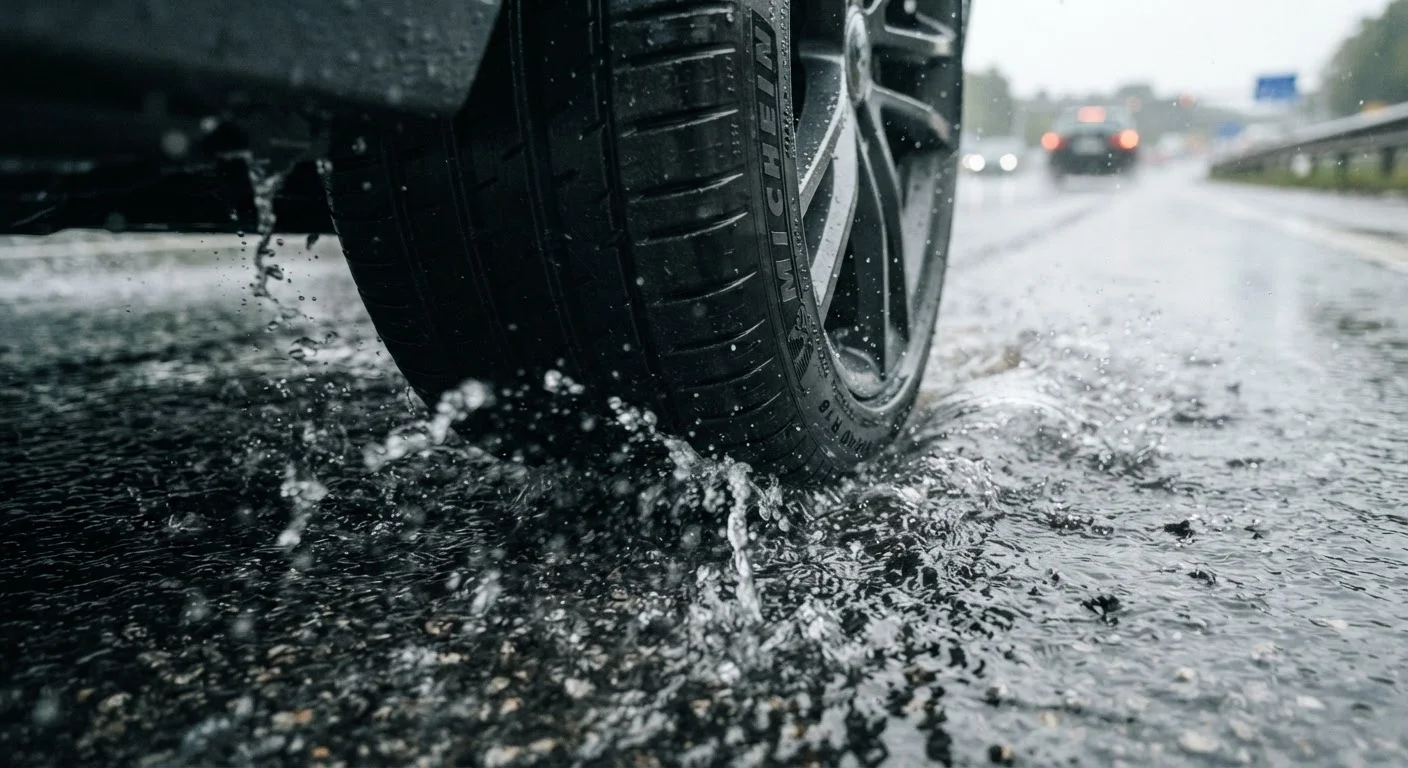
Tread grooves channel water away from the contact patch. As depth decreases, a tire's ability to displace water degrades. On a wet road at highway speed, a tire at 2/32" can require up to 100 additional feet to stop compared to the same tire at 4/32". That distance difference can determine whether a collision happens. See how stopping distance physics work in our article on reaction time and stopping distance.
Practical Maintenance Habits
Consistent monitoring doesn't require special tools or technical expertise. A basic digital tire pressure gauge costs a few dollars and removes all guesswork. Most automotive industry guidance suggests checking pressure at least once a month and before any long trip.
Tire pressure drops approximately 1 PSI for every 10°F decrease in ambient temperature, which means fall and winter months typically require more frequent checks. For drivers in cold climates, underinflation in winter is one of the most common - and preventable - tire issues.
Tread wear also isn't always uniform. Uneven wear patterns (feathering on edges, center wear, cupping) often signal alignment, inflation, or suspension issues that a qualified mechanic should evaluate. Rotating tires on a regular schedule - typically every 5,000-7,500 miles, though your owner's manual is the authoritative source - promotes even wear and extends tire life.
For a complete overview of tire care basics, our companion article on tire pressure, tread, and rotation fundamentals covers rotation intervals and what uneven wear patterns mean. And if you're thinking about what to carry in case a tire fails on the road, our guide to basic roadside preparedness is a practical next read.
Understanding tire condition is also part of the broader picture of car ownership costs - worn tires replaced proactively cost significantly less than damage caused by a blowout or accident.