

Key Takeaways
Start here
Why Tires Deserve More Attention
Next
Tire Pressure: The One Check Most Drivers Skip
Then
Tread Depth: Reading the Wear Before It Reads You
When you're ready
Tire Rotation: Extending Life and Keeping Wear Even
Wrap up
Putting It All Together
Why Tires Deserve More Attention
Tires are the only part of your vehicle in direct contact with the road - four small patches of rubber, each roughly the size of a human hand, are all that stand between your car and the pavement. Yet tire care consistently ranks among the most overlooked aspects of routine vehicle maintenance.
Neglecting tires isn't just a mechanical issue. Underinflated or worn tires can meaningfully increase stopping distances, reduce handling response, and raise the risk of a blowout. They also quietly hurt your fuel economy - a detail that adds up over thousands of miles. For a deeper look at how pressure and tread depth interact with braking and grip, see Tire Pressure, Tread Depth, and the Safety Math Behind Them.
The good news: the three core tire basics - pressure, tread, and rotation - require no special skills and very little time. Understanding them puts you in control of one of the most safety-critical systems on your vehicle.
Tire Pressure: The One Check Most Drivers Skip
Tire pressure is measured in PSI - PSI, or pounds per square inch. Every vehicle has a recommended PSI range set by the manufacturer, and finding it takes about ten seconds: look at the sticker on the inside edge of the driver's door, or consult your owner's manual. Do not use the number printed on the tire sidewall; that figure is the tire's maximum rated pressure, not the target operating pressure.
Check Pressure When Tires Are Cold
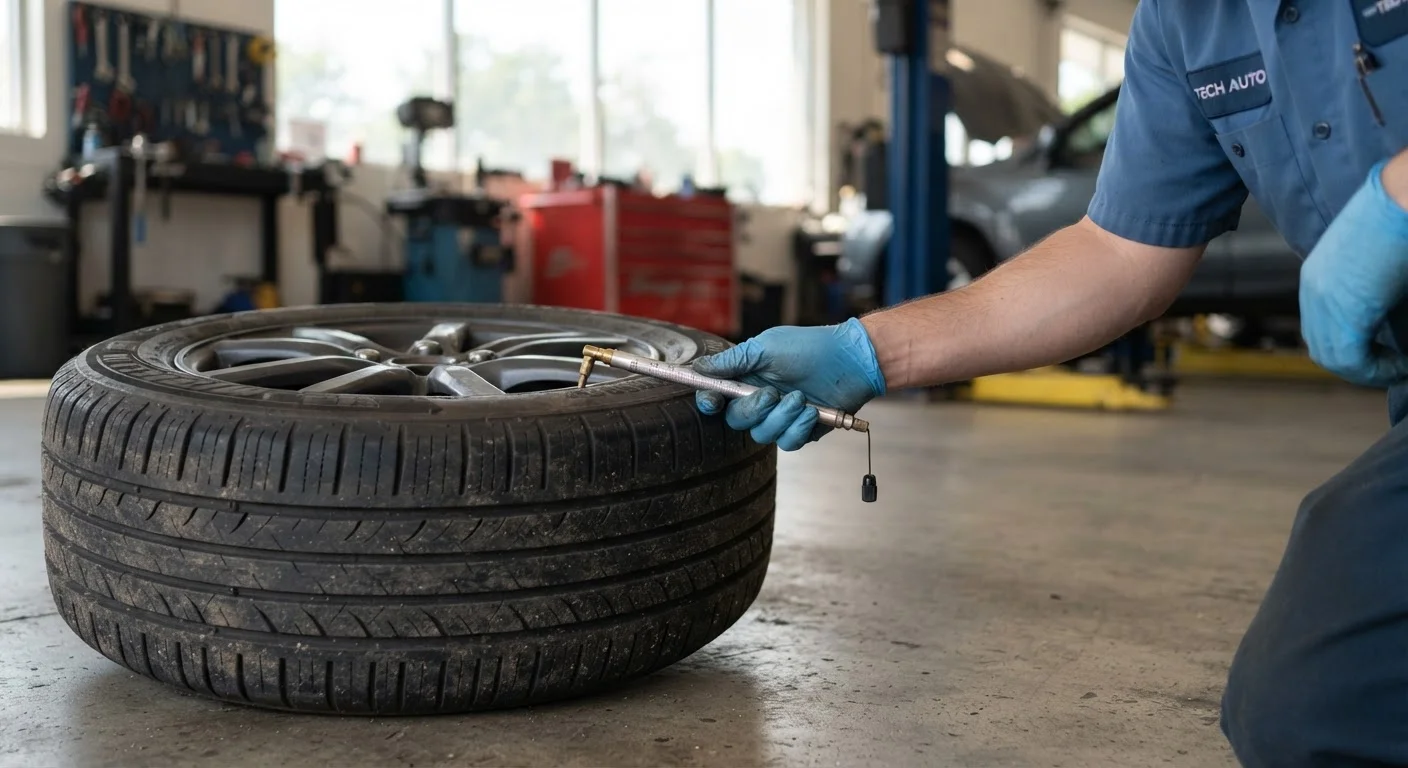
Always measure tire pressure before driving or at least three hours after the vehicle has been parked. Heat from driving expands the air inside, inflating your reading and making tires appear properly inflated when they may not be. For best accuracy, keep a gauge in your glove box and check on cool mornings.
Pressure naturally fluctuates with temperature. For roughly every 10°F drop in ambient temperature, tire pressure falls by about 1 PSI. This means a properly inflated tire in October can be noticeably low by January without a single nail or puncture involved. Checking monthly - and before any significant road trip - is a straightforward habit that costs almost nothing.
When checking pressure, do so when tires are cold - meaning the vehicle has been stationary for at least three hours. Driving heats air inside the tire, which raises pressure and gives a falsely high reading. A simple handheld gauge from any auto parts store is all you need; many gas stations also provide air pumps with built-in gauges.
Tread Depth: Reading the Wear Before It Reads You
Tread depth determines how well your tires channel water away from the road surface. Deeper grooves push water out to the sides, maintaining contact and reducing the risk of hydroplaning - that unsettling loss of grip when a film of water lifts the tire off the pavement. As tread wears down, that ability diminishes.
Tread depth is measured in 32nds of an inch. New tires typically start at 10/32" to 11/32". Legal minimum tread depth in most U.S. states is 2/32". Many safety experts recommend considering replacement at 4/32", particularly if you drive in wet or wintry conditions.
The classic field test uses a penny. Place it into a tread groove with Lincoln's head facing down toward the tire. If the top of his head is visible, your tread is at or near 2/32" - time to replace. Using a quarter instead gives you an earlier warning: if the top of Washington's head is visible, you're around 4/32" and should start planning for new tires.
Also pay attention to where wear appears. Wear concentrated in the center suggests overinflation; wear on both outer edges suggests chronic underinflation; wear on just one edge often signals an alignment problem. If your car pulls to one side, that may be worth investigating.
PSI
Pounds per square inch - the unit used to measure tire air pressure. Your vehicle's recommended PSI is found on the driver's door jamb sticker or in your owner's manual.
Tread depth
The measurement of how much rubber groove remains on a tire. Deeper tread channels water more effectively and provides better grip, especially in wet conditions.
Hydroplaning
When a film of water builds up between your tires and the road faster than the tread can disperse it, causing the tire to lose contact with the pavement and reducing steering control.
Tire rotation
Moving tires from one position on the vehicle to another to distribute wear evenly across all four tires and extend their overall lifespan.
Cold tire pressure
The pressure measured when a tire has not been driven on for at least three hours. This is the accurate baseline for comparing against manufacturer recommendations.
Sidewall
The side surface of a tire between the tread and the wheel rim. It carries size and load markings, but the maximum pressure number printed there is not the recommended operating pressure.
Tire Rotation: Extending Life and Keeping Wear Even
Tires don't wear uniformly on their own. Front tires handle steering forces and, on front-wheel-drive vehicles, also transmit power - making them work harder than rear tires. Without rotation, front tires wear significantly faster, creating mismatched traction across the axles.
Tire rotation means moving each tire to a different position on the vehicle - front to rear, side to side, or in a cross pattern - according to your vehicle's drivetrain layout. A common recommendation is to rotate tires every 5,000 to 7,500 miles, though your owner's manual may specify a different interval. Some drivers align rotations with oil changes as a convenient reminder.
Rotation doesn't require specialized equipment and is typically a low-cost service at any tire shop or quick-lube facility. Some tire purchases even include free rotations - check the terms if that applies to yours. Beyond extending tire life, even wear helps maintain predictable, balanced handling - something that matters most when you need to brake or steer quickly. For a broader look at what your manufacturer actually recommends servicing and when, your owner's manual is the definitive source.
Putting It All Together
Tire maintenance isn't complicated - it's consistent. A monthly pressure check, periodic tread inspections, and rotation every several thousand miles form a simple routine that most drivers can manage largely on their own.
These habits also fit naturally into broader seasonal upkeep. If you want a structured framework for what to check throughout the year, the seasonal car maintenance checklist covers tires alongside the other systems worth monitoring as conditions change.
One caution worth noting: if you notice significant uneven wear, persistent pressure loss, visible cracking or bulging in the sidewall, or vibration you can't explain, have a qualified mechanic inspect the tires rather than assuming a rotation or inflation fix will resolve it. Some tire conditions - like sidewall damage or internal belt separation - aren't visible from a casual glance and require a professional eye.
Your tires do a lot of quiet work. A little attention goes a long way toward keeping that work reliable.