

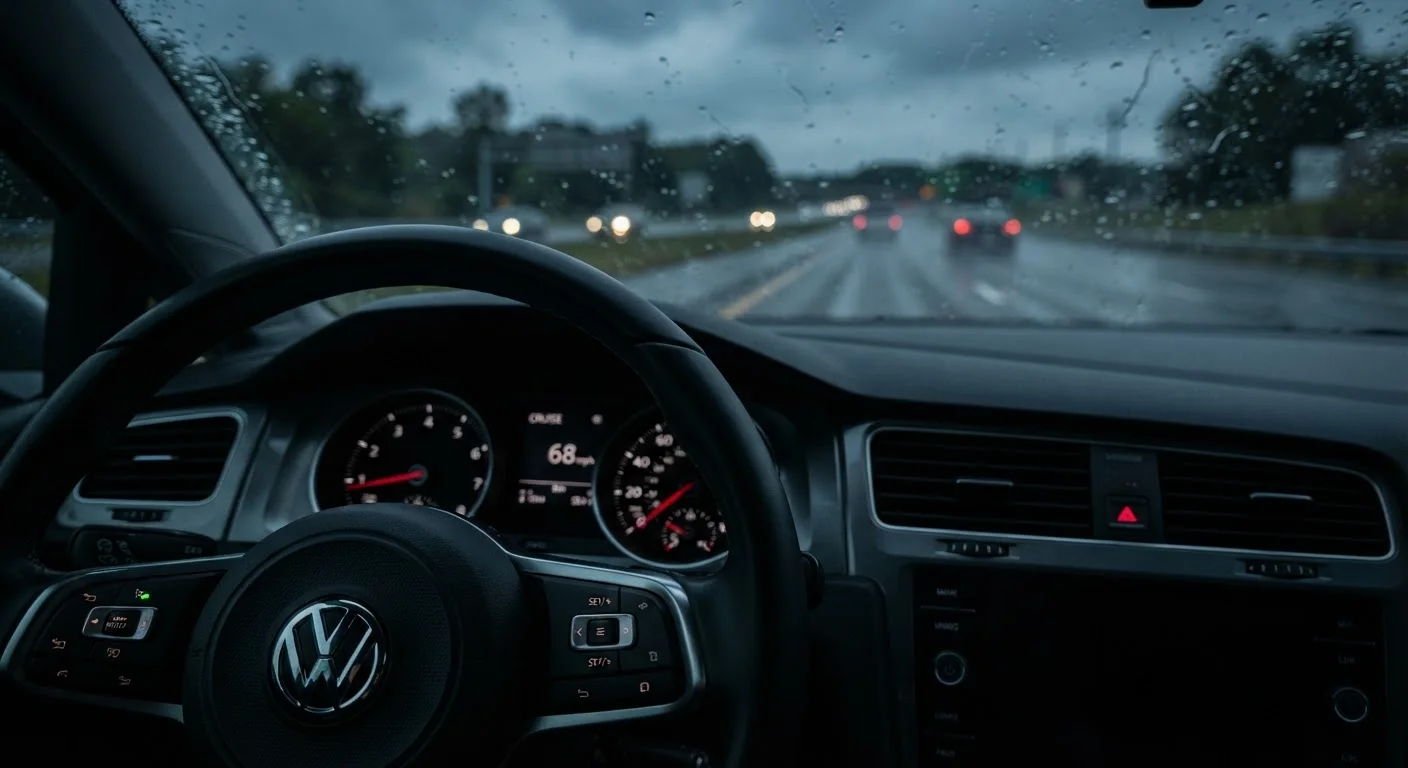
Key Takeaways
Reduces driver fatigue on long steady drives
Holding a consistent throttle position for hours is physically tiring. On extended highway stretches with predictable conditions, cruise control relieves that sustained effort and helps drivers stay more mentally alert.
Maintains consistent speed, avoiding micro-accelerations
Subtle throttle surges from manual driving can momentarily disturb tire grip on damp pavement. A locked cruise speed eliminates that variability on lightly wet, otherwise stable roads.
Passive protection against unintentional speeding
Highway monotony often causes drivers to gradually exceed safe speeds without realizing it. Cruise control enforces the set limit, which is especially valuable when rain has reduced stopping distances.
Adaptive systems maintain safe following distance automatically
Adaptive cruise control uses sensors to keep a buffer between your vehicle and the one ahead, reducing the tailgating risk that amplifies danger on slick surfaces.
Cannot detect or respond to aquaplaning
When tires lose contact with the road surface due to water buildup, the correct response is a gradual throttle lift. Cruise control may instead increase throttle to hold the set speed, worsening the skid before the driver can cancel the system.
Slows driver reaction to sudden grip loss
A driver manually controlling the throttle feels traction changes through the pedal and can react within fractions of a second. With cruise control engaged, that feedback loop is interrupted, adding critical delay.
Unsuited to variable wet-road conditions
Rainfall intensity, road drainage, standing water, and pavement texture can change from one stretch to the next. Cruise control cannot adapt to these rapid shifts; the driver must remain constantly ready to cancel it.
Can encourage complacency in dangerous conditions
The ease of cruise control can subtly lower a driver's alertness. In wet conditions that demand heightened attention, that reduction in engagement is a meaningful safety liability.
Not a substitute for proper tire maintenance
Even the most sophisticated cruise system cannot compensate for worn tread or improper inflation. Tires with insufficient tread depth aquaplane at lower speeds, making cruise control use far riskier.
Our Verdict
Cruise control is a genuinely useful feature on dry, open highways with steady traffic flow. On wet pavement, however, its inability to sense aquaplaning or adjust for sudden grip loss makes manual throttle control the safer default. The technology itself isn't dangerous - but using it without understanding its limits in adverse conditions can be.
Drivers who want to use cruise control safely will benefit most from understanding exactly when conditions make it a liability rather than a convenience.
What Cruise Control Actually Does - and Doesn't Do
Cruise control maintains a set vehicle speed by automatically managing throttle input. Once engaged, the system takes over acceleration duties so the driver doesn't have to hold steady pressure on the gas pedal. Standard cruise control operates purely on speed - it has no awareness of road surface, weather, or traction conditions.
Adaptive cruise control (ACC), found on many newer vehicles, adds radar or camera sensors to monitor the vehicle ahead and adjust speed accordingly. It's a step forward in sophistication, but even ACC systems are not designed to detect aquaplaning - the phenomenon where a tire rides up on a film of water and loses contact with the road surface.
Understanding this boundary is the starting point for any honest conversation about wet-road use. See also: how different weather conditions affect vehicle control.
The Case for Cruise Control: Where It Genuinely Helps
Reduces driver fatigue on long steady drives
Holding a consistent throttle position for hours is physically tiring. On extended highway stretches with predictable conditions, cruise control relieves that sustained effort and helps drivers stay more mentally alert.
Maintains consistent speed, avoiding micro-accelerations
Subtle throttle surges from manual driving can momentarily disturb tire grip on damp pavement. A locked cruise speed eliminates that variability on lightly wet, otherwise stable roads.
Passive protection against unintentional speeding
Highway monotony often causes drivers to gradually exceed safe speeds without realizing it. Cruise control enforces the set limit, which is especially valuable when rain has reduced stopping distances.
Adaptive systems maintain safe following distance automatically
Adaptive cruise control uses sensors to keep a buffer between your vehicle and the one ahead, reducing the tailgating risk that amplifies danger on slick surfaces.
On long interstate drives in light rain - where roads are damp but not pooling, speeds are consistent, and traffic is sparse - cruise control can legitimately reduce driver fatigue. Maintaining a perfectly steady speed also avoids the micro-accelerations that can disturb traction. For drivers prone to gradually creeping over the speed limit during highway monotony, the system provides passive speed discipline.
Modern ACC systems add an extra layer by maintaining safe following distance automatically, which reduces one of the most common wet-weather risks: tailgating on slick pavement.
The Hidden Risks on Wet Pavement
Cannot detect or respond to aquaplaning
When tires lose contact with the road surface due to water buildup, the correct response is a gradual throttle lift. Cruise control may instead increase throttle to hold the set speed, worsening the skid before the driver can cancel the system.
Slows driver reaction to sudden grip loss
A driver manually controlling the throttle feels traction changes through the pedal and can react within fractions of a second. With cruise control engaged, that feedback loop is interrupted, adding critical delay.
Unsuited to variable wet-road conditions
Rainfall intensity, road drainage, standing water, and pavement texture can change from one stretch to the next. Cruise control cannot adapt to these rapid shifts; the driver must remain constantly ready to cancel it.
Can encourage complacency in dangerous conditions
The ease of cruise control can subtly lower a driver's alertness. In wet conditions that demand heightened attention, that reduction in engagement is a meaningful safety liability.
Not a substitute for proper tire maintenance
Even the most sophisticated cruise system cannot compensate for worn tread or improper inflation. Tires with insufficient tread depth aquaplane at lower speeds, making cruise control use far riskier.
The core danger is response lag. When a tire begins to aquaplane, the driver needs to lift off the throttle immediately and smoothly - not brake hard, not steer sharply. With cruise control engaged, the system may actually increase throttle output to maintain the set speed precisely as traction is being lost, making the situation worse before the driver can intervene.
Standing water, road camber, and drainage quality vary constantly on real roads. Even a brief patch of ponding can be enough to trigger aquaplaning at highway speeds. Your tire's tread depth and pressure directly influence how quickly water is channeled away from the contact patch - worn or underinflated tires raise the aquaplaning risk substantially.
Highway driving also involves lane changes, merging traffic, and shifting wind - all of which demand dynamic throttle responses that cruise control simply isn't designed to handle. For a broader view of how highway driving demands differ, see highway vs. city driving safety skills.
Aquaplaning: What It Feels Like
Aquaplaning typically feels like a sudden lightness in the steering - the wheel may feel vague or disconnected, and the vehicle can drift without responding normally to steering input. If you experience this, ease off the throttle gently and hold the wheel straight. Do not brake hard or make sudden steering corrections. Cruise control makes it harder to execute this response quickly because the system must first be cancelled - usually by tapping the brake - before manual control is restored.
Practical Rules for Wet-Road Decisions
A sensible framework helps drivers make consistent, safe decisions rather than guessing in the moment:
- Light mist or damp roads: Cruise control may be used with caution at moderate highway speeds if tires are in good condition and traffic is predictable. Stay alert and keep a longer following distance.
- Visible rain or wet spray from other vehicles: Disengage cruise control. Conditions are dynamic enough that manual throttle control gives you faster response capability.
- Standing water, puddles, or heavy rain: Never use cruise control. Aquaplaning risk is real, and the system's throttle management works against you.
- Night rain: The combination of reduced visibility and wet roads makes cruise control especially ill-advised. Night driving already carries elevated risk - adding wet roads compounds it.
Drivers should also ensure their tires are regularly inspected. Infrequent driving can mask tire degradation that only becomes apparent in demanding wet conditions.