

Key Takeaways
Why the Nutrition Facts Label Exists
The Nutrition Facts label is a federally regulated panel required on most packaged foods sold in the United States. The U.S. Food and Drug Administration (FDA) oversees its format, and the label was significantly updated in 2016 to better reflect current nutrition science - including a mandatory line for added sugars and larger, bolder calorie print.
Its purpose is transparency: to give consumers consistent, comparable information regardless of brand or marketing language on the front of the package. Front-of-package claims like "natural," "light," or "wholesome" are largely unregulated, but the Nutrition Facts panel on the back is standardized. Learning to read it moves your food decisions from marketing to evidence.
For a broader picture of how individual nutrients work together in your body, see our guide to macronutrients.
How to Read the Label Step by Step
Follow these steps each time you pick up a packaged food. With practice, the process takes under a minute.
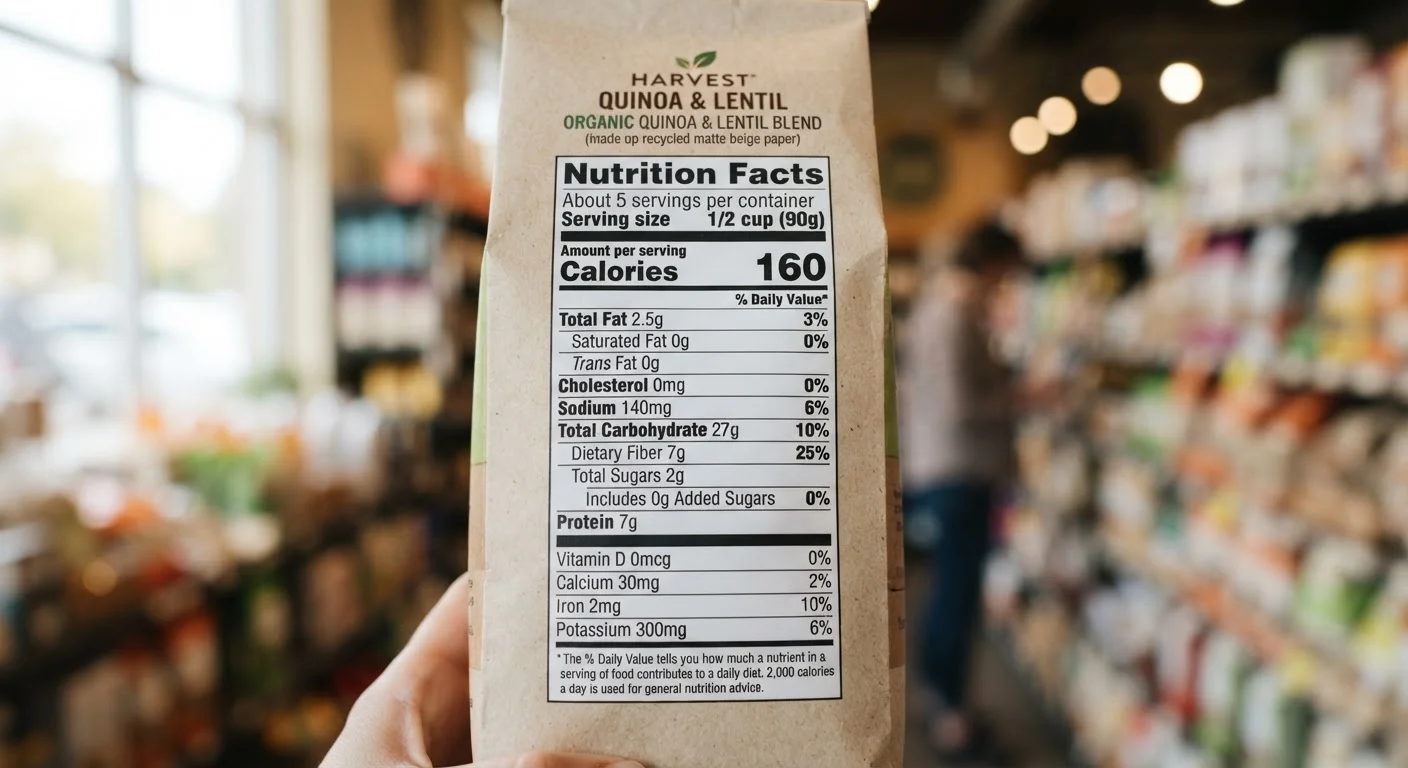
Start with the Serving Size
Every number on the label - calories, grams of fat, milligrams of sodium - refers to one serving, not the entire package. Check the serving size (listed in familiar units like cups or pieces, plus grams) and the servings per container. If a bag lists 3 servings and you eat the whole bag, multiply every value by 3.
Note the Calories per Serving
Calories measure the total energy one serving provides. This number is displayed prominently. It's one data point among many - not the only thing worth tracking - but it anchors everything else on the label. A high-calorie food isn't automatically unhealthy, and a low-calorie food isn't automatically nutritious.
Scan the Nutrients to Limit
Look at saturated fat, sodium, and added sugars. Most Americans consume these in excess relative to general dietary guidelines. The label separates total sugars (naturally occurring plus added) from added sugars - a distinction that matters, since natural sugars in fruit or dairy come packaged with fiber, vitamins, and protein that slow their absorption.
Check the Nutrients to Prioritize
Look for dietary fiber, vitamin D, calcium, iron, and potassium - nutrients many Americans under-consume. A food that delivers a meaningful %DV of these while keeping saturated fat and sodium low is generally a solid nutritional choice within a balanced diet.
Use % Daily Value as a Quick Gauge
Run down the %DV column. Values at or below 5% mean the food contributes little of that nutrient per serving; values at or above 20% mean it contributes substantially. You don't need to add up percentages across the day - just use them to compare two similar products or to spot when a single food is dominating your intake of something you're trying to limit.
Once you're comfortable reading labels, you can use them to compare similar products and make more deliberate choices - without needing to count every calorie. For more on translating this knowledge into everyday meals, explore building a balanced plate.
What the % Daily Value Actually Means
The % Daily Value (%DV) column is one of the most misunderstood parts of the label. It tells you how much of a nutrient one serving contributes toward a general daily reference amount, based on a 2,000-calorie diet. That reference isn't a prescription - individual calorie needs vary - but it gives a useful benchmark for comparison.
A practical rule of thumb endorsed by nutrition researchers: 5% DV or less is considered low for a nutrient; 20% DV or more is considered high. Use this to quickly identify whether a food is a meaningful source of fiber or vitamin D, or whether it's pushing your sodium intake uncomfortably high in a single serving.
A Quick %DV Shortcut
When comparing two similar products, align them side by side and scan the %DV column. The product with higher %DV for fiber and lower %DV for sodium and saturated fat is generally the more nutrient-dense option. This comparison takes about 20 seconds once you're practiced.
Nutrients to limit (where lower %DV is generally better): saturated fat, sodium, and added sugars. Nutrients to get enough of (where higher %DV is generally better): dietary fiber, calcium, iron, potassium, and vitamins D and C. For a deeper look at how individual vitamins and minerals function, refer to our micronutrient reference guide.
The Ingredient List and What It Tells You
Just below or beside the Nutrition Facts panel, you'll find the ingredient list. Ingredients are listed in descending order by weight - meaning the first ingredient is present in the largest amount. If added sugar (under any of its many names: corn syrup, dextrose, cane juice, maltose) appears in the first three ingredients, the product is heavily sweetened.
The ingredient list complements the Nutrition Facts panel. A food can show modest sugar grams per serving but still be highly processed if its ingredient list is long and dominated by refined starches, stabilizers, and artificial additives. Understanding that distinction is explored further in our article on whole foods vs. processed foods.
You don't need to memorize every additive. Focus first on whether recognizable, whole-food ingredients lead the list, and whether any form of sugar or refined flour appears multiple times under different names - a common way total sugar content is effectively spread across several entries.
This article is for general informational and educational purposes only and is not a substitute for personalized nutrition or medical advice. Consult a registered dietitian or qualified healthcare professional for guidance specific to your health needs.