

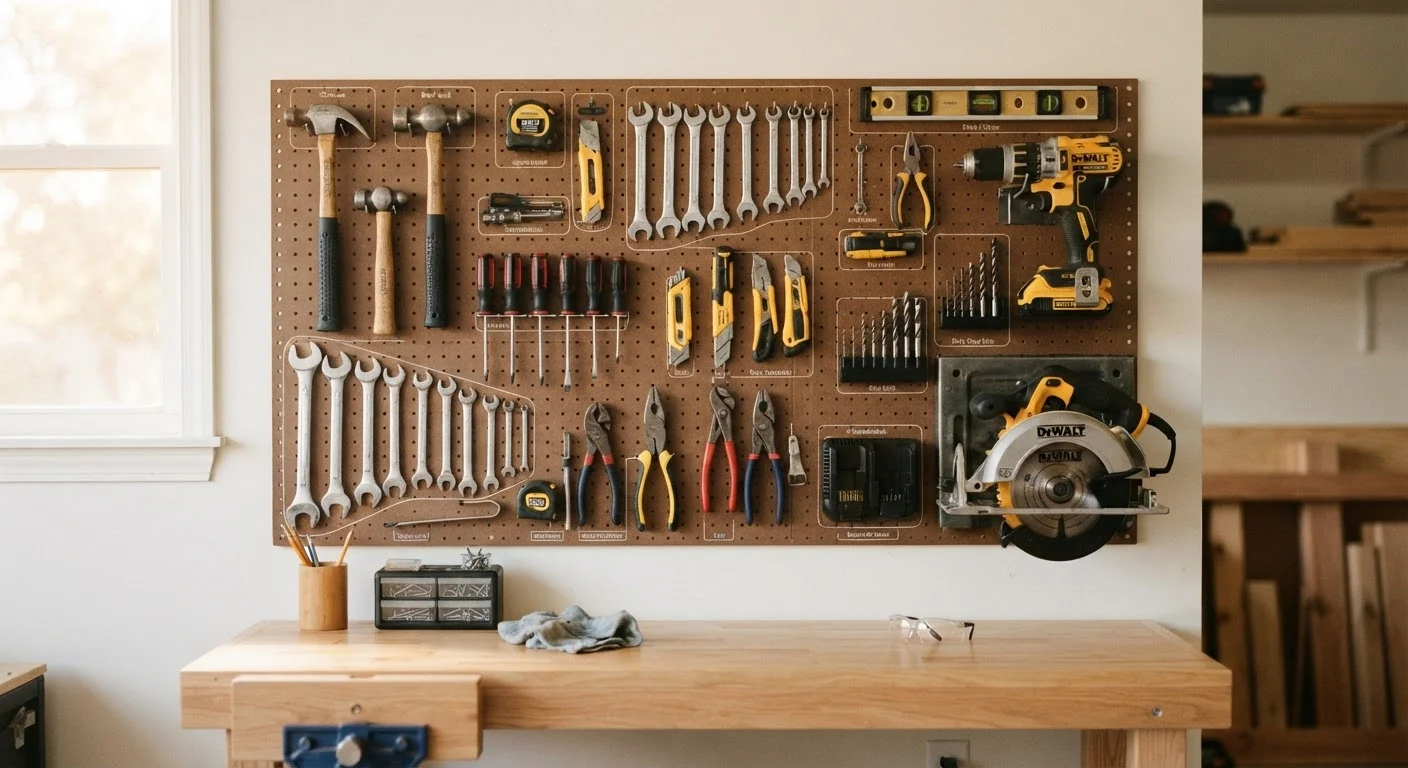
Key Takeaways
Option A
Hand Tools
The precise, quiet, and budget-friendly staple of every toolkit.
Best for: Detailed finishing work, small repairs, and jobs where control and feel matter more than speed.
Option B
Power Tools
The high-speed workhorse for repetitive or large-scale tasks.
Best for: Projects involving volume, repetition, or materials that resist manual effort - such as framing, decking, or long rip cuts.
If you're doing occasional small repairs around the house
Hand Tools
A quality set of hand tools handles most patching, tightening, and trim work without the cost or storage demands of powered equipment.
If you're tackling a large renovation or multi-step project
Power Tools
Repetitive cuts, driving dozens of screws, or sanding large surfaces become manageable in a fraction of the time with the right power tools.
If you live in an apartment or noise-sensitive environment
Hand Tools
Hand tools generate minimal noise and dust, making them far more neighbor-friendly and practical in shared living situations.
If you're a first-time DIYer building foundational skills
Hand Tools
Learning to work with hand tools builds spatial awareness and material intuition that makes you a safer, more capable power-tool user later.
If precision and a clean finish are the top priority
Hand Tools
Tasks like trimming a door, cutting a mortise, or fitting trim joints benefit from the tactile feedback only hand tools provide.
Why the Choice Matters More Than You Might Think
Most homeowners default to whatever tool feels most impressive - often a power tool - without asking whether it's actually the right fit. That mismatch is behind a surprising number of botched repairs: stripped screws from an over-torqued drill, splintered trim from a circular saw, or a drywall patch that's rougher than the original damage.
The goal isn't to pick a side. It's to understand what each category does well so you can make smarter choices job by job. For a broader foundation on this thinking, see everything first-time DIYers need to know.
| Criterion | Hand Tools | Power Tools |
|---|---|---|
| Upfront cost | Lower - basic set is affordable | Higher - varies by category |
| Precision and control | Excellent for fine work | Good, but less tactile feedback |
| Speed on repetitive tasks | Slower | Significantly faster |
| Noise and dust | Minimal | Significant; PPE required |
| Storage and portability | Compact, lightweight | Bulkier; some require power access |
| Learning curve | Lower - intuitive for beginners | Higher - safety training needed |
| Best project scale | Small repairs and finishing | Medium to large projects |
Where Hand Tools Have a Clear Edge
Hand tools shine in three situations: confined spaces, delicate materials, and finish work. A sharp chisel gives you feedback through your hands that no router can replicate - you feel the grain, sense resistance, and adjust in real time. That tactile loop is critical for fitting a door latch plate, paring a hinge recess, or scribing trim to an uneven wall.
Hand tools also win on setup time. Driving a single screw? A good screwdriver beats hunting down the drill, finding the right bit, and charging the battery. For repairs that involve a handful of fasteners or one precise cut, hand tools are simply faster from start to finish.
Cost is another factor worth taking seriously. A solid set of hand tools - hammer, tape measure, combination square, chisels, hand saw, and assorted screwdrivers - can be assembled for a fraction of what a comparable power-tool kit costs. For guidance on evaluating larger tool investments, principles for making big purchases wisely apply directly here.
~60%
US homeowners who attempt DIY repairs
Various home improvement surveys consistently find that a majority of US homeowners undertake at least some DIY repairs or improvements each year.
3-5×
Time savings for repetitive tasks with power tools
General estimates in woodworking and construction literature suggest power tools can reduce time on high-repetition tasks by three to five times compared to hand-tool equivalents.
$200-$400
Typical cost of a solid starter hand-tool set
A functional general-purpose hand-tool kit covering most common home repairs typically falls in this range, based on general market data for non-specialty tools.
Where Power Tools Justify the Investment
Power tools earn their place when volume or resistance exceeds what manual effort can handle efficiently. Driving 200 deck screws by hand would take hours and leave you with sore wrists. A cordless impact driver does the same job in a fraction of the time with consistent torque.
Similarly, any project requiring repeated cuts to the same dimension - shelving, framing, flooring - benefits enormously from a miter saw or circular saw with a guide fence. Manual saws can make the same cuts, but maintaining consistent angles across 30 boards is genuinely difficult without mechanical assistance.
Power sanders transform refinishing work. What takes an afternoon with sandpaper and a sanding block takes 20 minutes with a random-orbit sander - and the finish is often more even because the tool eliminates the directional pressure humans naturally apply.
Important safety note: Power tools require proper safety equipment (eye protection, hearing protection, dust masks) and a clear understanding of the tool's operation before use. Never bypass guards or use a tool in a way not described in its manual. For tasks touching electrical systems, always consult what homeowners can legally do with DIY electrical work before proceeding.
Task-by-Task Guidance for Common Home Repairs
Rather than choosing a camp, think task-first:
- Hanging a picture or mirror: Hand tools only - a hammer, level, and nail or wall anchor is all you need.
- Installing cabinet hardware: A power drill speeds up pilot holes, but a hand screwdriver gives better feel for final tightening without stripping.
- Patching drywall: Hand tools for mixing compound and applying it; a sanding block for finishing. A drywall saw is useful for cutting patches but isn't essential for small holes.
- Trimming a door that sticks: A hand plane is ideal for small adjustments; a power planer or circular saw for removing significant material.
- Building a raised garden bed: A power drill and impact driver make driving long screws manageable, while a hand saw can handle cutting lumber to length for simple designs.
The pattern: power tools rough in, hand tools refine. Combining both - rather than treating them as competitors - is how experienced DIYers get professional-looking results.
Keeping your tools in good condition is equally important. Neglecting routine maintenance always costs more - the same principle applies to tools: a dull blade or corroded battery terminal turns a 20-minute job into a frustrating hour.
When Neither Is Enough: Knowing When to Call a Pro
Some jobs fall outside the safe DIY zone regardless of which tools you own. Structural work, load-bearing modifications, gas lines, and most electrical panel work typically require licensed professionals - and in many jurisdictions, permits and inspections are legally required. No tool choice substitutes for that expertise or legal protection.
If a repair reveals damage beyond your skill level or scope, stepping back is the right call. Review a homeowner's contractor vetting checklist before bringing anyone in, so you know exactly what to look for in licensing, insurance, and written scope.
Permits and Codes Apply to Tools and Tasks
The tool you use doesn't change whether a job requires a permit. Structural alterations, electrical work beyond device replacement, and plumbing into mains supply commonly require permits in most US jurisdictions. Always check with your local building department before starting - unpermitted work can complicate home sales and insurance claims. This is general guidance; requirements vary significantly by location.