

| Primary communication channel with humans | Meowing (adult cats rarely meow to other cats) |
| Tail-up greeting signal | Indicates friendliness and confidence |
| Slow blink studied in | Scientific Reports, 2020 (Humphrey et al., Scientific Reports, 2020) |
| Purring function | Contentment and self-soothing (not exclusively positive) |
| Belly exposure meaning | Trust signal - not necessarily an invitation to touch |
| Yowling warrants | Veterinary evaluation if persistent |
How to Use This Guide
Cats communicate through a layered system of body posture, vocalizations, facial signals, and scent - most of which happens below the level of human conversation. This reference guide breaks those signals into scannable categories so you can look up what you're seeing and respond appropriately.
Because signals rarely appear in isolation, context always matters. A flattened ear means something different during play than during a vet visit. Use the glossary to anchor unfamiliar terms, and cross-reference with our species body language guide for broader context. If a behavior change is sudden or unexplained, consult your veterinarian - behavioral shifts can sometimes signal underlying health concerns. See also our guide to signs your pet may be in pain.
| Primary communication channel with humans | Meowing (adult cats rarely meow to other cats) |
| Tail-up greeting signal | Indicates friendliness and confidence |
| Slow blink studied in | Scientific Reports, 2020 (Humphrey et al., Scientific Reports, 2020) |
| Purring function | Contentment and self-soothing (not exclusively positive) |
| Belly exposure meaning | Trust signal - not necessarily an invitation to touch |
| Yowling warrants | Veterinary evaluation if persistent |
Tail Signals
A cat's tail is one of its most expressive tools. Learning to read it quickly gives you a reliable read on emotional state.
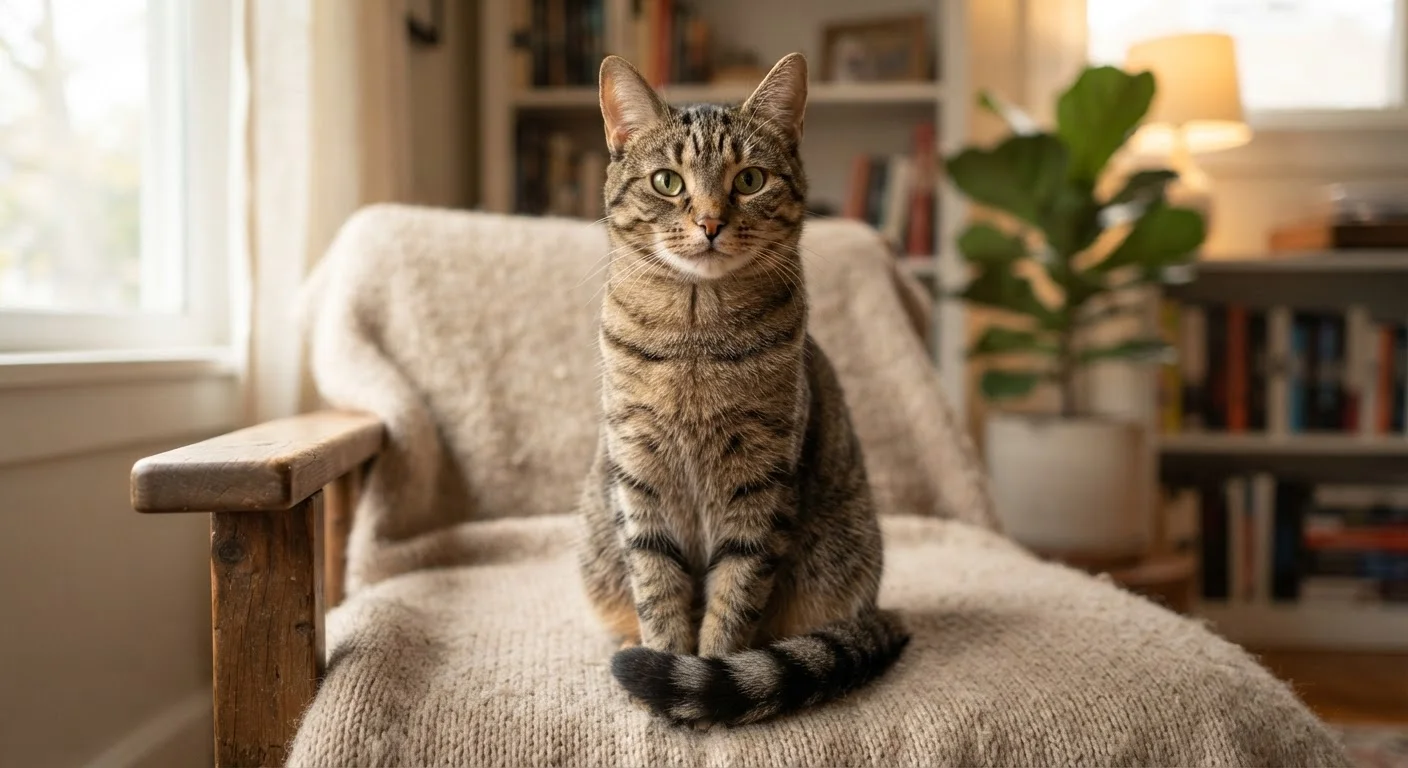
- Tail held high, tip slightly curved: Confident, friendly greeting. Common when a cat approaches someone it trusts.
- Tail puffed (piloerection): Fear or extreme arousal. The cat is trying to appear larger. Give space.
- Tail tucked low or under body: Anxiety or submission. The cat feels threatened or insecure.
- Slow, wide tail sweep: Mild irritation or conflict between competing urges - not the same as a dog's happy wag.
- Tail wrapped around another cat or person: Social bonding and affiliation.
Ear and Eye Signals
Ears and eyes shift rapidly, making them reliable real-time indicators of mood.
Ears
- Forward and slightly outward: Alert, interested, engaged.
- Rotated to the side ("airplane ears"): Mild stress or conflict - the cat is uncertain.
- Flat against skull: Fear, defensiveness, or aggression. Do not approach.
Eyes
- Slow blink: A well-documented affiliative signal. Cats often use it with trusted humans. Returning a slow blink can reinforce trust - research published in Scientific Reports (2020) found cats were more likely to slow-blink back when humans initiated the gesture.
- Dilated pupils in normal light: Arousal, fear, or playfulness - context clarifies which.
- Constricted pupils in low light: Calm or focused aggression. Notably different from the expected dilation response.
- Direct stare: A challenge or threat in feline social language.
For a broader breakdown of feline and canine body language side by side, see our field guide to pet body language.
Vocalizations at a Glance
Adult cats rarely meow to other cats - meowing appears to be a communication style directed primarily at humans. Understanding the nuances helps you respond meaningfully.
- Short, rising meow: Greeting or request - the feline equivalent of "hey."
- Prolonged, low meow: Complaint or demand. Often food- or attention-related.
- Chirping or chattering: Excited prey-directed vocalization, typically aimed at birds or insects through a window.
- Trill or chirrup: Friendly, affiliative - often used by mothers calling kittens, and by adult cats greeting trusted companions.
- Hissing or spitting: Clear warning. The cat feels cornered or threatened.
- Yowling: Intense distress, pain, territorial conflict, or reproductive signaling. Persistent yowling warrants a veterinary check.
- Purring: Usually contentment, but cats also purr when stressed or unwell. Purring has a self-soothing function.
Piloerection
Involuntary raising of the fur along the spine or tail, caused by activation of the sympathetic nervous system. It makes the animal appear larger and signals fear or high arousal.
Affiliative behavior
Social actions that promote bonding and positive relationships between individuals, such as head bunting, grooming, or slow blinking.
Displacement behavior
An out-of-context action (like grooming mid-play) that signals internal conflict or stress. It's a coping mechanism, not random behavior.
Trill
A short, rising, chirp-like vocalization cats use to greet familiar individuals or signal friendly intent. Distinct from meowing or hissing.
Bunting
When a cat presses its forehead or cheek against a person, object, or other animal. Scent glands in the face deposit the cat's scent, marking the target as familiar and safe.
Kneading
A rhythmic pushing motion with alternating front paws. Originates from nursing behavior in kittens and persists into adulthood as a comfort signal.
Posture and Touch Behaviors
How a cat holds its body and chooses to interact physically reveals confidence level and emotional intent.
- Slow, deliberate blinking + relaxed posture: Comfortable and at ease in the environment.
- Exposing belly: Often misread as an invitation to pet. It usually signals trust and relaxation - not a request for a belly rub. Many cats will redirect suddenly if touched there.
- Head bunting (bumping head against you): Affiliative scent-marking and social bonding.
- Kneading: A holdover from nursing behavior; indicates contentment and comfort with the surface or person.
- Loaf posture (paws tucked under body): Relaxed and content, not ready to flee.
- Crouched low with wide eyes: Fear response. Avoid forcing interaction.
Sudden changes in how a cat positions itself - especially combined with reduced grooming or altered bathroom habits - can be early indicators of discomfort. If your cat has stopped using its litter box, behavioral and environmental causes are worth ruling out first: see our guide on litter box avoidance in cats. For general day-to-day care context, the Pet Care Basics hub is a useful starting point.