

Key Takeaways
Our Verdict
Neither peak nor off-season travel is universally superior - the right choice depends on what you value most. Peak season rewards those who prioritize atmosphere, dependable weather, and access to every experience a destination offers. Off-season suits travelers who put budget and crowd-free sightseeing first and can adapt to reduced services. For many, shoulder season threads the needle between the two.
| Best for | Recommended |
|---|---|
| Families with school-age children or fixed vacation windows | Peak Season |
| Budget-conscious solo or couple travelers with flexible schedules | Off-Season |
| Travelers seeking the best value-to-experience ratio | Shoulder Season |
| Those planning event-driven or festival-focused trips | Peak Season |
The Real Trade-Offs: Cost, Crowds, and Conditions
Choosing when to travel shapes virtually every element of the experience - what you pay, how long you wait in line, which services are actually running, and what the destination feels like when you arrive. Let's be specific about what each season actually delivers.
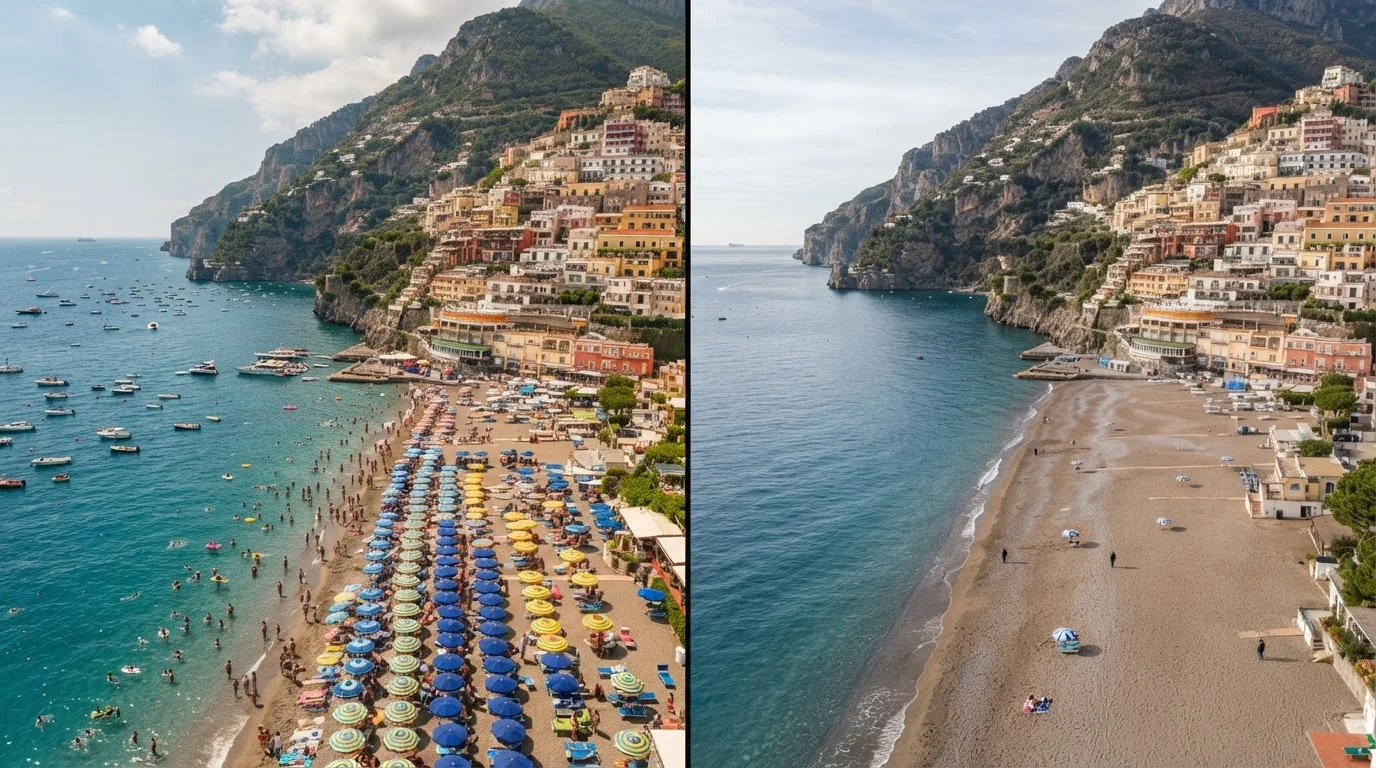
Peak season clusters around school holidays, summer months, and major local festivals. Demand is highest, which means prices for flights and accommodations follow. Attractions are fully open, guided tours run frequently, and the destination hums with energy. The downside: queues at major sites can stretch hours, accommodation availability shrinks the closer you book, and the general atmosphere can tip from lively to overwhelming.
Off-season flips those dynamics. Prices for the same flights and hotels frequently drop - often substantially - and popular sights feel genuinely accessible. But some experiences genuinely don't exist off-season: mountain resorts may close entirely, beach bars shutter, and ferry routes to island destinations can run on reduced or suspended schedules. Weather uncertainty is the other variable; off-season timing at many destinations coincides with rainy periods or extreme temperatures.
For a deeper look at how timing interacts with what a destination actually feels like, see how off-season changes a destination's atmosphere.
| Peak Season | Off-Season | |
|---|---|---|
| Flight & hotel prices | Highest; book well in advance | Noticeably lower; more last-minute flexibility |
| Crowd levels | High; queues common at major sites | Low to moderate; easier access to attractions |
| Service availability | Full - tours, restaurants, transport running | Reduced; some venues or routes may close |
| Weather reliability | Generally predictable and favorable | More variable; check destination-specific patterns |
| Booking lead time needed | Months in advance for popular destinations | Weeks; spontaneous travel more feasible |
| Atmosphere | Energetic, festive, occasionally overwhelming | Quieter, local-feeling, sometimes sparse |
| Best suited for | Families, event-seekers, fixed schedules | Budget travelers, flexible schedules, solitude-seekers |
The Shoulder Season Advantage (and Its Limits)
Shoulder season - broadly defined as the weeks on either side of peak - is frequently the strategist's pick. Prices have eased from their peak but services haven't yet wound down. Crowds are thinner, but the restaurant you want is still open and the museum runs its full program. Weather is often still favorable, particularly in Mediterranean and coastal destinations.
The limitation is that shoulder season isn't uniformly defined across destinations. In Iceland, it might mean May or September. In Southeast Asia, the margins are tighter and shaped by monsoon patterns rather than tourist calendars. Doing destination-specific research - not relying on general rules - is essential. Our guide to planning around shoulder season breaks this down by destination type.
The other caveat: if you have a fixed travel window (school schedules, work calendars), shoulder season may not be a realistic option. In that case, knowing how to navigate peak season smartly matters more than avoiding it.
Booking Strategy Changes by Season
When you book matters as much as when you travel. Peak season compresses the window for securing good options - flights and hotels at popular destinations during summer or major holidays can sell out or spike in price months in advance. The general pattern: the higher the demand, the earlier you need to commit.
Off-season gives you more runway. Last-minute flexibility becomes viable in a way it simply isn't during peak. This suits travelers who prefer looser structures - for a framework on that approach, see flexible vs. fully scheduled itineraries.
Regardless of season, understanding lead times for each travel component - flights, hotels, and activities - helps you sequence your planning effectively. How booking timing actually works covers that in detail.
One practical note: travel insurance terms and cancellation policies often differ between peak and off-season bookings. Always verify what you're agreeing to before confirming a reservation, and check official government travel advisories and entry requirements before any trip, as these can change.
Matching Season to Your Travel Style
The honest answer to "when should I travel?" is that it depends on what you're optimizing for. Run through these questions before committing to dates:
- How flexible is your schedule? Fixed windows often mean peak season by default. Work with that rather than against it.
- What's your priority - budget or experience completeness? Off-season saves money but may mean closed attractions or limited dining.
- How do you feel about weather uncertainty? Off-season often means higher risk of disrupted plans due to conditions.
- Is the destination event-driven? Some places are worth visiting specifically during their busiest periods - Carnival in New Orleans, cherry blossom season in Japan - and off-season removes the entire point.
Your travel style also factors in. Slow travelers who linger in one place for days tend to experience off-season more richly - they find the open local cafés, the empty trails, the unhurried conversations. Fast-paced itineraries depend more on everything being operational. For more on how travel style intersects with planning, city break vs. slow travel lays out those trade-offs clearly.
More practical tools and seasonal planning advice are collected in our Travel Tips & Hacks hub.