

Key Takeaways
Our Verdict
Neither open shelving nor closed cabinetry is universally superior - the right choice depends on how your household actually uses and maintains the kitchen. Open shelving rewards organized, aesthetically intentional cooks, while closed cabinetry suits those who value low-maintenance tidiness and maximum concealed storage. Most kitchens benefit from a thoughtful combination of both.
| Best for | Recommended |
|---|---|
| Homeowners who entertain frequently and keep a curated, orderly collection of dishware | Open Shelving |
| Busy households that prioritize low daily maintenance and ample concealed storage | Closed Cabinetry |
| Those wanting visual lightness without sacrificing total storage capacity | Hybrid Approach |
| Anyone planning a renovation with resale value in mind | Closed Cabinetry |
The Core Trade-Off: Visibility vs. Concealment
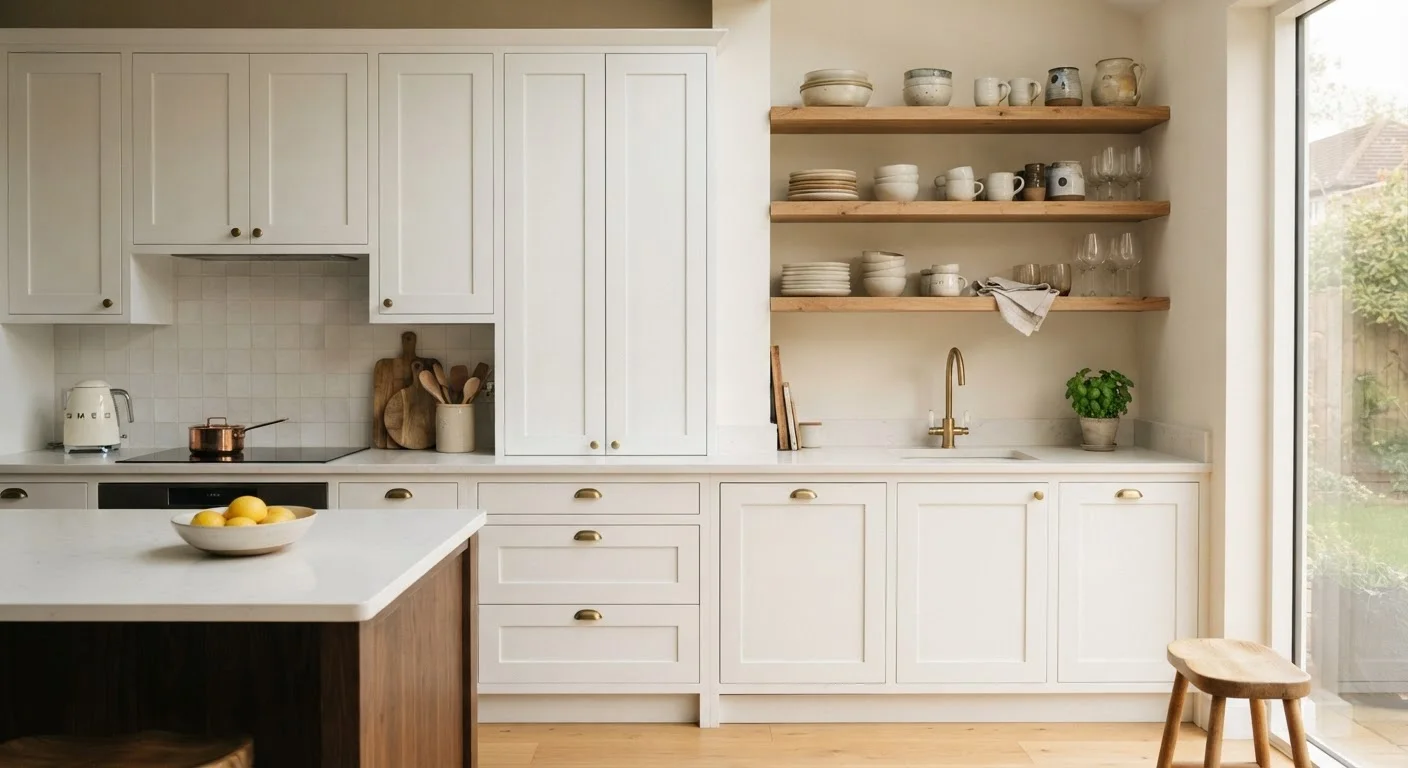
The debate between open shelving and closed cabinetry often gets framed as a style question, but it's really a question of how you want to live in your kitchen day to day. Open shelves put everything on display - your dishware becomes décor, your organization becomes permanent performance. Closed cabinets, by contrast, draw a curtain between your storage and your living space, letting the kitchen look composed regardless of what's tucked inside.
Understanding this distinction matters especially if you're mid-renovation and weighing where to invest. As the sequence of your renovation affects which decisions lock in early, storage layout is one worth settling before walls are committed.
| Open Shelving | Closed Cabinetry | |
|---|---|---|
| Maintenance | Frequent dusting and wiping required | Low - doors contain dust and grease |
| Visual effect | Airy, spacious, decorative | Tidy, cohesive, traditional or modern |
| Accessibility | Instant visibility, easy reach | Requires opening doors; interior organizers help |
| Clutter tolerance | Low - everything is visible | High - doors conceal disorder |
| Grease/dust protection | Minimal - items exposed to kitchen air | Strong - contents fully enclosed |
| Resale appeal | Style-specific, divides buyers | Broadly appealing to most buyers |
| Customization | Limited to shelf depth and material | Extensive interior organizer options |
Open Shelving: What It Actually Demands
Open shelving looks effortless in design magazines, but it comes with a real maintenance contract. Kitchens generate grease vapor, steam, and fine dust - all of which settle on exposed surfaces. Items stored on open shelves need to be wiped down regularly, and the shelves themselves require frequent cleaning. In a busy cooking household, this is a meaningful time commitment.
Accessibility is genuinely better with open shelves: you can see everything at a glance and reach items without opening doors. This works beautifully for frequently used pieces - everyday plates, glasses, and a few well-chosen pantry items. The challenge comes with the inevitable visual noise of a real kitchen versus a staged one. Mismatched containers, half-empty boxes, and everyday clutter read immediately on open shelves in a way they never do behind cabinet doors.
If you're drawn to open shelving near your food storage area, it's worth thinking through what goes where. Our guide to stocking a pantry that supports daily eating habits can help you decide which staples earn visible real estate and which belong behind a door.
Closed Cabinetry: The Case for Concealment
Closed cabinetry remains the dominant kitchen storage choice for good reason. It protects contents from grease, dust, and light - preserving dishware finishes and food packaging longer. It also absorbs organizational imperfection: doors close and the kitchen looks finished, regardless of what's stacked behind them.
Cabinet interiors can be customized extensively with pull-out drawers, lazy Susans, door-mounted organizers, and adjustable shelving - tools that improve accessibility without sacrificing concealment. That flexibility makes closed cabinetry adaptable to a wide range of storage needs over time.
From a resale perspective, buyers tend to respond positively to well-proportioned, cohesive cabinetry. Open shelving reads as a deliberate stylistic choice that appeals to some buyers but alienates others - a relevant consideration if you view your kitchen as a long-term investment.
Test Before You Commit
If you're unsure whether open shelving suits your habits, try a low-stakes trial first. Remove the doors from one or two existing upper cabinets and live with the open shelves for four to six weeks. You'll quickly learn whether your organizational habits and cleaning routine can sustain the look - before any permanent changes are made.
The Hybrid Approach: Strategic Mixing
Most designers and experienced homeowners land on a hybrid model - not as a compromise, but as a genuinely intentional strategy. The logic is straightforward: place open shelves where items are beautiful, frequently used, and easy to keep organized. Reserve closed cabinetry for everything that doesn't need to be seen.
Common hybrid configurations include open shelves flanking a range hood (for oils, spices, and a few decorative pieces), with full-depth closed cabinets along the perimeter for bulk storage. Another approach uses open lower shelves on a kitchen island - where items are accessed from multiple angles - with traditional uppers remaining closed.
If your kitchen is compact, the visual weight of upper cabinetry can make the room feel enclosed. In those cases, removing upper cabinets in favor of open shelving can meaningfully open a space - a strategy covered in more depth in our piece on decorating compact rooms to feel intentional and open.
How to Decide What's Right for Your Kitchen
Before committing to either approach - or a mix of both - work through a few honest questions about your household:
- How often do you cook? Heavy daily cooking generates more grease and steam, increasing maintenance demands on open shelves.
- How consistent is your organization? Open shelves reward systems that stay in place. If your storage habits are fluid, closed doors protect the overall look.
- What does your dishware look like? A curated collection of matching or complementary pieces works well on display. Mismatched or utilitarian items often look better behind doors.
- How does the kitchen connect to adjacent rooms? If your kitchen flows directly into a living or dining area, visual cohesion matters more. Consider how storage choices affect the whole space - a principle explored in our piece on why room-by-room decorating often undermines cohesion.
There's no objectively correct answer. The best kitchen storage is the kind that fits how you actually live - not how you plan to live once everything is perfectly organized.