

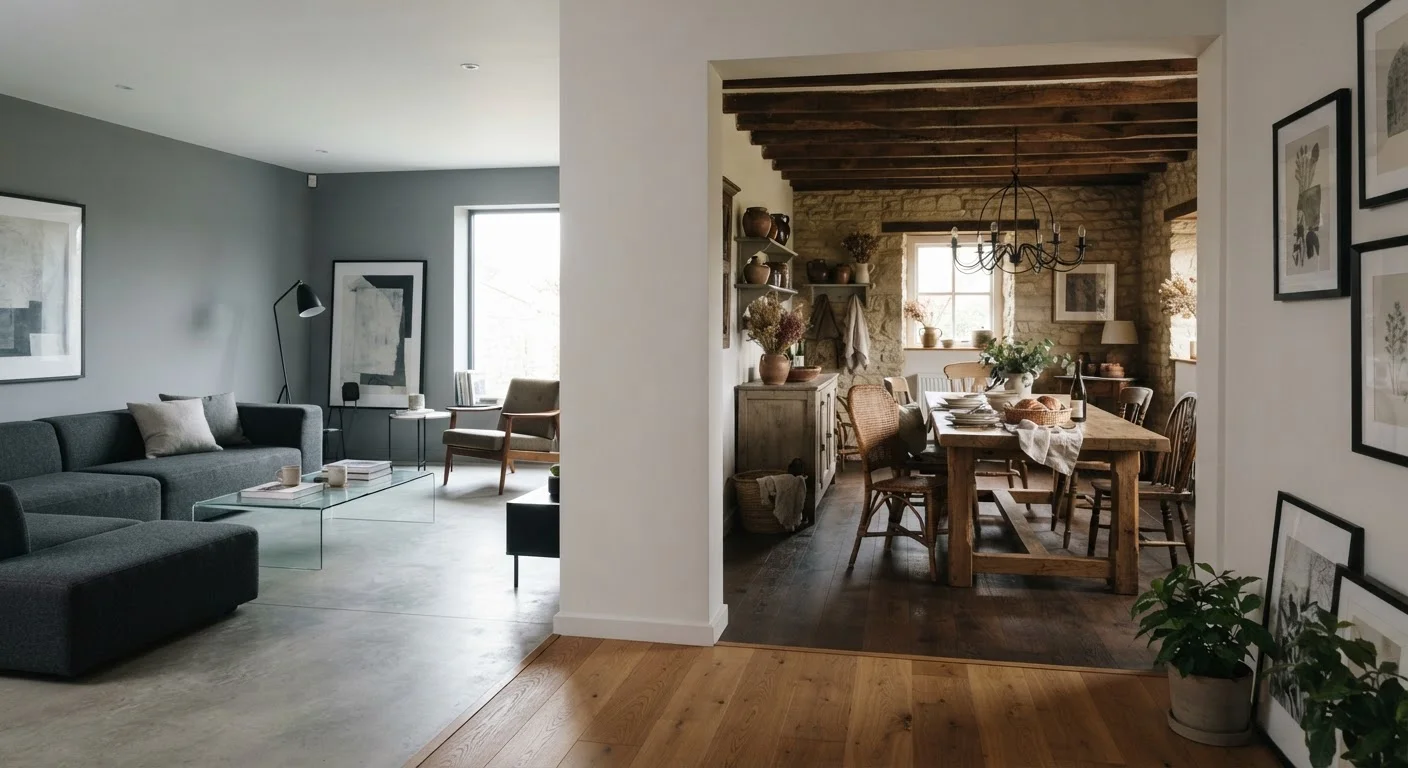
Key Takeaways
The Room-by-Room Trap and Why It Feels So Logical
It makes intuitive sense to tackle your home one room at a time. You have a budget, a free weekend, and a bedroom that desperately needs attention. So you focus there - pick paint, buy furniture, hang art - and it looks great in isolation. Then you step into the hallway. Something feels off. The bedroom looks like it belongs to a different house than the living room.
This is the room-by-room trap: each space is treated as a self-contained project, with no connective tissue linking it to the rest of the home. The result is a series of decent rooms that never add up to a coherent home. If you're just getting started, the first home decorator's grounding guide can help you establish a whole-home perspective before you spend a dollar.
Choosing each room's color palette independently, with no reference to adjacent spaces.
Why it happens: Paint decisions often happen in isolation - you love a deep teal for the bedroom, a warm terracotta for the kitchen - without ever checking how those colors look through a shared doorway.
Mixing unrelated furniture styles - mid-century in one room, coastal in the next - with no visual bridge.
Why it happens: Furniture is often purchased at different times, from different sources, based on what's available or on sale, rather than what fits a defined overall style.
Ignoring flooring transitions as a design element, treating them as purely functional.
Why it happens: Flooring is often inherited from a previous owner or installed room-by-room as budgets allow, leaving awkward clashes between wood tones, tile styles, or carpet patterns at every threshold.
Treating lighting as an afterthought selected per room, rather than as part of a home-wide fixture language.
Why it happens: Lighting is often the last purchase in any room project, chosen quickly from whatever fits the electrical box rather than for how it relates to fixtures elsewhere in the home.
Selecting art and textiles room-by-room without considering scale, tone, or material consistency.
Why it happens: Art and soft furnishings are emotional purchases made in the moment, which is why a home ends up with bold abstract canvas in one room and pastel botanical prints in the next.
The Mistakes That Break a Home's Cohesion
Understanding where things go wrong is the fastest way to course-correct - whether you're starting fresh or untangling a home that already feels scattered. These are the patterns we see most often.
Once you've identified these errors, you'll also want to understand the design principles behind rooms that actually feel good to be in - because cohesion isn't just about matching; it's about rhythm, balance, and intention across the whole space.
How to Build a Home That Reads as One
The antidote to room-by-room decorating isn't designing every space the same. Cohesion allows for variety - a moody home office and an airy kitchen can coexist - as long as they share a unifying thread. That thread might be a recurring accent color, a consistent wood tone, a shared material palette, or simply a tonal mood (warm vs. cool).
Start by identifying two or three elements that will appear in every room: a metal finish for hardware and lighting, a base neutral for walls or floors, and a texture family (linen, rattan, matte ceramic). From there, each room can express its own personality within those guardrails. This is how professional designers create homes that feel collected rather than chaotic. Explore how color, pattern, and texture work together to reinforce this kind of layered cohesion.
Sightlines deserve special attention. Stand in your front entry and note what rooms are visible. Whatever the eye travels to first sets expectations for the whole home. That view - even a partial one - should feel intentional. For room-specific focal points, see how to find and frame a room's focal point.
Before starting your next room project, use a pre-project clarity checklist to map your decisions against the whole-home vision - not just the room in front of you.
Don't Let 'One Room at a Time' Become an Excuse
Tackling your home incrementally is perfectly reasonable - budgets and time demand it. The mistake isn't the pace; it's the lack of a guiding framework. Decide on your whole-home palette, material family, and style direction first, then execute room-by-room within that plan. Skipping the framework turns every room into a fresh start that fights the rooms already finished.