

Key Takeaways
What a Focal Point Actually Does
A focal point is the dominant visual element a room is organized around - the first thing your eye lands on when you step through the door. It gives a space a sense of intention. Without one, furniture floats, the eye bounces aimlessly, and even well-furnished rooms feel somehow unresolved.
Understanding this concept is one of the foundational ideas in the design principles behind rooms that feel good. A focal point creates hierarchy - it tells you where to look first, which in turn tells you where to sit, where to place your coffee table, and where to hang your art.
The good news: every room either already has a natural focal point or can have one built. The process is the same either way - identify, evaluate, and frame.
One Anchor Makes Every Decision Easier
A focal point doesn't just improve how a room looks - it simplifies every decorating decision that follows. Once you know what the room is organized around, choices about rug size, art placement, and lamp height all have a clear reference point. For a broader perspective on how rooms connect across a home, see why decorating room-by-room can backfire.
How to Find, Build, and Frame Your Focal Point
Follow these steps whether you're working with a grand living room or a compact bedroom. The principles scale to any space - and if your room is on the smaller side, these same ideas apply well alongside the decorating strategies for compact rooms.
Stand at the room's entry point and observe
Position yourself in the doorway or wherever someone first enters the room. Look straight ahead without deliberately moving your eyes - where does your gaze land naturally? That instinctive landing spot is either your existing focal point or where one wants to be.
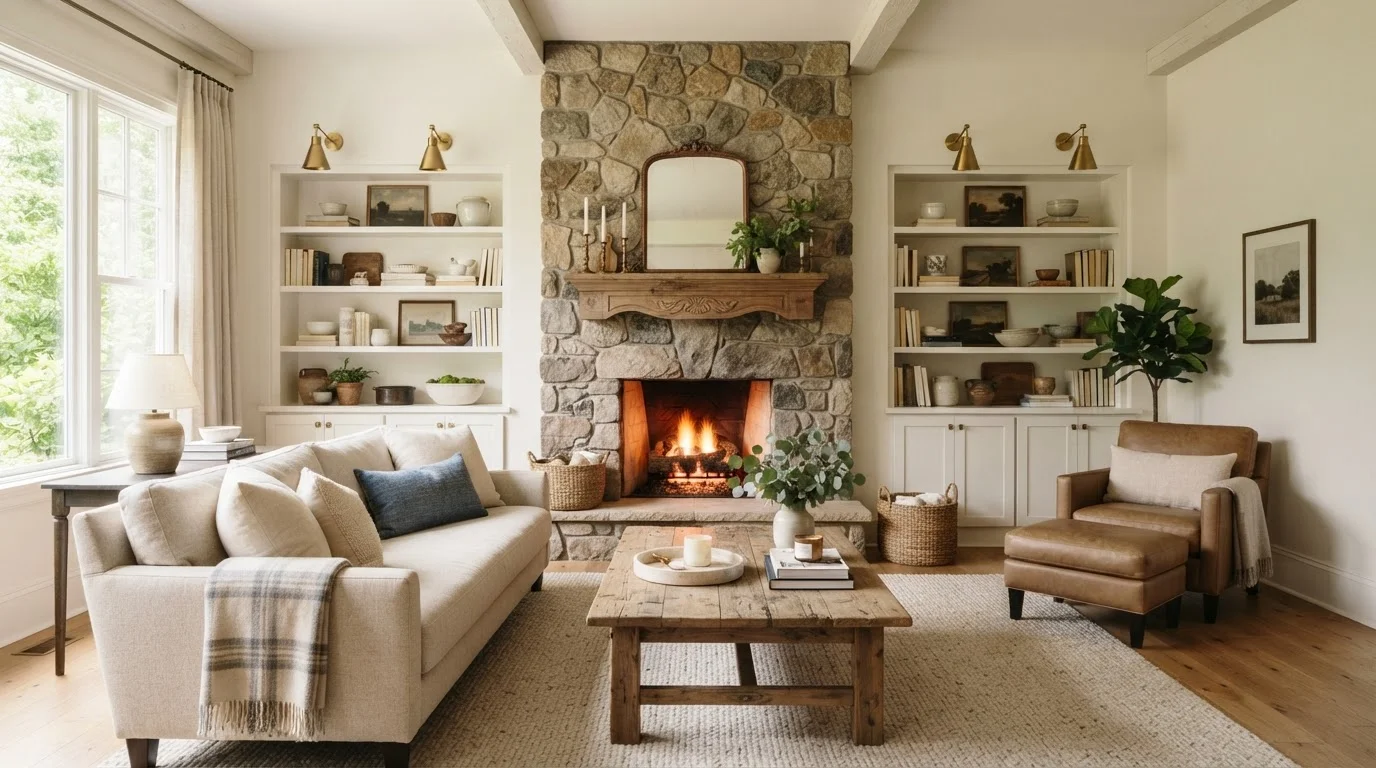
Note whether the room already has an architectural anchor: a fireplace, a bay window, a built-in bookcase, or a dramatically pitched ceiling. These are pre-built focal points the room's structure handed you for free.
Evaluate whether the existing feature is worth leading with
Once you've identified the candidate feature, ask three questions:
- Is it visually strong enough to hold attention - or does it currently get lost?
- Is it in a logical position for furniture to orient toward?
- Does it reflect your personal style, or is it a default you have never consciously chosen?
A north-facing window with an uninspiring view may be the room's dominant feature by default - but you might choose to redirect attention elsewhere by creating a stronger designed element and minimizing the window with simple, receding treatments.
Build a focal point if none exists
Rooms without architectural features - many bedrooms, dining rooms, and open-plan spaces - need a designed focal point. Effective approaches include:
- A large-scale piece of art or a curated gallery wall centered on the primary wall
- A statement headboard in a bedroom, centered on the wall opposite the door
- An accent wall in a bold color, textured wallpaper, or architectural paneling such as board-and-batten
- An oversized mirror or a dramatically framed window treatment
The key is scale - whatever you choose must be large enough to claim visual authority. A single small print rarely reads as a focal point; a grouping or a single oversized piece does.
Arrange furniture to face and reinforce the focal point
Furniture placement is how you communicate the focal point to anyone entering the room. In a living room, the main sofa should face - or angle toward - the focal feature. Chairs should complete a conversation grouping that keeps the feature in everyone's sightline.
Avoid lining furniture against walls. Floating pieces inward, even just 12-18 inches, creates a more intimate grouping that reinforces the focal point rather than ignoring it. Use an area rug to anchor the grouping and visually connect the pieces to the featured element.
Frame the focal point with symmetry, contrast, and light
Once identified and arranged around, the focal point needs deliberate framing - the design choices that make it feel chosen rather than accidental:
- Symmetry: Flanking a fireplace or headboard with matching lamps, sconces, or plants creates visual weight and signals importance.
- Contrast: A light-colored art piece pops against a darker wall; a dark wood console reads clearly against a pale backdrop. Contrast directs the eye efficiently.
- Accent lighting: A picture light, directional recessed fixture, or wall sconce aimed at the focal feature elevates it dramatically, especially in evening light.
- Negative space: Give the focal point breathing room. Crowding it with too many objects reduces its authority rather than building on it.
Common Mistakes That Undermine a Focal Point
Even after identifying the right element, a few recurring mistakes dilute its impact.
- Two focal points competing: A fireplace on one wall and a large television on another split the room's energy. Decide which takes priority and subordinate the other with lower contrast, smaller scale, or less lighting.
- Furniture pushed to the walls: Lining all seating against the perimeter breaks the visual conversation with the focal feature. Float furniture inward, angled toward it.
- Ignoring lighting: A beautiful art piece in dim light loses its authority. Layered lighting - especially accent light aimed at the focal feature - is what transforms it from nice to commanding.
- Mismatched scale: A small mirror above a wide mantle, or a tiny print above a long sofa, signals that the focal point was not considered deliberately. Scale your feature and its framing elements to one another.
If you're building a gallery wall as your focal point, plan it on paper before committing to the wall - see our guide on gallery wall layout planning for a methodical approach. And when you're ready to reinforce the focal element with color, pattern, or texture, using all three together is more achievable than most people expect.