

Key Takeaways
Why Small Spaces Deserve Serious Design Attention
Compact rooms are often treated as a problem to solve rather than a canvas to work with. In reality, limited square footage forces a kind of design discipline that larger rooms never require - every choice carries more weight, and thoughtful decisions pay off proportionally more. The strategies below aren't workarounds; they're genuinely good design principles that happen to be especially effective in smaller spaces.
Understanding what makes a room feel cramped versus open is the foundation. It's rarely just the raw dimensions. It's visual clutter, poor light distribution, furniture that's too large or too numerous, and color choices that absorb light rather than reflect it. Address those factors, and a small room starts to feel like an asset.
Core Decorating Practices for Compact Rooms
These six practices form the practical backbone of small-space decorating. Apply them selectively based on your room's specific constraints - not every tactic is needed in every space.
Anchor the room with a cohesive, light-toned color palette.
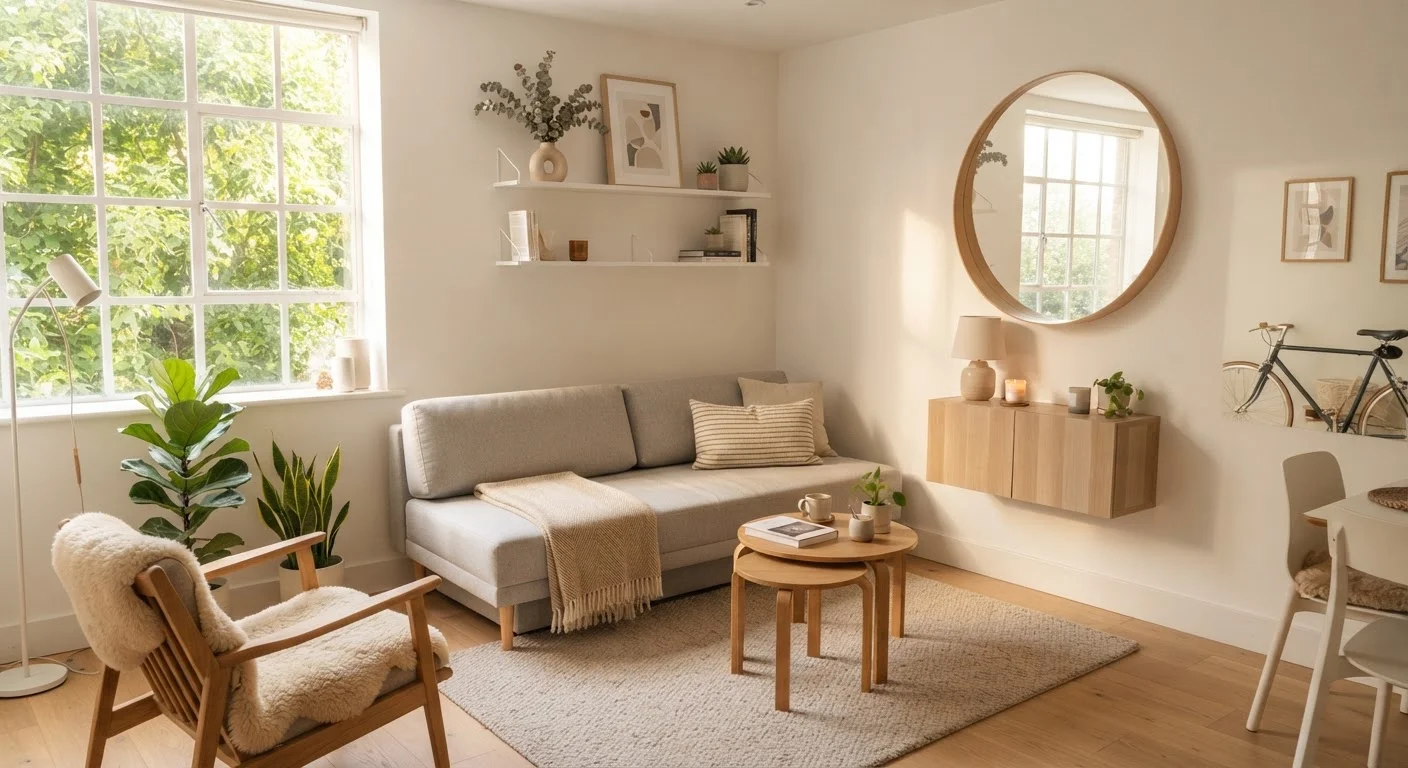
Cool whites, warm creams, and soft neutrals reflect light back into the room and reduce the visual weight of walls closing in. Using the same undertone across walls, trim, and large upholstered pieces keeps the eye moving smoothly rather than stopping at jarring contrasts. A single consistent palette also makes a small room feel deliberate rather than cramped.
Choose multifunctional furniture over single-purpose pieces.
Every piece of furniture in a small room must justify its footprint. Ottomans with interior storage, dining tables that fold against the wall, and bed frames with built-in drawers eliminate the need for extra accent pieces that eat floor space. Fewer pieces of higher utility let each item breathe.
Treat vertical space as prime real estate.
Most small-room decorators focus on the floor plan and ignore the walls above eye level. Floating shelves installed close to the ceiling, tall bookcases, and vertically oriented artwork all draw the gaze upward, making ceilings feel higher and rooms feel larger. It also relocates storage off the floor, which is the fastest way to reduce visual noise.
Use mirrors strategically to add depth and amplify light.
A well-placed mirror effectively doubles a room's visual real estate by reflecting the space back at the viewer. Positioning a mirror opposite or adjacent to a window bounces natural light deeper into the room and reduces the cave-like feeling that small spaces can develop. Even a modestly sized mirror with a slim frame earns its wall space.
Layer lighting to replace reliance on a single overhead fixture.
A single overhead light flattens a small room and emphasizes its boundaries. Layering table lamps, floor lamps, and wall sconces creates pools of warm light that break the room into inviting zones, distracting from its overall dimensions. This approach also gives the room flexibility for different moods and times of day.
Edit accessories ruthlessly and give each object room to breathe.
Clutter visually contracts a room faster than almost any structural limitation. Editing down to a smaller number of meaningful, well-spaced objects lets each one register - and makes even modest decor feel considered. The goal is curation, not minimalism for its own sake; personality comes through clearly chosen pieces, not quantity.
For rooms where open storage is part of the plan, it's worth understanding the full trade-offs. Our comparison of open shelving versus closed cabinetry is framed around kitchens but applies to any room where visual weight and accessibility are in tension.
Quick Moves You Can Make Today
Not every small-space improvement requires a furniture haul or a weekend project. These immediate actions can shift the feel of a room in an afternoon.
Upgrade Finishes Before Buying New Furniture
Before investing in new furniture for a small room, consider targeted surface upgrades. Refreshed tile grout, a new paint color, or updated trim can dramatically shift how a room reads without adding physical volume. Our guide to small-scale upgrades covers the highest-impact options.
If you're drawn to bringing greenery into a compact room, plant scale and placement matter significantly in tight quarters. Our guide to decorating with indoor plants covers species that work well in lower-light spaces and how to arrange them without overwhelming the room.
Keeping the Big Picture in View
Small rooms are most successful when they're designed with the surrounding home in mind rather than treated as standalone projects. A compact bedroom that shares paint undertones and material textures with the living room it opens onto will always read as more spacious than one that's been decorated in isolation.
Small Rooms Benefit from a Whole-Home View
How individual rooms connect visually to the rest of your home matters just as much as what's inside them. Consistent color undertones and material choices across rooms help compact spaces feel like intentional parts of a larger whole rather than isolated afterthoughts. See our guide to decorating for cohesion for practical ways to tie rooms together.
If you're considering a gallery wall as part of a compact room's personality, composition planning becomes especially important where space is tight. Our gallery wall layout guide walks through how to map arrangements on paper before committing to nail holes - a smart step in any room, and essential in smaller ones where proportions are less forgiving.