

Key Takeaways
Pet Food Label
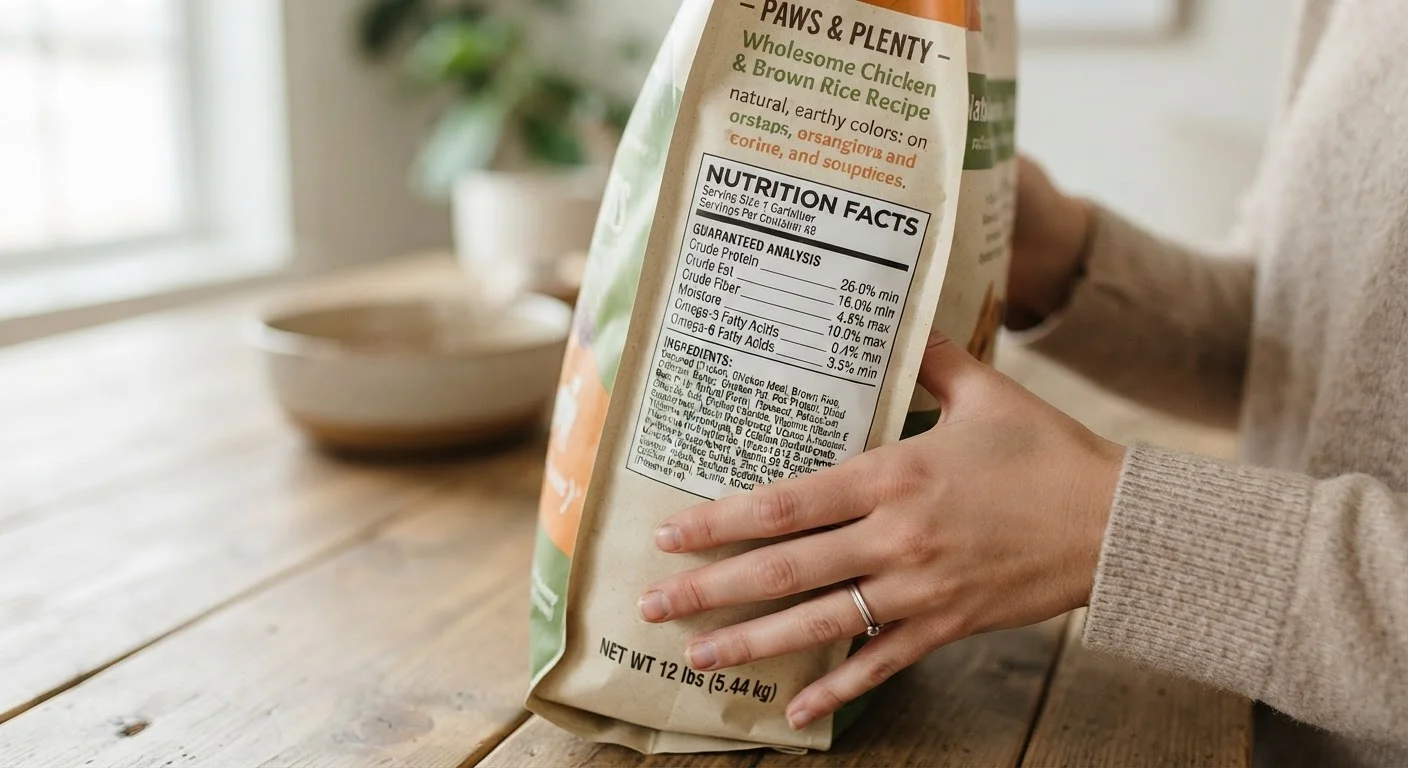
A pet food label is the printed panel on commercial pet food packaging that discloses ingredients, nutrient levels, feeding directions, and regulatory compliance information. In the US, pet food labels are regulated by the Association of American Feed Control Officials (AAFCO) and, in some states, state feed control officials. Reading these labels correctly helps owners evaluate whether a food meets their pet's nutritional needs.
AAFCO establishes model regulations for pet food labeling, including nutrient profiles and ingredient definitions, but enforcement is carried out at the state level - meaning standards can vary slightly by state.
Why Pet Food Labels Are Worth Understanding
Walking down the pet food aisle, it's easy to be swayed by packaging phrases like "natural," "premium," or "grain-free." These terms are largely marketing language and carry little or no regulatory meaning. The actual nutrition story lives in the label panel - a dense block of text that most owners skip. Learning to read it takes less time than you might think, and it can meaningfully inform the choices you make for your pet's daily diet.
Pet food sold in the US must comply with AAFCO model regulations, which cover everything from how ingredients are named to what claims manufacturers can make. Understanding the label's key sections - the ingredient list, the guaranteed analysis, and the nutritional adequacy statement - gives you a reliable framework for evaluating any food, regardless of its packaging design.
For a broader look at how diet format affects your pet, see our comparison of dry kibble and wet food.
Decoding the Ingredient List
Ingredients are listed in descending order by weight before cooking or processing. This matters because whole meats like chicken or salmon contain significant water - often 70% or more - which inflates their apparent position on the list. After moisture is removed during processing, the actual protein contribution may be smaller than it appears.
This is why named meat meals (such as "chicken meal" or "salmon meal") deserve more credit than they often get. A meat meal is a rendered, concentrated protein source with most moisture already removed. It can contribute more protein per pound than an equivalent weight of whole meat listed above it.
A Note on Ingredient Splitting
"Ingredient splitting" is a practice where manufacturers divide a single ingredient - such as different forms of corn (corn flour, corn gluten meal, ground corn) - into multiple separate entries. Each entry falls lower on the list individually, making other ingredients appear more prominent. While not prohibited, it's a useful pattern to recognize when assessing ingredient lists. Looking at the guaranteed analysis alongside the ingredient list gives you a more complete picture.
Ingredient "splitting" is a practice where manufacturers divide a single ingredient - like different forms of corn - into multiple entries to push each one lower on the list. While not illegal, it's worth being aware of when assessing how prominent any single ingredient actually is.
AAFCO maintains definitions for ingredient names, so terms like "poultry by-product meal" have specific, regulated meanings. By-products are not unregulated scraps - they include organ meats and other nutrient-dense components, though quality can vary between manufacturers.
Understanding the Guaranteed Analysis
The guaranteed analysis (GA) panel lists minimum or maximum percentages for four core nutrients: crude protein, crude fat, crude fiber, and moisture. Note that these are guarantees of thresholds, not exact measurements - actual nutrient levels may differ from what's printed.
One important limitation: comparing a wet food's GA to a dry food's GA is misleading because wet food contains far more moisture (often 75-80%) versus dry food (around 10%). To make a fair comparison, nutritionists use a calculation called dry matter basis (DMB), which removes the moisture percentage from the equation before comparing nutrients side by side.
For example, a wet food showing 10% crude protein on the GA with 78% moisture actually contains about 45% protein on a dry matter basis - considerably higher than it appears. Your veterinarian can walk you through this calculation if you're comparing foods for a pet with specific health needs.
The AAFCO Nutritional Adequacy Statement
This is arguably the most important line on the entire label. The nutritional adequacy statement tells you whether the food is formulated to meet AAFCO nutrient profiles for a specific life stage - and how that was determined.
There are two ways a food can earn this statement:
- Formulation method: The recipe was calculated to meet AAFCO nutrient profiles on paper. This is common but does not confirm that nutrients are actually bioavailable or that animals thrive on the diet.
- Feeding trial method: The food was fed to animals over a defined period under AAFCO protocols, and the animals maintained adequate health markers. This is a more rigorous standard.
The life stage listed - "growth," "adult maintenance," or "all life stages" - matters too. A food labeled for "all life stages" meets the higher nutrient requirements for puppies and kittens, which means it may deliver more calories and certain nutrients than an adult pet needs. Portion sizing should always account for life stage.
Nutrition directly affects how your pet looks and feels. Poor diet over time can show up in unexpected ways - our article on what your pet's coat reveals about their health explains the visible signs worth monitoring.
Putting It All Together
No single section of a pet food label tells the complete story. A food with a named whole protein first on the ingredient list, a solid guaranteed analysis, and a feeding-trial-backed AAFCO statement is generally a more thoroughly validated choice than one relying on marketing language alone. But "validated" doesn't mean universally appropriate - individual pets have different needs based on age, breed, health status, and activity level.
If you're weighing the merits of commercial food against alternative approaches, our article on the raw diet vs. commercial food debate offers a research-grounded overview. And for broader pet wellness context, explore the Pet Health & Wellness hub.
This article is for general informational purposes only and does not constitute veterinary or nutritional advice. Always consult a licensed veterinarian or board-certified veterinary nutritionist before making significant changes to your pet's diet, especially if your pet has a health condition.