

| Opposite ends of the spectrum | Minimalist and Maximalist |
| Most commonly blended styles | Scandinavian + Bohemian; Traditional + Contemporary |
| Easiest style to adapt to small spaces | Minimalist or Scandinavian |
| Style defined by a specific historical era | Mid-Century Modern (1940s-1970s) |
| Newest widely recognized hybrid style | Japandi (Japanese + Scandinavian) |
| Key unifier for eclectic interiors | A consistent color palette or repeating material |
Understanding the Design Style Spectrum
Interior design styles aren't rigid boxes - they're reference points that help you articulate what you're drawn to and why. Whether a room feels calm, energized, cozy, or dramatic comes down to deliberate choices about form, color, texture, and objects. Understanding the vocabulary of these styles makes it far easier to make those choices intentionally.
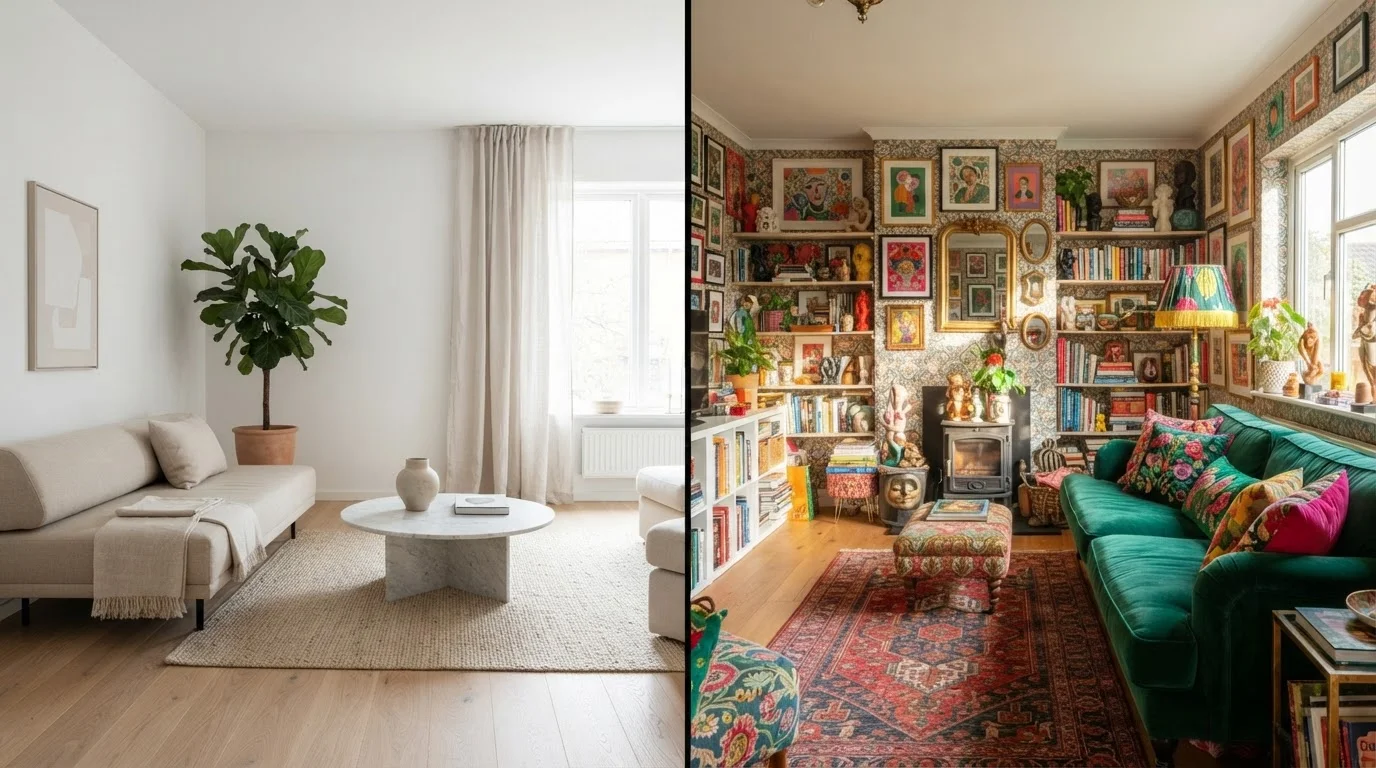
Think of the spectrum as running from minimalist (restraint, negative space, utility) at one end to maximalist (abundance, layering, visual richness) at the other. Most real-world interiors land somewhere in between, often blending elements from two or more styles. If you're just getting started, this first-timer's guide walks through how to discover and define your personal aesthetic before you spend a dollar.
| Opposite ends of the spectrum | Minimalist and Maximalist |
| Most commonly blended styles | Scandinavian + Bohemian; Traditional + Contemporary |
| Easiest style to adapt to small spaces | Minimalist or Scandinavian |
| Style defined by a specific historical era | Mid-Century Modern (1940s-1970s) |
| Newest widely recognized hybrid style | Japandi (Japanese + Scandinavian) |
| Key unifier for eclectic interiors | A consistent color palette or repeating material |
Key Styles Defined
Below is a plain-language reference for the most widely recognized interior design styles, organized loosely from restrained to expressive.
Minimalist
A style defined by deliberate reduction: only what is functional or truly meaningful stays. Neutral palettes, uncluttered surfaces, and high-quality materials with visible craftsmanship are hallmarks. The goal is visual calm through restraint.
Scandinavian
Rooted in Nordic design tradition, this style combines minimalist principles with warmth. Think natural wood, soft whites and grays, cozy textiles (wool, sheepskin), and simple functional furniture. Hygge - a Danish concept of coziness - is its emotional core.
Modern
Refers specifically to the design movement of the early-to-mid 20th century: clean horizontal lines, open floor plans, and an embrace of industrial materials like steel and glass. Often confused with 'contemporary,' which describes whatever is current right now.
Mid-Century Modern
A subset of Modern design spanning roughly the 1940s-1970s, characterized by organic curves, tapered legs on furniture, bold accent colors against neutral backgrounds, and a love of bringing the outdoors in.
Industrial
Inspired by converted factories and warehouses: exposed brick, raw concrete, steel beams, and Edison-bulb lighting. Color palettes stay dark and muted. The style celebrates structure and material honesty over decoration.
Bohemian (Boho)
A free-spirited, globally influenced style that layers patterns, textiles, and collected objects without rigid rules. Rich jewel tones, macramé, rattan, and plants are common. Bohemian interiors feel lived-in and personal rather than curated.
Traditional
Draws from European - particularly English and French - decorating heritage. Symmetrical arrangements, ornate wood furniture, rich fabrics like velvet and damask, and a formal sense of order define the look.
Transitional
A deliberate blend of traditional and contemporary elements, creating spaces that feel timeless rather than trend-dependent. Clean lines coexist with warm textures; formal silhouettes pair with casual fabrics.
Farmhouse
Combines rustic and casual elements - shiplap, reclaimed wood, apron sinks, cotton slipcovers - with a light, airy palette. Modern farmhouse updates the look with cleaner lines while retaining a homey, unpretentious character.
Maximalist
The deliberate embrace of abundance: bold color, mixed patterns, layered textiles, and collections of meaningful objects. Maximalism is not clutter - it's intentional density where every element is chosen to contribute to an overall richness.
Japandi
A hybrid of Japanese wabi-sabi (finding beauty in imperfection) and Scandinavian minimalism. Muted earthy tones, natural materials, handcrafted objects, and extreme visual calm define the style.
Eclectic
Not a style so much as a method: deliberately combining elements from multiple periods, cultures, and styles into a cohesive whole. Successful eclectic interiors are held together by a consistent color palette or repeating material, not by matching pieces.
Blending styles is not only acceptable - it's how most well-loved homes are actually decorated. A Scandinavian foundation with a few Bohemian textiles, for example, pairs beautifully. The key is understanding the underlying design principles that hold a room together, regardless of style label.
Applying a Style to Your Space
Once you have a style direction, the practical work begins. A few guidelines apply across nearly every style:
- Start with a neutral shell. Walls and floors set the stage. Committing to a bold paint color or flooring material before you've landed on a style makes pivoting expensive.
- Choose one anchor piece per room. In minimalist spaces this might be a single sculptural chair. In maximalist spaces it might be a statement wallpaper. Either way, one element should lead the eye.
- Layer in texture and pattern deliberately. Even minimalist rooms benefit from varied surfaces - linen, wood grain, matte ceramics. Color, pattern, and texture work together more naturally than most people expect.
- Maintain coherence across rooms. Decorating each room as a separate project is one of the fastest ways to make a home feel unsettled. Cohesion across rooms doesn't mean everything must match - it means shared threads of color, material, or mood.
For smaller spaces, style choices carry extra weight because there's less room to correct an overpowering element. These compact-room strategies adapt well to any style on this spectrum. And if budget is a factor, spending intentionally matters more in design than in almost any other area of home life - because the wrong purchase is rarely returnable and often lives with you for years.